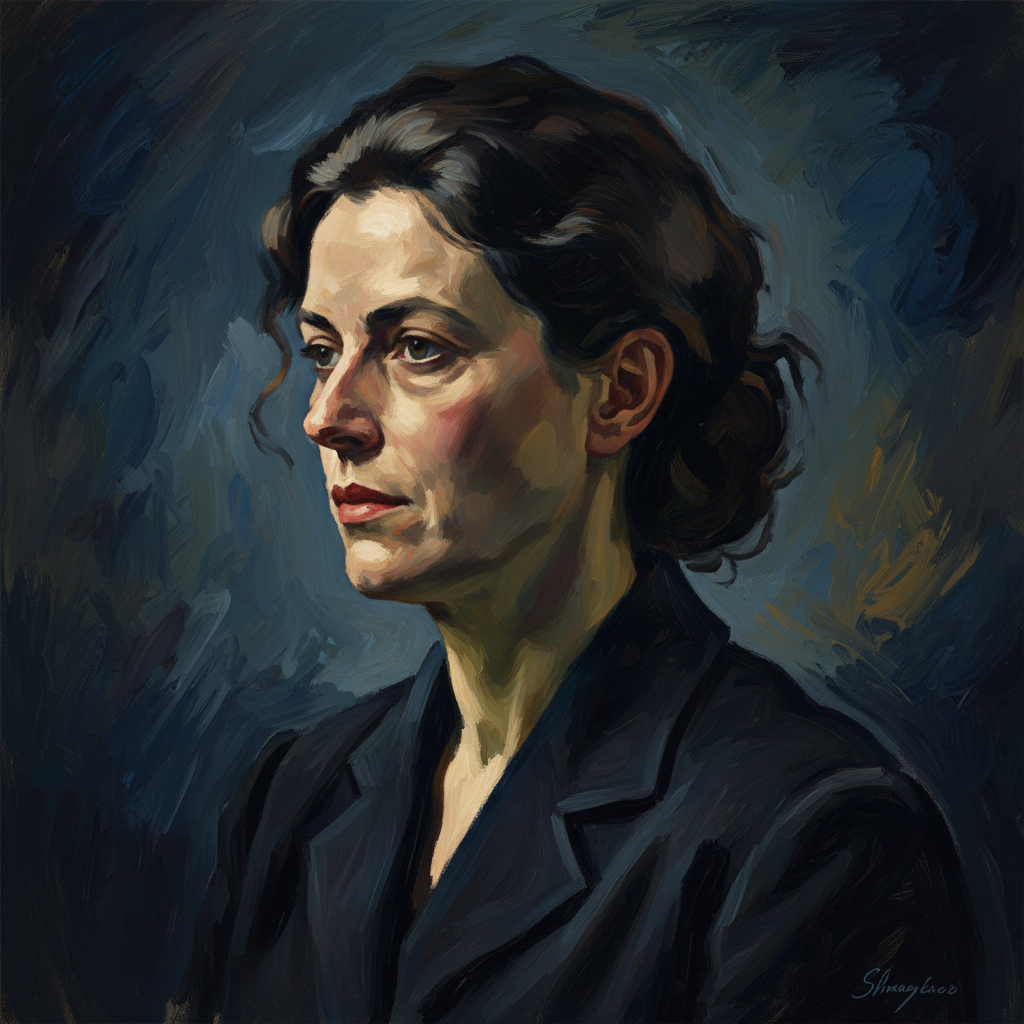
Simone de Beauvoir — "The purpose of life is to live it."
The purpose of life is to live it.
The purpose of life is to live it.
Click any product to generate a realistic preview. Up to 3 at a time.
* Initial load can take up to 90 seconds — revising the preview in another color is nearly instant.
"I have always been a stranger to myself."
"Marriage is a scandalous institution."
"To be free is not to have the power to do anything you like; it is to be able to surpass the given toward an open future."
"If you live long enough, you'll make mistakes. But if you learn from them, you'll be a better person."
"Self-knowledge is no guarantee of happiness, but it is on the side of happiness and can supply the courage to fight for it."
French existentialist philosopher whose The Second Sex (1949) is the foundational text of modern feminist theory. Closely associated with Jean-Paul Sartre (lifetime partner and existentialist co-founder) and Albert Camus (existentialist contemporary in Paris). For an intellectual contrast, see Camille Paglia, American cultural critic and Sexual Personae author — Paglia argues for biological-essentialist roots of gender that Beauvoir's social-construction view — 'one is not born, but rather becomes, a woman' — explicitly rejects. The two are the cleanest constructed-vs-essentialist poles in feminist theory.
The standard scholarly entry points to Simone de Beauvoir's work: Toril Moi (Duke, James B. Duke Distinguished Professor) — Simone de Beauvoir: The Making of an Intellectual Woman (1994); Margaret A. Simons (Southern Illinois University, Emerita) — Beauvoir and The Second Sex (1999); Kate Kirkpatrick (Oxford, Regent's Park College) — Becoming Beauvoir: A Life (2019). These are the works graduate seminars cite when teaching Simone de Beauvoir.
Your cart is empty