Max Planck — "The quantum of action, as I called it, was a purely formal assumption and I real…"
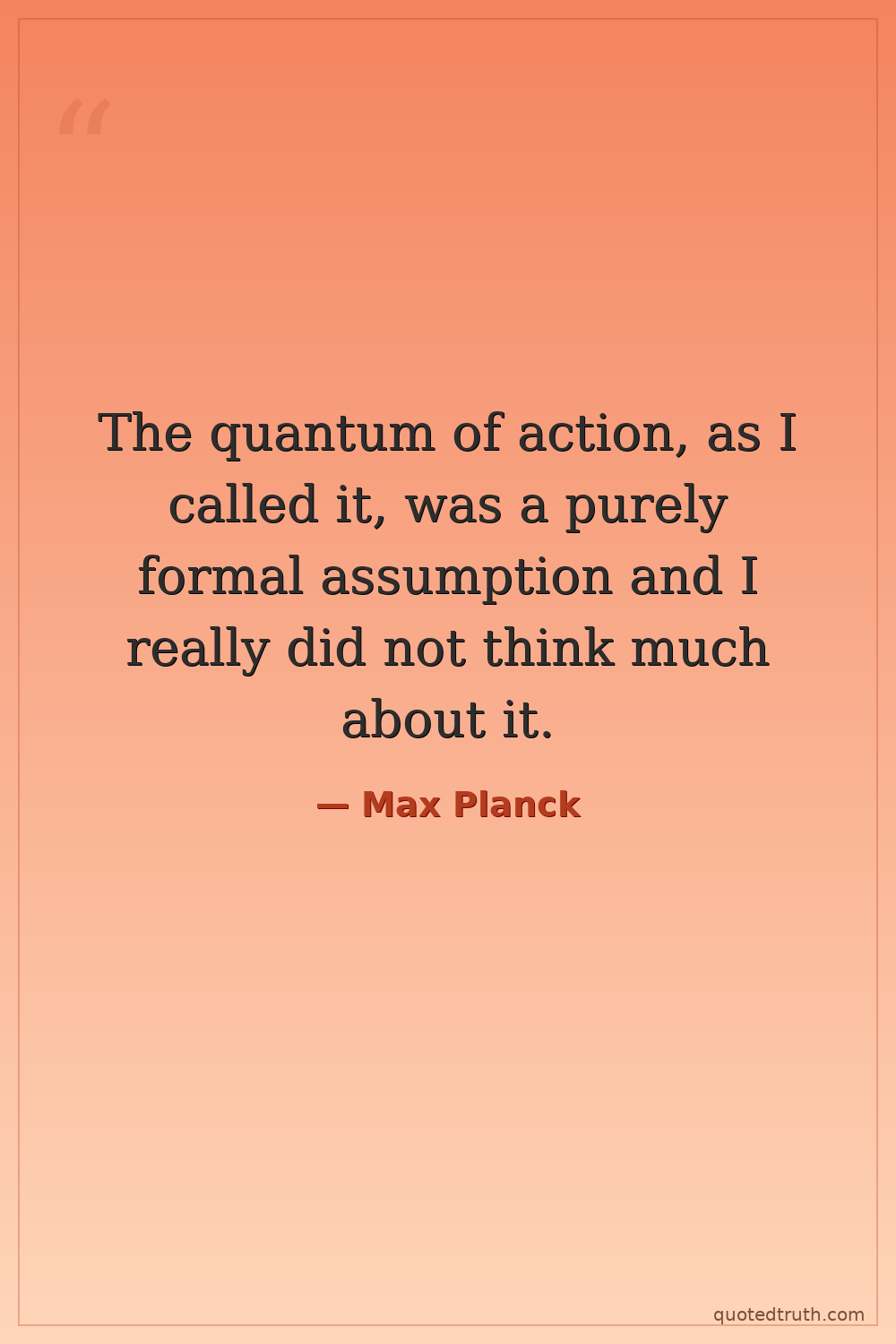
The quantum of action, as I called it, was a purely formal assumption and I really did not think much about it.
The quantum of action, as I called it, was a purely formal assumption and I really did not think much about it.
Click any product to generate a realistic preview. Up to 3 at a time.
* Initial load can take up to 90 seconds — revising the preview in another color is nearly instant.
"What is the good of a scientific discovery that does not make a difference in everyday life?"
"All great discoveries are made by men whose feelings run ahead of their thinking."
"When you change the way you look at things, the things you look at change."
"The scientific method is a never-ending process of refinement and correction."
"When we consider the development of science, we cannot help noticing that it is in many places the work of individuals who, in opposition to the general current of their time, have succeeded in imposi…"
Reflecting on the initial, almost accidental, nature of his revolutionary discovery.
Date: Early 20th century, reflecting on 1900
GeneralFound in 1 providers: grok
1 source checked
Planck is admitting that when he first introduced the idea of energy coming in discrete packets, he treated it as a mathematical trick to make his equations work, not as a real physical insight. He didn't grasp that he had stumbled onto something revolutionary. In plain terms: he made a guess to patch a formula and only later realized it had cracked open an entirely new branch of science.
Planck spent 1900 trying to solve blackbody radiation and inserted the constant h almost reluctantly, since he was a classical physicist by training and temperament. He resisted the radical implications of his own work for years, hoping quantization could be reconciled with continuous physics. This quote captures his lifelong humility and the irony that a conservative thinker accidentally launched the most disruptive theory of the twentieth century.
Around 1900, classical physics seemed nearly complete, with only small puzzles like the ultraviolet catastrophe left over. Within decades, Planck's reluctant assumption sparked Einstein's photon, Bohr's atom, and the full quantum revolution, all while Europe was upended by two world wars. Planck himself lived through the collapse of imperial Germany, the Nazi era, and the loss of his son Erwin to the Gestapo, watching his quiet equation reshape reality.
AI-generated insights based on extensive research and information for context. Factual errors? Email [email protected].
Your cart is empty