What it means
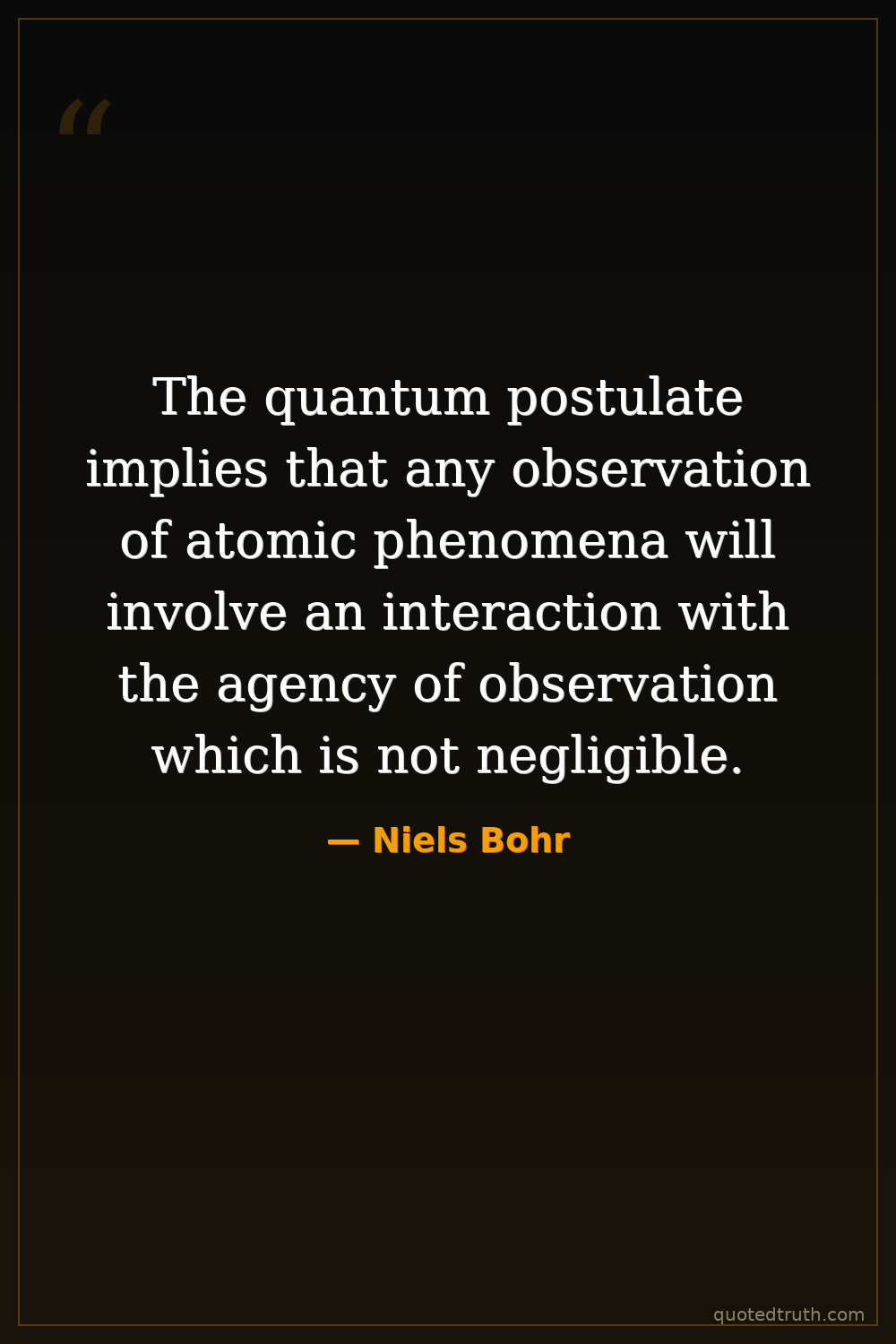
When you measure something as tiny as an atom, the act of measuring changes what you're trying to measure. You can't just peek at a quantum particle the way you'd glance at a car passing by. The tools you use—light, electrons, instruments—bump into the particle and alter it. So observation and reality become tangled together, and perfect objective knowledge of atomic behavior isn't possible.
Relevance to Niels Bohr
Bohr built his career on exactly this puzzle. His atomic model introduced quantized electron orbits, and he later developed the complementarity principle, arguing that particles behave as waves or particles depending on how we look. He spent decades debating Einstein, who hated this implication. For Bohr, the observer wasn't separate from the experiment—a radical stance that defined his Copenhagen interpretation and his leadership of the institute there.
The era
Bohr wrote this in the late 1920s, when physics was being rewritten. Heisenberg's uncertainty principle appeared in 1927, Schrödinger's wave equation in 1926, and the Solvay Conferences were staging historic debates. Classical Newtonian certainty was collapsing. Meanwhile, Europe was between world wars, and intellectual life in Copenhagen, Göttingen, and Munich crackled with the sense that humanity's grasp of reality itself was being fundamentally redrawn by a small group of physicists.
AI-generated insights based on extensive research and information for context. Factual errors? Email [email protected].