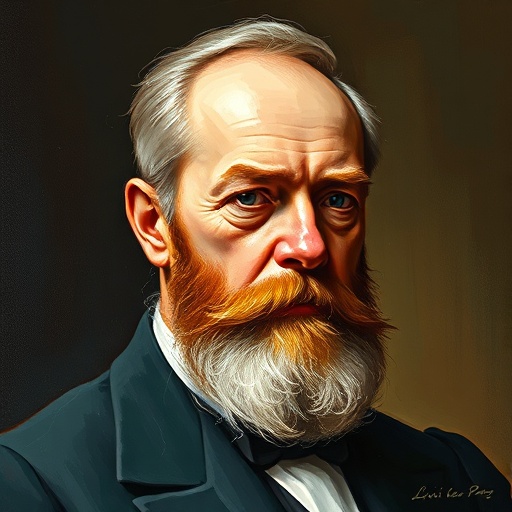
Louis Pasteur — "The study of nature is always a source of profound joy."
The study of nature is always a source of profound joy.
The study of nature is always a source of profound joy.
Click any product to generate a realistic preview. Up to 3 at a time.
* Initial load can take up to 90 seconds — revising the preview in another color is nearly instant.
"The day will come when the microbe is both friend and foe."
"The universe is asymmetric and I am persuaded that life, as it is known to us, is a direct result of the asymmetry of the universe."
"To him who devotes his life to science, nothing can be more important than the study of its history."
"Without laboratories, men of science are soldiers without arms."
"Do not let yourself be discouraged by the difficulties of research, and do not be afraid of a little suffering, for it is in this way that the truth will be revealed."
Attributed, expressing his personal satisfaction from scientific exploration.
Date: Late 19th Century (approx.)
EducationalFound in 1 providers: grok
1 source checked
Looking closely at the natural world brings deep, lasting happiness. Observing how living systems work, how organisms interact, and how tiny mechanisms produce complex outcomes is genuinely rewarding. The pleasure is not casual entertainment but a richer satisfaction that grows the more carefully you pay attention. Curiosity about nature rewards the person asking questions, regardless of whether the discoveries prove useful, because the investigation itself is meaningful.
Pasteur spent his career peering through microscopes at fermentation, silkworm diseases, anthrax, and rabies, and repeatedly described his laboratory work with near-religious devotion. His discoveries of microbial life, vaccination, and pasteurization came from patient observation of organisms invisible to earlier scientists. A devout Catholic, he saw no conflict between faith and research, treating nature as a book worth reading closely, and insisted that chance favored only the prepared, observing mind.
Nineteenth-century France was transforming biology through the microscope just as Darwin reshaped thinking about life itself. Louis-Napoleon's Second Empire funded science heavily, and Pasteur worked amid fierce debates over spontaneous generation, disease causation, and vaccination. Industrial brewing, wine spoilage, and livestock plagues gave experimental biology urgent practical stakes. Romantic-era reverence for nature blended with rigorous laboratory method, making careful observation both a professional duty and, for many scientists, a form of secular devotion.
AI-generated insights based on extensive research and information for context. Factual errors? Email [email protected].
Your cart is empty