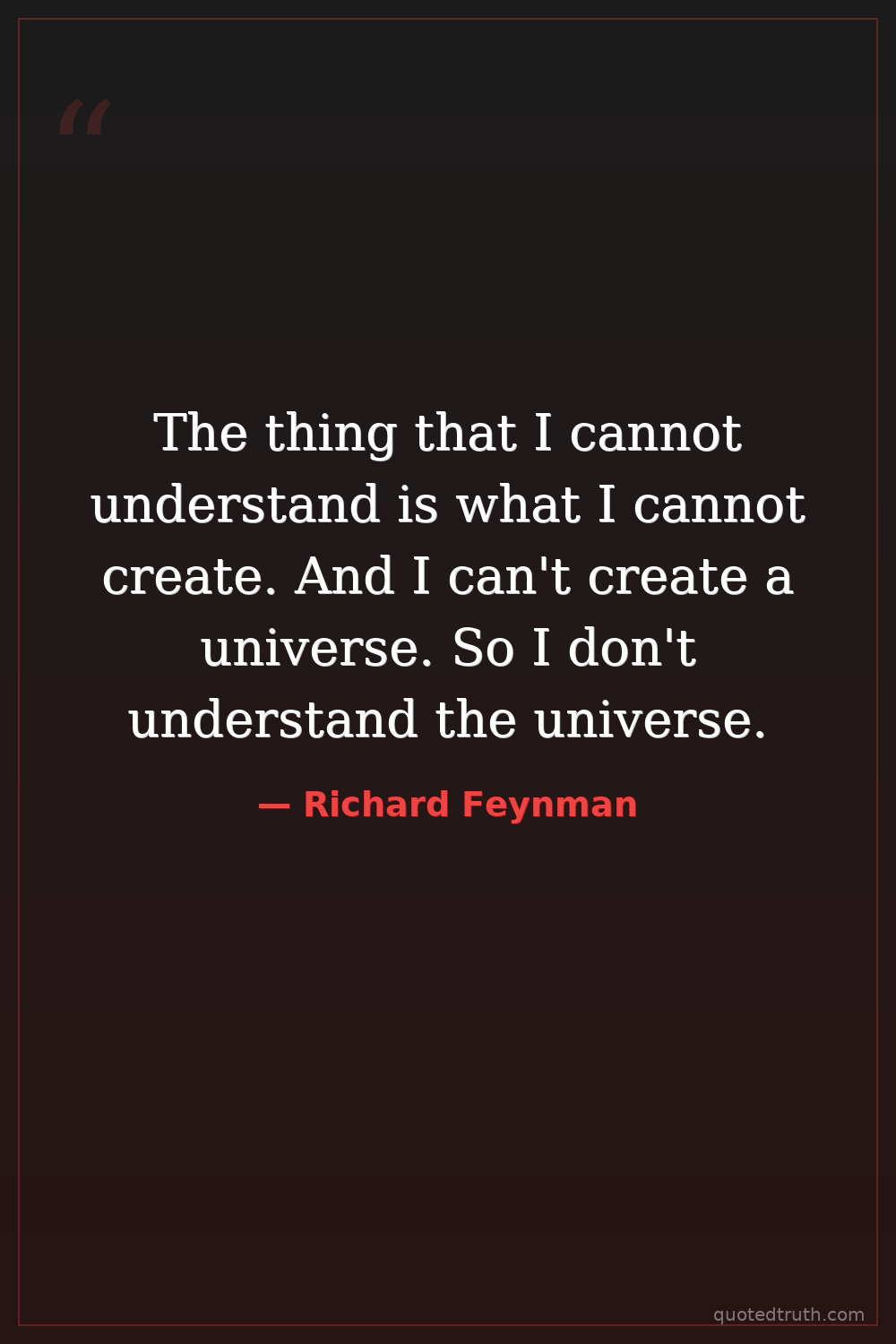
Richard Feynman — "The thing that I cannot understand is what I cannot create. And I can't create a…"
The thing that I cannot understand is what I cannot create. And I can't create a universe. So I don't understand the universe.
The thing that I cannot understand is what I cannot create. And I can't create a universe. So I don't understand the universe.
Click any product to generate a realistic preview. Up to 3 at a time.
* Initial load can take up to 90 seconds — revising the preview in another color is nearly instant.
"I have often thought that if I were to be reborn, I'd like to be a biologist."
"I would rather have a world with five billion people that are happy and healthy and well-fed and full of wonderful things than a world with twenty billion people who are starving and miserable."
"If you want to master something, teach it."
"I guess I'm just mischievous. I just love to do that to people. Well especially when they're so gleefully happy that it's been going to cost 13 signatures haha."
"I'm smart enough to know that I'm dumb."
American theoretical physicist who shared the 1965 Nobel for QED, developed Feynman diagrams, and wrote the Feynman Lectures on Physics. Closely associated with Julian Schwinger (co-Nobelist for QED) and Murray Gell-Mann (Caltech rival and Eightfold-Way physicist). For an intellectual contrast, see Deepak Chopra, physician and quantum-mysticism author — Feynman's Caltech 'cargo cult science' commencement address is the precise template for what he saw as misuse of physics terminology — Chopra-style appropriation of quantum vocabulary for metaphysical claims is the canonical example of what Feynman called 'fooling yourself'.
Found in 1 providers: grok
1 source checked
True understanding requires the ability to build something from scratch. If you genuinely grasp how something works, you can reconstruct it yourself. Since no human can construct a universe from first principles, we remain fundamentally ignorant of its deepest nature. Knowledge claimed without the capacity to reproduce or create the thing is incomplete — understanding demands active construction, not passive observation.
Feynman lived this principle. He reconstructed physics from the ground up, developing path integral formulations and diagrammatic methods because rebuilding problems his own way was how he truly understood them. His famous Caltech blackboard read 'What I cannot create, I do not understand.' As a Nobel laureate in quantum electrodynamics, he built mathematical tools that others only applied — creation was his epistemology.
Feynman worked during the mid-to-late 20th century, when physics was simultaneously triumphant and humbled — quantum mechanics and relativity were established, yet a unified theory of everything remained elusive. The space race and nuclear age made humanity feel capable of creating almost anything, yet fundamental cosmological questions about the universe's origin and nature remained stubbornly beyond reach, making this sentiment especially resonant.
AI-generated insights based on extensive research and information for context. Factual errors? Email [email protected].
Your cart is empty