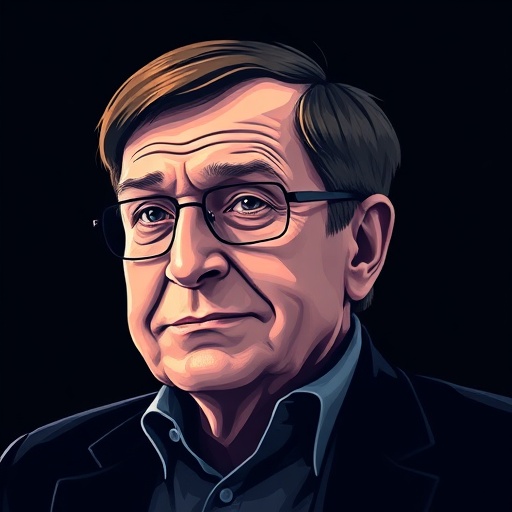
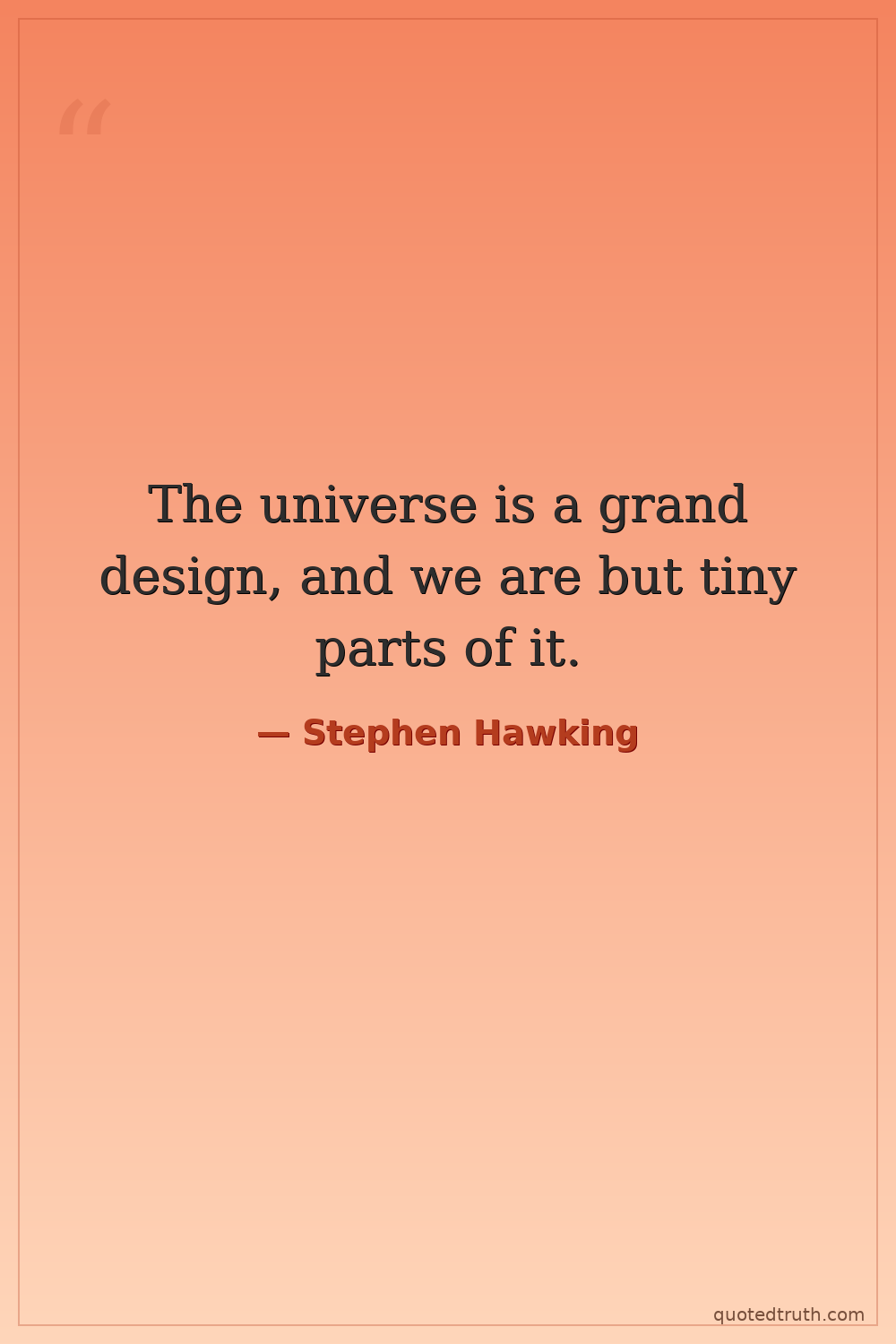
Stephen Hawking — "The universe is a grand design, and we are but tiny parts of it."
The universe is a grand design, and we are but tiny parts of it.
The universe is a grand design, and we are but tiny parts of it.
Click any product to generate a realistic preview. Up to 3 at a time.
* Initial load can take up to 90 seconds — revising the preview in another color is nearly instant.
"The greatest achievement of mankind is to understand the universe."
"The universe is a place of endless possibilities, and we are just beginning to explore them."
"I have always been very optimistic about the future of the human race."
"Try to make sense of what you see and wonder about what makes the universe exist. Be curious, and however difficult life may seem, there is always something you can do and succeed at."
"The universe is a great place to be, and I'm glad to be a part of it. But it's also a very dangerous place, and we need to be careful."
British theoretical physicist whose Hawking radiation work and A Brief History of Time (1988) brought black-hole physics to a mass audience while he lived with ALS for 55 years. Closely associated with Roger Penrose (his collaborator on singularity theorems) and Carl Sagan (fellow popularizer who wrote Brief History's foreword). For an intellectual contrast, see William Lane Craig, American philosopher of religion — Craig's Kalam cosmological argument depends on the Big Bang requiring a divine first cause; Hawking's no-boundary proposal was specifically designed to remove the moment that would require one — the cleanest cosmology-vs-natural-theology contrast in modern thought.
Found in 1 providers: grok
1 source checked
The quote asserts that the universe operates according to deep, discoverable laws—a "grand design"—while humans are vanishingly small components within it. It balances two ideas: awe at the ordered, comprehensible structure of the cosmos, and humility about our scale within it. Recognizing that smallness is not nihilistic but clarifying—we inhabit something vast and lawful, and grasping our place is the foundation of genuine understanding.
Hawking dedicated his life to decoding the universe's deepest rules—black holes, the Big Bang singularity, and quantum gravity. His 2010 book "The Grand Design" argued the cosmos emerges from physical law alone, requiring no external creator. Living with ALS from age 21, he embodied the quote's central paradox: a body almost entirely immobile, yet a mind ranging freely across billions of light-years, insisting human intellect could illuminate the whole.
Hawking worked from the 1960s through 2018, an era that transformed cosmology from speculation into precision science. Discovery of cosmic microwave background radiation, Hubble imagery revealing billions of galaxies, and the 2016 detection of gravitational waves made humanity's smallness viscerally measurable. Cold War space rivalry, moon landings, and Sagan's "pale blue dot" imagery simultaneously embedded cosmic humility into popular culture, giving this sentiment immediate resonance beyond academic physics.
AI-generated insights based on extensive research and information for context. Factual errors? Email [email protected].
Your cart is empty