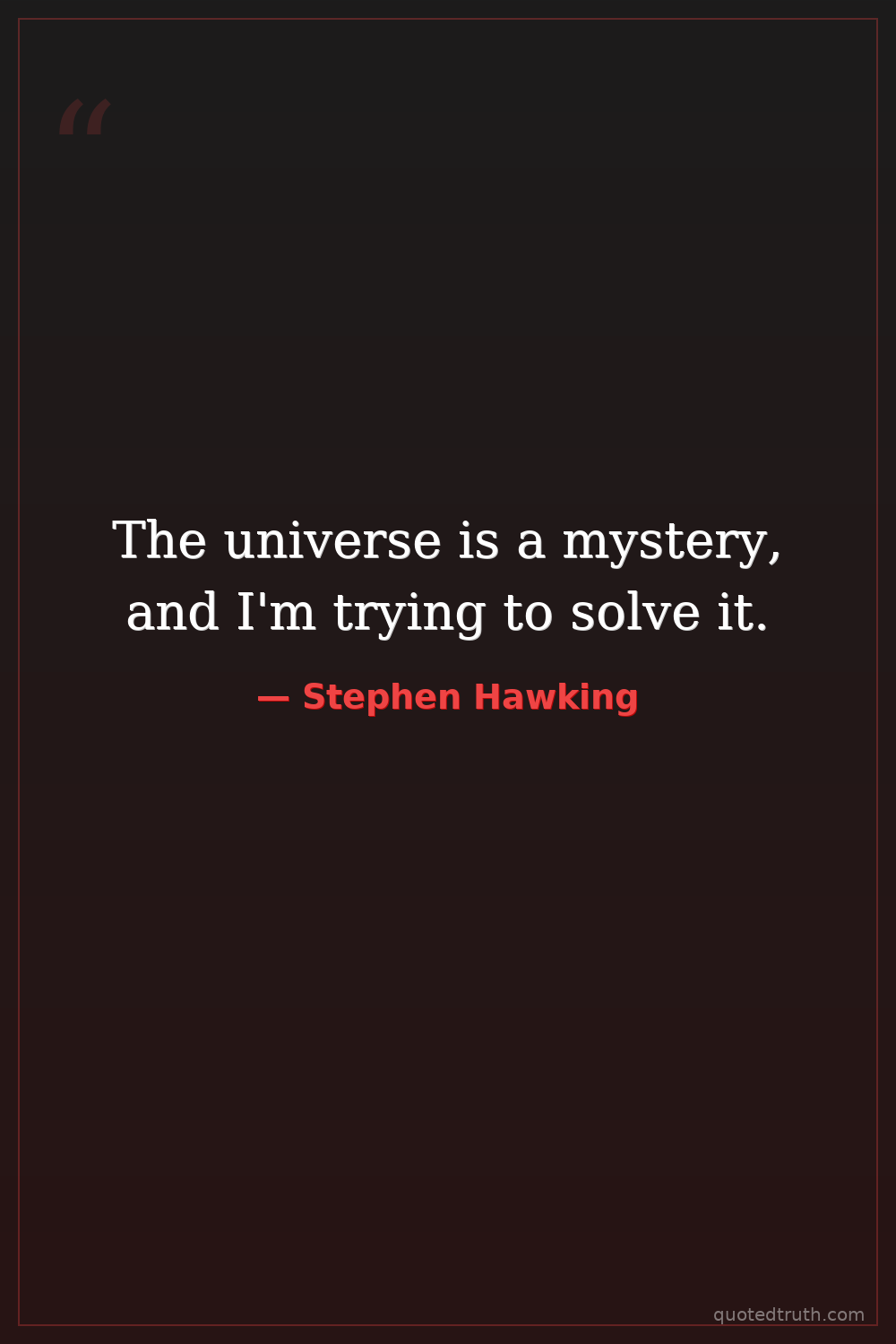
Stephen Hawking — "The universe is a mystery, and I'm trying to solve it."
The universe is a mystery, and I'm trying to solve it.
The universe is a mystery, and I'm trying to solve it.
Click any product to generate a realistic preview. Up to 3 at a time.
* Initial load can take up to 90 seconds — revising the preview in another color is nearly instant.
"The ultimate goal of science is to provide a single theory that describes the whole universe."
"I tell my kids: Don't spend all your time at the computer. But then I realize, I do that myself all day."
"Some people say I have a chip on my shoulder but it is actually my chin."
"I have no idea what the future holds, but I'm optimistic."
"The greatest enemy of knowledge is not ignorance, it is the illusion of knowledge."
British theoretical physicist whose Hawking radiation work and A Brief History of Time (1988) brought black-hole physics to a mass audience while he lived with ALS for 55 years. Closely associated with Roger Penrose (his collaborator on singularity theorems) and Carl Sagan (fellow popularizer who wrote Brief History's foreword). For an intellectual contrast, see William Lane Craig, American philosopher of religion — Craig's Kalam cosmological argument depends on the Big Bang requiring a divine first cause; Hawking's no-boundary proposal was specifically designed to remove the moment that would require one — the cleanest cosmology-vs-natural-theology contrast in modern thought.
Found in 1 providers: grok
1 source checked
Pure curiosity paired with intellectual honesty. The universe holds phenomena — dark matter, black holes, quantum gravity — that resist full explanation. Rather than pretending certainty, this declares science as an ongoing pursuit: acknowledge what you don't understand, then spend your life chasing it. Mystery isn't defeat; it's the engine of inquiry. The drive to solve the unsolvable is what separates a scientist from someone who simply accepts the world as given.
Hawking spent his career tackling the universe's deepest puzzles: proving singularity theorems with Penrose, discovering that black holes emit thermal radiation — now called Hawking radiation — and popularizing cosmology through A Brief History of Time. Diagnosed with motor neuron disease at 21 and given two years to live, he worked for five more decades almost entirely paralyzed. His physical confinement made his cosmic ambitions starker — a mind relentlessly pursuing universal mysteries from a body that could barely move.
Hawking's active career (1960s–2018) spanned cosmology's most transformative decades. The cosmic microwave background was confirmed in 1965, vindicating the Big Bang. Black hole candidates were identified observationally. Dark matter and dark energy were established as real but unexplained. Each discovery spawned deeper questions rather than closure. Hawking worked precisely when fundamental answers were suddenly within mathematical reach, yet the universe kept revealing new layers of mystery — the productive tension his statement captures exactly.
AI-generated insights based on extensive research and information for context. Factual errors? Email [email protected].
Your cart is empty