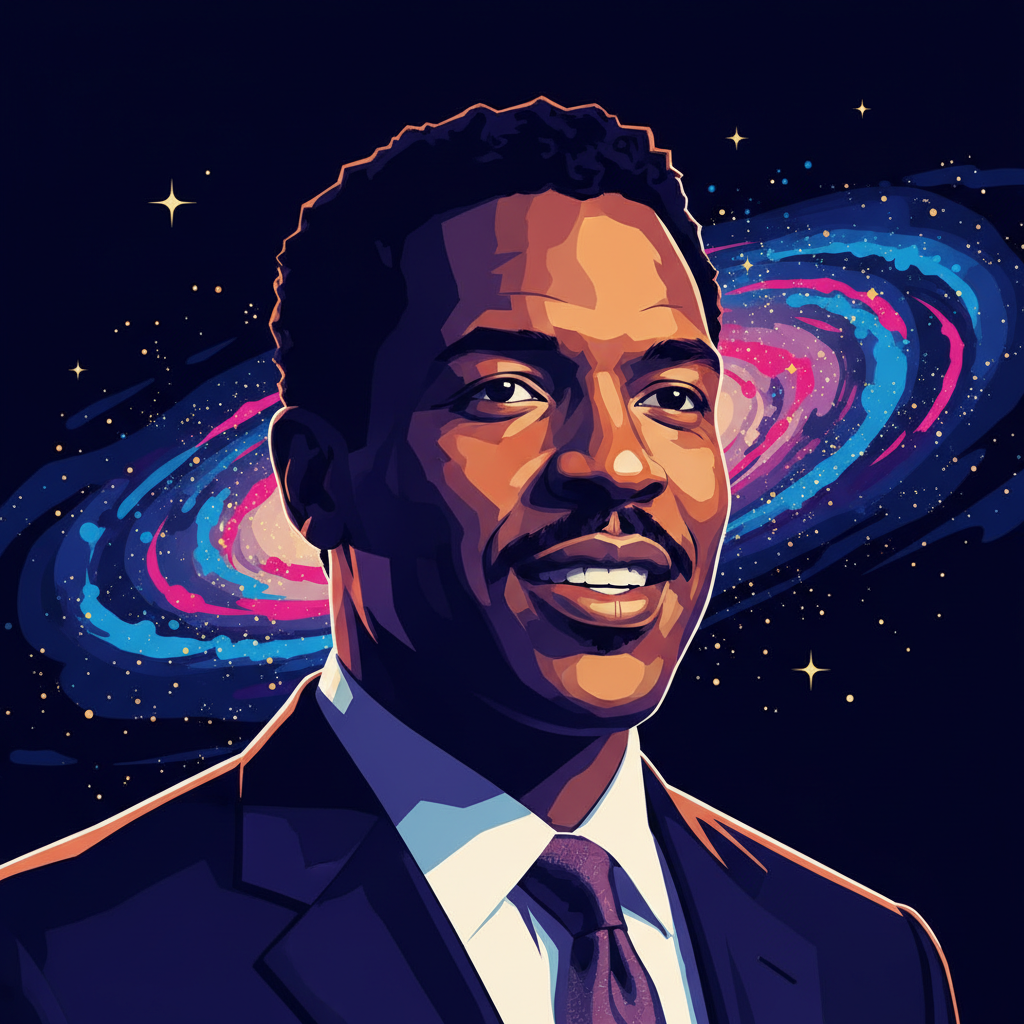
Neil deGrasse Tyson — "The universe is not a hostile place, it's just indifferent."
The universe is not a hostile place, it's just indifferent.
The universe is not a hostile place, it's just indifferent.
Click any product to generate a realistic preview. Up to 3 at a time.
* Initial load can take up to 90 seconds — revising the preview in another color is nearly instant.
"The universe is a grand and glorious place, and it's all ours to explore."
"I'm not saying I'm a genius. I'm just saying I have a lot of questions."
"The universe is a mirror. It reflects back to you what you put into it."
"You know, the nice thing about science is that it’s an equal-opportunity destroyer of belief systems."
"I'm not a fan of the idea of 'alternative facts.' Facts are facts. There's no alternative to them."
American astrophysicist, Hayden Planetarium director, and Cosmos: A Spacetime Odyssey host who carries the Carl Sagan public-science mantle. Closely associated with Bill Nye (fellow science communicator) and Brian Greene (theoretical physicist and string-theory popularizer). For an intellectual contrast, see Ken Ham, founder of Answers in Genesis and the Creation Museum — Ham's career has been organized around defending biblical 6-day creationism — exactly the science-education position Tyson's mainstream-science communication is structured to refute.
Found in 1 providers: grok
1 source checked
The universe doesn't want to harm us — it simply has no awareness of us at all. Hostility requires intent; indifference requires none. Stars explode, planets collide, and species vanish not because the cosmos is cruel but because physical laws operate without preference or mercy. This distinction matters: it replaces existential dread with clarity, freeing us to find meaning ourselves rather than searching for it in a universe that isn't looking back.
Tyson has spent his career replacing cosmic fear with cosmic wonder. As director of the Hayden Planetarium and host of Cosmos, he consistently argues that science is liberating, not diminishing. This quote captures his central conviction: the universe's scale and power needn't be terrifying if understood correctly. His own journey — a Black astrophysicist who navigated real human hostility to reach the stars — gives the indifference-not-hostility framing a personal resonance beyond mere philosophy.
Tyson rose to cultural prominence in the 2000s–2020s amid climate anxiety, pandemic shock, AI existential dread, and sharp science-vs-religion tensions. Americans debated intelligent design in schools and searched for meaning after 9/11. In that climate, a scientist offering a secular, emotionally honest framework — not 'God protects us' nor 'the universe is out to get us' — filled a specific cultural gap, giving a secular public language for mortality and cosmic scale.
AI-generated insights based on extensive research and information for context. Factual errors? Email [email protected].
Your cart is empty