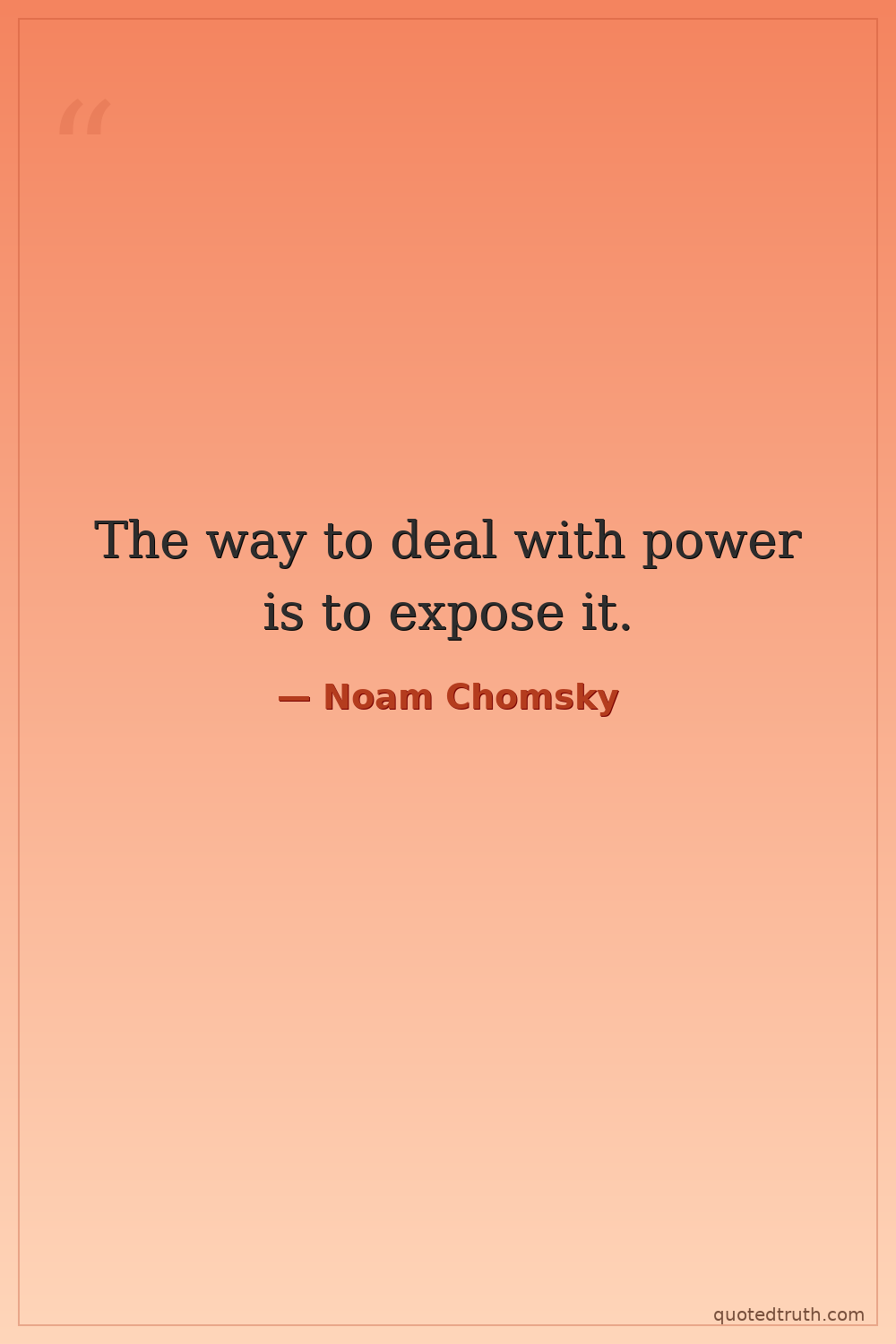
Noam Chomsky — "The way to deal with power is to expose it."
The way to deal with power is to expose it.
The way to deal with power is to expose it.
Click any product to generate a realistic preview. Up to 3 at a time.
* Initial load can take up to 90 seconds — revising the preview in another color is nearly instant.
"The United States is the most frightening power in the world—it’s the only power that has the capacity to destroy organized human life."
"The United States has a long and bloody history of intervention in the affairs of other countries, often with devastating consequences."
"The United States is a deeply unjust society, and its policies perpetuate inequality and oppression."
"Optimism is a strategy for making a better future. Because unless you believe that the future can be better, you're unlikely to step up and take responsibility for making it so."
"The state is an instrument of violence in the hands of the ruling class."
American linguist whose generative-grammar revolution (Syntactic Structures, 1957) reshaped linguistics, and whose Manufacturing Consent (1988, with Edward Herman) reshaped media criticism. Closely associated with Edward S. Herman (media-criticism co-author) and Howard Zinn (left historian peer and friend). For an intellectual contrast, see B.F. Skinner, Harvard behaviorist psychologist (1904-1990) — Chomsky's 1959 review of Skinner's Verbal Behavior is the most-cited demolition in 20th-century psychology — the moment behaviorism's dominance ended and the cognitive-science era began. Skinner's stimulus-response account of language and Chomsky's innate-faculty account are the cleanest 'environment vs nature' linguistic poles.
The standard scholarly entry points to Noam Chomsky's work: Robert F. Barsky (Vanderbilt, Chomsky biographer) — Noam Chomsky: A Life of Dissent (1997); James McGilvray (McGill, philosophy of language) — The Cambridge Companion to Chomsky (ed., 2005). These are the works graduate seminars cite when teaching Noam Chomsky.
Your cart is empty