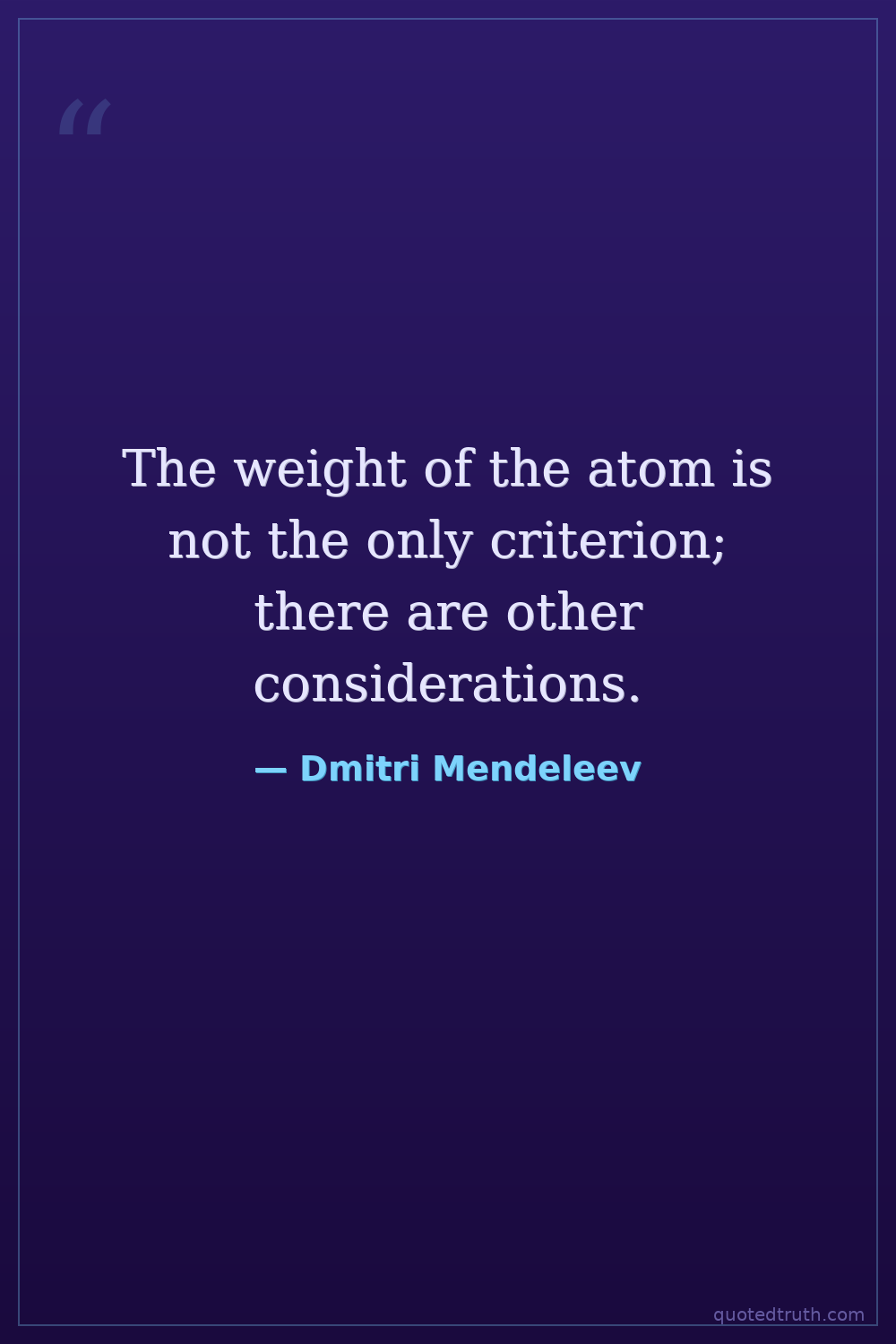
Dmitri Mendeleev — "The weight of the atom is not the only criterion; there are other considerations…"
The weight of the atom is not the only criterion; there are other considerations.
The weight of the atom is not the only criterion; there are other considerations.
Click any product to generate a realistic preview. Up to 3 at a time.
* Initial load can take up to 90 seconds — revising the preview in another color is nearly instant.
"There is no death, but only change."
"My main interest is to help my country, Russia, develop its industrial capacity."
"The invisible world of chemical atoms is still waiting for the creator of chemical mechanics."
"Without knowledge, without work, there is no hope for humanity."
"Pleasures flit by -- they are only for yourself; work leaves a mark of long-lasting joy, work is for others."
Explaining the deviations in his periodic table from simple atomic weight order
Date: 1869
WisdomFound in 1 providers: grok
1 source checked
Atomic weight alone cannot determine where an element belongs or how it behaves. Other factors, such as chemical properties, valence, reactivity, and patterns of similarity with neighboring elements, must also guide classification. Judging something by a single measurable number oversimplifies reality. A complete understanding requires weighing multiple characteristics together, recognizing that numeric data is one input among several, not the final word on identity, order, or meaning.
Mendeleev built the periodic table by ordering elements largely by atomic weight, yet he famously broke that order when properties demanded it, placing tellurium before iodine despite heavier weight. He even left gaps and predicted undiscovered elements like gallium and germanium based on property patterns. This quote captures his guiding conviction that chemical behavior, not raw mass, reveals the deeper structural logic of matter.
In the 1860s and 1870s, chemists were drowning in newly isolated elements with no unifying framework. Atomic weights had only recently been standardized at the 1860 Karlsruhe Congress, and many rivals, including Meyer and Newlands, were racing to find patterns. Mendeleev's 1869 table emerged in a Russia rapidly modernizing its science under Alexander II, when empirical rigor and bold theoretical leaps were reshaping chemistry into a predictive, law-governed discipline.
AI-generated insights based on extensive research and information for context. Factual errors? Email [email protected].
Your cart is empty