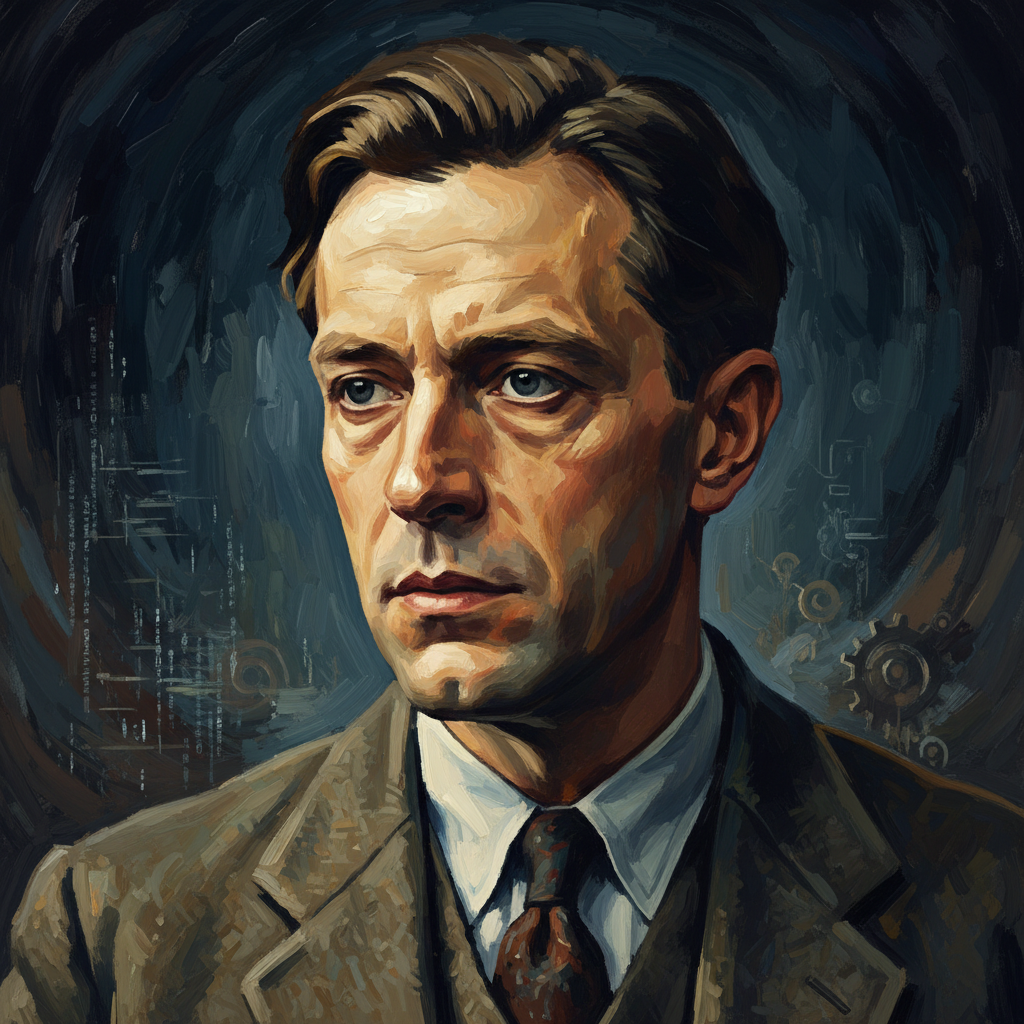
Alan Turing — "The whole problem can be reduced to the question: Can machines think?"
The whole problem can be reduced to the question: Can machines think?
The whole problem can be reduced to the question: Can machines think?
Click any product to generate a realistic preview. Up to 3 at a time.
* Initial load can take up to 90 seconds — revising the preview in another color is nearly instant.
"At some stage therefore we should have to expect the machines to take control."
"The process of learning is a very complex one."
"It is possible to invent a single machine which can be used to compute any computable sequence."
"A man provided with paper, pencil, and rubber, and subject to strict discipline, is in effect a universal machine."
"I am a homosexual. I have been convicted of gross indecency. I have been subjected to chemical castration."
Found in 1 providers: grok
1 source checked
The quote strips away all peripheral debates and asks the single foundational question underlying artificial intelligence: is thought a purely biological process, or can it be replicated mechanically? If machines can think, there is no ceiling on what computation can achieve. If they cannot, intelligence remains uniquely organic. Everything we now call AI hinges on how that one question is answered.
Turing wrote this in his 1950 paper 'Computing Machinery and Intelligence,' introducing the Imitation Game, now called the Turing Test. Having spent WWII breaking Enigma with electromechanical Bombes, he had direct experience of machines performing seemingly intelligent tasks. His theoretical work on computable functions led him to believe cognition might be substrate-independent — a radical conviction that became the founding premise of computer science.
In 1950, the first electronic computers — ENIAC, Manchester Mark 1 — were barely operational, filling entire rooms. WWII had just proved machines could crack codes once considered unbreakable. Cold War competition accelerated investment in automation. Philosophy, neuroscience, and computing had never seriously intersected before. Turing's question arrived at the precise moment humanity first possessed machinery capable of making it non-trivial.
AI-generated insights based on extensive research and information for context. Factual errors? Email [email protected].
Your cart is empty