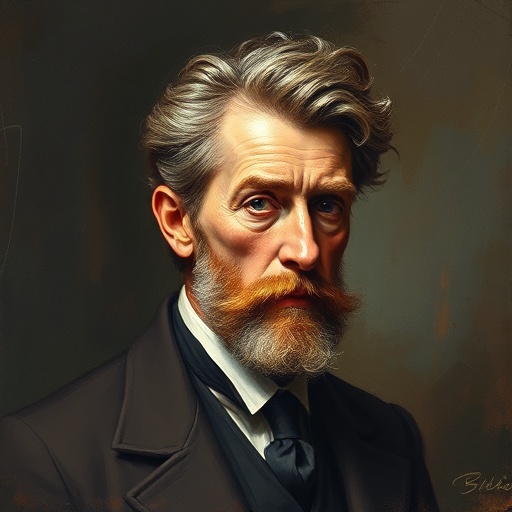
Soren Kierkegaard — "The whole world is a misunderstanding."
The whole world is a misunderstanding.
The whole world is a misunderstanding.
Click any product to generate a realistic preview. Up to 3 at a time.
* Initial load can take up to 90 seconds — revising the preview in another color is nearly instant.
"What is a poet? An unhappy man who in his heart harbors a profound agony, but whose lips are so fashioned that the sounds that emerge from them are like the beautiful music of an organ."
"The dialectic of despair is this, that the despairing self is unable to get rid of itself."
"The ethical individual is the one who chooses himself, and thereby chooses the universal."
"The greatest danger in life is that you may take too many precautions."
"The most dangerous of all delusions is that you are not deluded."
Danish philosopher and theologian considered the founder of existentialism; Either/Or (1843) and Fear and Trembling (1843) explored the leap of faith. Closely associated with Friedrich Nietzsche (his existentialist successor working in the opposite theological direction) and Fyodor Dostoevsky (literary parallel exploring faith-and-despair). For an intellectual contrast, see G.W.F. Hegel, German Idealist of the totalizing system — Kierkegaard called Hegel's system a 'palatial residence' that nobody could actually live in — his entire authorship is structured against Hegelian abstraction in favor of the existing individual's inwardness.
The standard scholarly entry points to Soren Kierkegaard's work: Joakim Garff (University of Copenhagen, Søren Kierkegaard Research Centre) — Søren Kierkegaard: A Biography (2000); Walter Lowrie (Princeton, his major postwar English translator) — A Short Life of Kierkegaard (1942); C. Stephen Evans (Baylor University, philosophy of religion) — Kierkegaard: An Introduction (2009). These are the works graduate seminars cite when teaching Soren Kierkegaard.
Your cart is empty