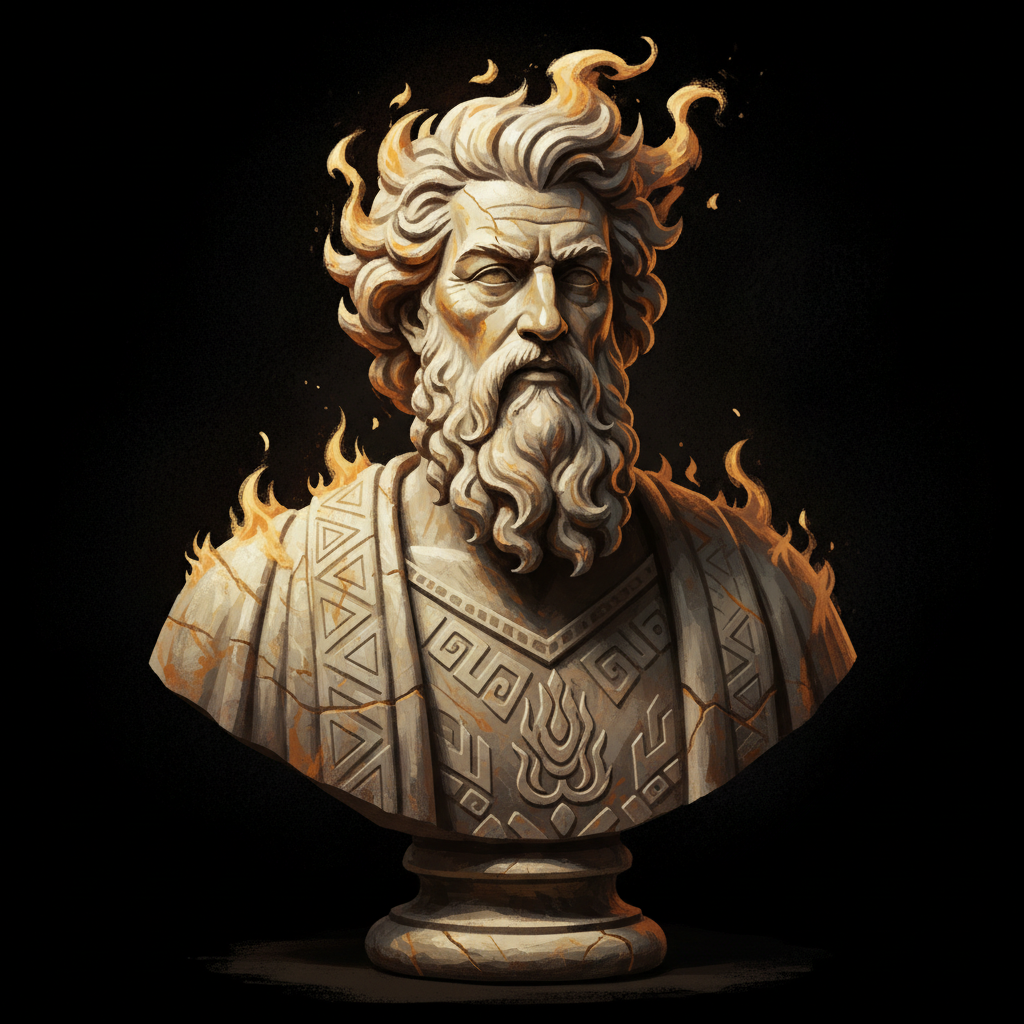
Zoroaster — "The wise choose the truth, the foolish choose the lie."
The wise choose the truth, the foolish choose the lie.
The wise choose the truth, the foolish choose the lie.
Click any product to generate a realistic preview. Up to 3 at a time.
* Initial load can take up to 90 seconds — revising the preview in another color is nearly instant.
"Aša Vahišta (Best Righteousness) is the best of all things, and happiness is to him who is righteous for the sake of Righteousness."
"The path of Good Thought leads to the Best Existence."
"Truth is the best of all things. As righteousness, it is happiness."
"To thee, Ahura Mazda, and to Asha (Truth) and Vohu Manah (Good Mind), I dedicate my life, my body, and my soul."
"The path of truth is the only path to lasting happiness."
Iranian prophet who founded Zoroastrianism, the first major religion of cosmic dualism between good (Ahura Mazda) and evil (Angra Mainyu). Closely associated with The Buddha (near-contemporary Eastern moral-cosmological revolutionary). For an intellectual contrast, see Friedrich Nietzsche, German philosopher of 'beyond good and evil' — Nietzsche appropriated Zarathustra's name for Thus Spoke Zarathustra (1883) precisely to invert the original's moral cosmology — the historical Zoroaster founded the good-versus-evil framework Nietzsche's character announces the end of.
Found in 1 providers: grok
1 source checked
People with good judgment commit themselves to honesty and reality, while those lacking wisdom embrace deception and falsehood. The saying frames truthfulness not as a passive trait but as an active decision everyone must make. Your alignment with truth or lies reveals your character and determines the quality of your life. It's a moral fork in the road where intelligence is measured by what you're willing to accept as real.
Zoroaster built his entire religion around the cosmic battle between asha (truth, order) and druj (the lie, chaos). As a reforming priest who rejected the polytheistic rituals of his time, he taught that every human must personally choose sides in this conflict. This saying captures his central doctrine, positioning moral discernment as humanity's defining responsibility and the core test of spiritual worth.
Zoroaster lived in ancient Persia, likely between 1500-1000 BCE, during a tribal era dominated by animal sacrifice, warrior cults, and polytheistic nature worship. Truthfulness and contractual honesty were survival tools in nomadic pastoral societies where cattle raiding and broken oaths caused violence. By elevating truth to a cosmic principle, Zoroaster gave ethical structure to a world governed by tribal loyalty, laying groundwork that would later shape Persian imperial justice and influence Judaism, Christianity, and Islam.
AI-generated insights based on extensive research and information for context. Factual errors? Email [email protected].
Your cart is empty