Confucius — "The wise find pleasure in water; the virtuous find pleasure in hills."
The wise find pleasure in water; the virtuous find pleasure in hills.
The wise find pleasure in water; the virtuous find pleasure in hills.
Click any product to generate a realistic preview. Up to 3 at a time.
* Initial load can take up to 90 seconds — revising the preview in another color is nearly instant.
"The gentleman is easy to serve but difficult to please. He who tries to please him in the wrong way will not be pleased. He uses men according to their abilities. The petty man is difficult to serve a…"
"If the mechanic wishes to do his work well, he must first sharpen his tools."
"The Master said, 'Riches and honors are what men desire. If they cannot be obtained in the proper way, they should not be held. Poverty and meanness are what men dislike. If they cannot be avoided in …"
"The man who asks a question is a fool for a minute, the man who does not ask is a fool for life."
"What you do not want done to yourself, do not do to others."
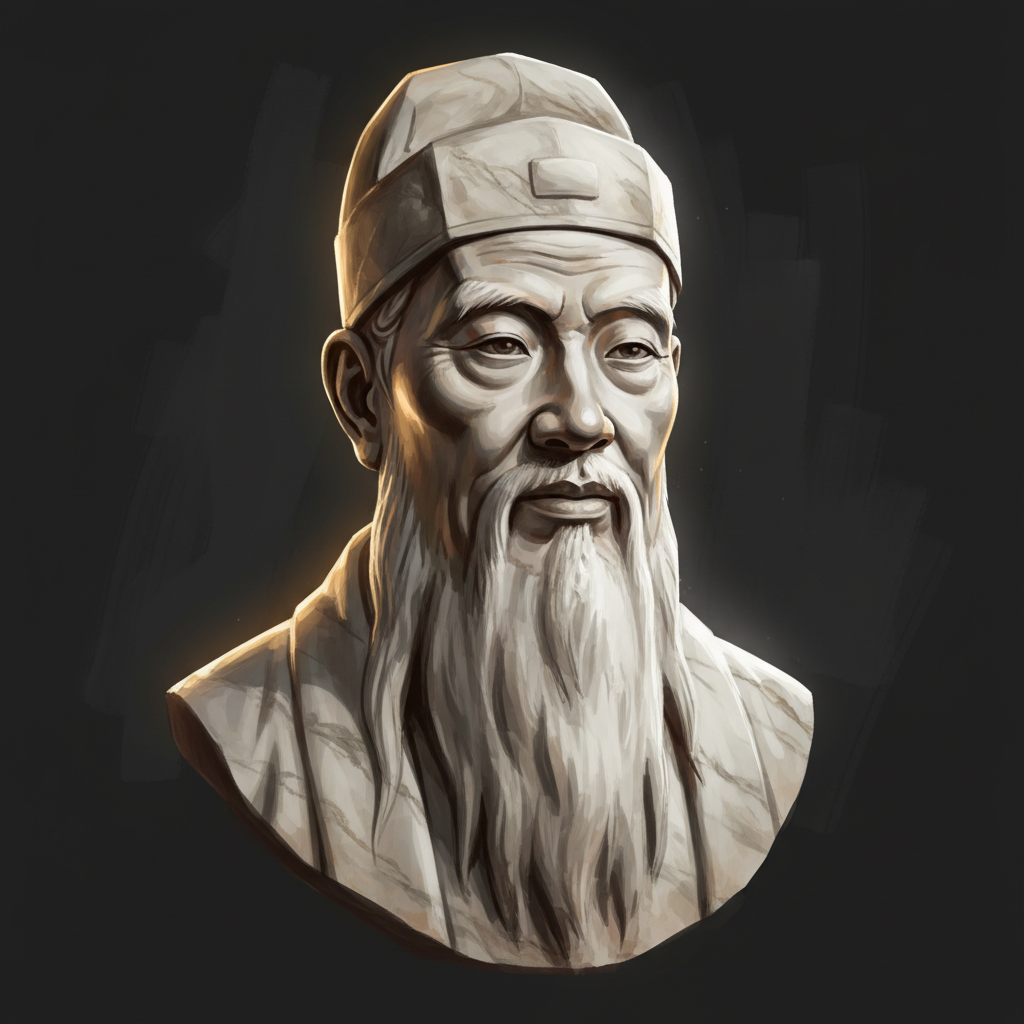
Chinese philosopher and teacher whose teachings (compiled by his students in the Analects) became the foundational ethical framework of East Asian civilization for 2,500 years. Closely associated with Mencius (his most-influential follower a century later). For an intellectual contrast, see Laozi, near-contemporary Chinese sage and Tao Te Ching author — Confucius systematized social order through ritual and family hierarchy; Laozi's Taoist effortless-action philosophy argued such systems were the disease, not the cure. The two founding poles of Chinese moral philosophy — every East Asian moral tradition since has positioned itself between them.
The standard scholarly entry points to Confucius's work: Philip J. Ivanhoe (Georgetown, Chinese philosophy) — Confucian Moral Self Cultivation (2000); Edward Slingerland (UBC, Asian Studies) — Effortless Action: Wu-wei as Conceptual Metaphor (2003); Tu Weiming (Harvard, Confucian scholar) — Confucian Thought: Selfhood as Creative Transformation (1985). These are the works graduate seminars cite when teaching Confucius.
Found in 1 providers: deepseek
1 source checked
Smart people enjoy things that move, change, and flow, much like rivers and streams. Good people, on the other hand, enjoy things that are steady, solid, and lasting, like mountains. The saying pairs two kinds of admirable character with two kinds of landscape, suggesting that intelligence thrives on activity and adaptability, while moral strength thrives on stability, patience, and quiet endurance over time.
Confucius spent his life teaching that personal character mattered more than wealth or rank, and he often used nature to illustrate inner virtues. As a traveling teacher who advised rulers and trained disciples in ethics, ritual, and self-cultivation, he prized both sharp thinking and steady moral grounding. This saying reflects his habit of pairing opposites, his love of concise imagery, and his belief that true learning shapes how a person feels, not just what they know.
Confucius lived during the late Spring and Autumn period of ancient China, when the Zhou dynasty was fracturing and rival states fought constantly. Social order, rituals, and trust in leaders were breaking down, and thinkers searched for ways to restore harmony. In that unstable world, the image of calm hills and flowing water offered a moral ideal: leaders and citizens who combined flexible wisdom with unshakable virtue could anchor a society that felt adrift.
AI-generated insights based on extensive research and information for context. Factual errors? Email [email protected].
Your cart is empty