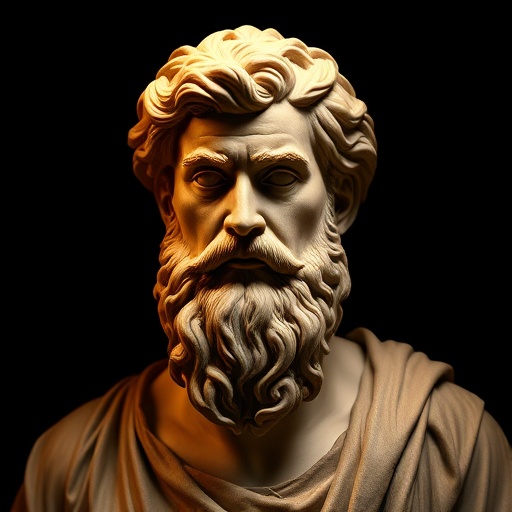
Epicurus — "The wise man is not afraid of death; indeed, he welcomes it as a release from th…"
The wise man is not afraid of death; indeed, he welcomes it as a release from the bondage of the body.
The wise man is not afraid of death; indeed, he welcomes it as a release from the bondage of the body.
Click any product to generate a realistic preview. Up to 3 at a time.
* Initial load can take up to 90 seconds — revising the preview in another color is nearly instant.
"Death is nothing to us; for that which has been dissolved into its elements experiences no sensation, and that which has no sensation is nothing to us."
"The greatest good is prudence; it is even more precious than philosophy itself."
"It is better to be a victim of injustice than to be the perpetrator."
"A free life cannot acquire many possessions, because this is no easy thing to do without servility to mobs or monarchs."
"It is not so much our friends' help that helps us as the confident knowledge that they will help us."
Greek philosopher who founded the Garden school in Athens, whose materialist atomism and pleasure-as-tranquility ethics shaped Hellenistic thought. Closely associated with Lucretius (Roman successor whose De Rerum Natura preserved Epicurean physics). For an intellectual contrast, see the Stoics (Zeno, Epictetus, Marcus Aurelius), the Hellenistic ethical school of discipline-of-acceptance — Stoic 'live according to nature' and Epicurean 'pleasure and absence of pain' framed every ancient ethical decision — every Roman of Cicero's era was implicitly choosing one path or the other. The Stoic-Epicurean rivalry was the central philosophical debate of the Hellenistic and Roman world for 400 years.
The standard scholarly entry points to Epicurus's work: A.A. Long (UC Berkeley, Classics) — Hellenistic Philosophy: Stoics, Epicureans, Sceptics (1974); Tim O'Keefe (Georgia State University, ancient philosophy) — Epicureanism (2010); David Sedley (Cambridge, Classics) — Lucretius and the Transformation of Greek Wisdom (1998). These are the works graduate seminars cite when teaching Epicurus.
Your cart is empty