What it means
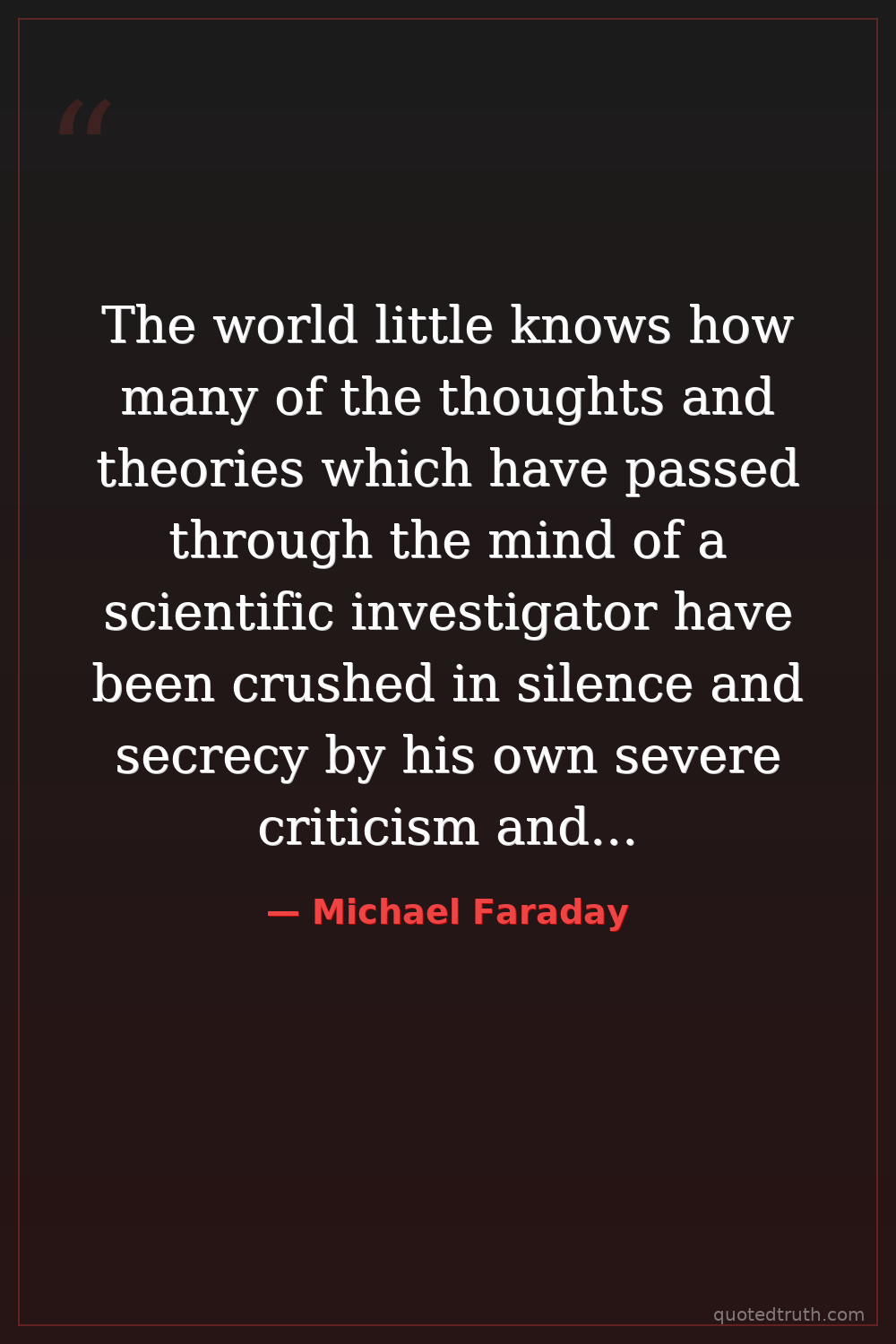
Most people never see the countless ideas a scientist privately rejects. Behind every published discovery lies a graveyard of hypotheses the researcher tested, doubted, and killed before anyone else saw them. The hard work of science isn't just finding what's true; it's ruthlessly discarding what isn't. Self-criticism does most of the filtering long before peer review ever gets involved.
Relevance to Michael Faraday
Faraday kept meticulous lab notebooks with over 16,000 numbered entries, documenting dead ends alongside breakthroughs like electromagnetic induction and the dynamo. Largely self-taught as a bookbinder's apprentice, he distrusted speculation and insisted on experimental proof. He famously spent a decade pursuing the link between magnetism and light before succeeding, repeatedly abandoning promising ideas that failed testing. This quote reflects his lived discipline of private skepticism.
The era
In the early-to-mid 1800s, science was professionalizing, shifting from gentleman-amateur natural philosophy toward rigorous experimental method. The Royal Institution, where Faraday worked, was central to this transition. Public lectures popularized discoveries, but there was growing pressure to publish only polished results. Faraday's warning against unseen intellectual labor pushed back on the myth of effortless genius that Victorian audiences increasingly expected from celebrated scientific figures.
AI-generated insights based on extensive research and information for context. Factual errors? Email [email protected].