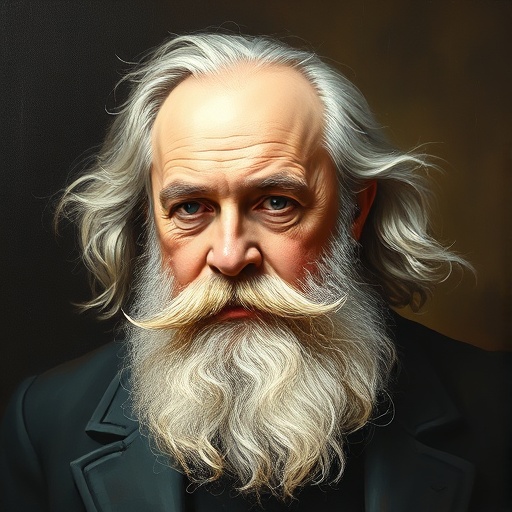
Dmitri Mendeleev — "There are no grounds to think that knowledge and our mastery over matter have bo…"
There are no grounds to think that knowledge and our mastery over matter have bounds.
There are no grounds to think that knowledge and our mastery over matter have bounds.
Click any product to generate a realistic preview. Up to 3 at a time.
* Initial load can take up to 90 seconds — revising the preview in another color is nearly instant.
"Work, look for peace and calm in work: you will find it nowhere else."
"The future of Russia is in its oil and its people."
"The law of periodicity was a result of the accumulation of a large number of facts."
"Without knowledge, without work, there is no hope for humanity."
"The capital fact to note is that petroleum was born in the depths of the earth, and it is only there that we must seek its origin."
Statement on the limitless potential of scientific inquiry and human capability.
Date: Undated
PhilosophicalFound in 1 providers: gemini
1 source checked
The statement asserts that human understanding and our ability to control the physical world have no ceiling. There is no reason to assume a final frontier where learning stops or where nature refuses to yield to investigation. Every apparent limit is provisional, waiting to be pushed further by better tools, sharper thinking, and patient work. Progress in science and technology is open-ended rather than finite.
Mendeleev built the periodic table by trusting that gaps in knowledge were temporary, famously predicting gallium, scandium, and germanium before they were isolated. That act required exactly this faith: undiscovered elements existed, and chemistry would eventually find them. He spent his career pushing Russian industry, agriculture, and metrology forward, convinced that systematic inquiry could tame any material problem, from oil refining to standardizing weights.
Mendeleev worked in late nineteenth-century Russia during a period of rapid industrialization, when chemistry, thermodynamics, and electromagnetism were rewriting what matter could do. Telegraphs, railroads, synthetic dyes, and new metals seemed to confirm that science kept breaking through supposed walls. Positivism was ascendant across Europe, and intellectuals broadly believed rational investigation would steadily expand human power, making his confidence in unbounded knowledge a mainstream scientific creed of the era.
AI-generated insights based on extensive research and information for context. Factual errors? Email [email protected].
Your cart is empty