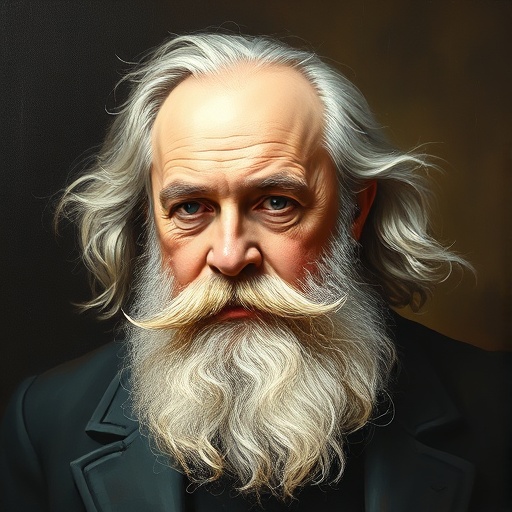
Dmitri Mendeleev — "There are no limits to the perfectibility of human knowledge, and it is in this …"
There are no limits to the perfectibility of human knowledge, and it is in this spirit that the periodic system was conceived.
There are no limits to the perfectibility of human knowledge, and it is in this spirit that the periodic system was conceived.
Click any product to generate a realistic preview. Up to 3 at a time.
* Initial load can take up to 90 seconds — revising the preview in another color is nearly instant.
"My main interest is to help my country, Russia, develop its industrial capacity."
"I have always been a practical man, and my science is for the benefit of mankind."
"The chemical elements are the children of the sun."
"Atomic weight belongs not to coal or diamond but carbon."
"I saw in a dream a table where all the elements fell into place as required."
Reflecting on the nature of scientific progress
Date: Undated, from his later reflections
EducationalFound in 1 providers: grok
1 source checked
Human understanding can always grow deeper and more refined; there is no ceiling on what we can learn or how well we can organize knowledge. The statement frames science as an open-ended project rather than a closed set of finished facts. Any system we build to explain nature is provisional, capable of being refined, extended, or corrected as new evidence arrives. Progress depends on treating current understanding as a starting point, not a conclusion.
Mendeleev built the periodic table in 1869 by arranging elements according to atomic weight and recurring chemical properties, deliberately leaving gaps where unknown elements should exist. He predicted gallium, scandium, and germanium years before their discovery, trusting that the pattern would be completed by future work. This quote captures his working philosophy: the table was not a final answer but a framework designed to be filled in, corrected, and extended by later chemists building on his foundation.
In the mid-to-late 1800s, chemistry was transitioning from a descriptive craft into a systematic science. Dozens of elements had been isolated, atomic weights were being measured with growing precision, and chemists like Dobereiner and Newlands were searching for underlying order. Russia was modernizing its universities and industries, and Mendeleev taught at St. Petersburg. The intellectual climate, shaped by Darwin and positivism, treated knowledge as cumulative and progressive rather than fixed by tradition.
AI-generated insights based on extensive research and information for context. Factual errors? Email [email protected].
Your cart is empty