What it means
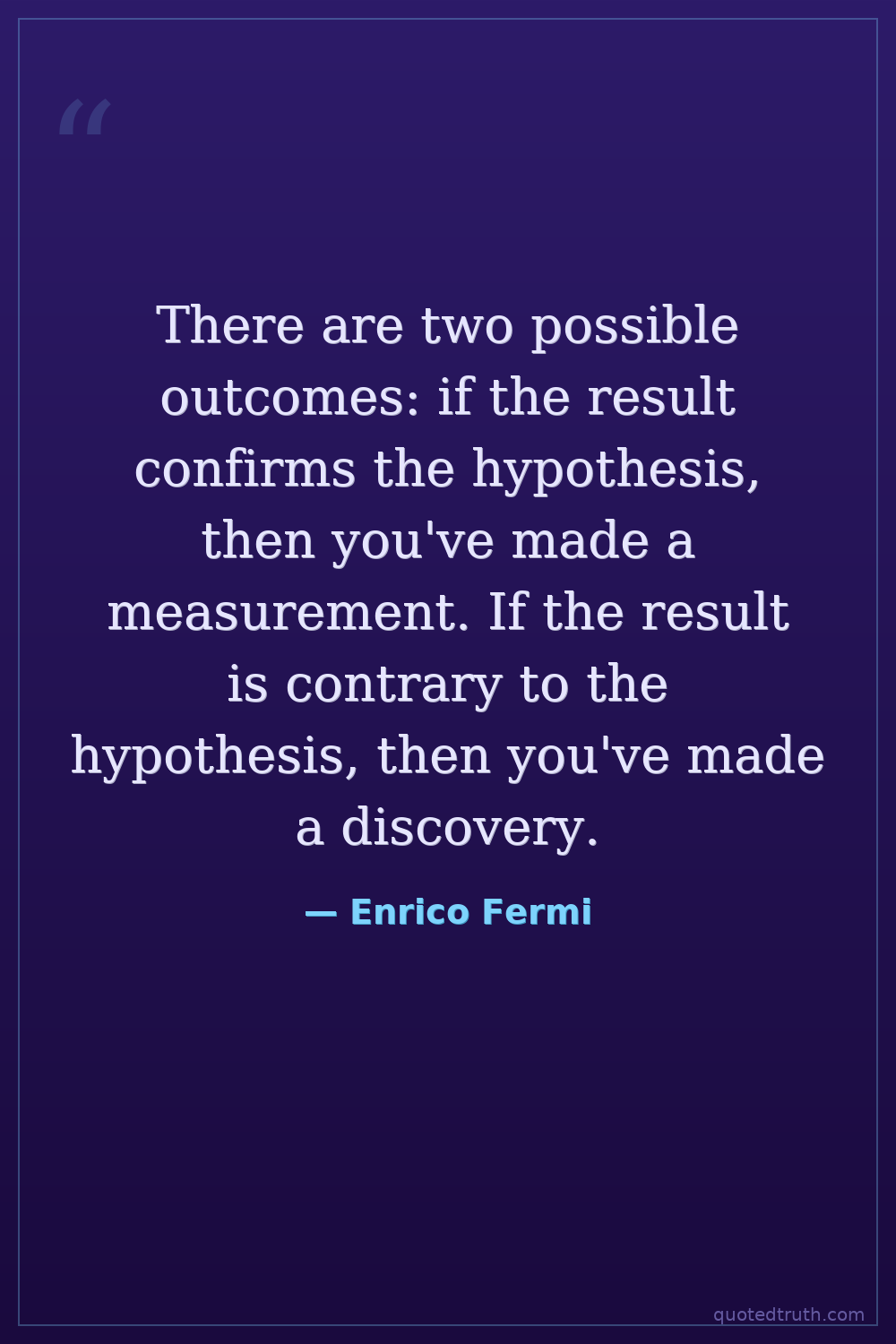
Experimental results are never wasted. When an experiment confirms your prediction, you've validated your model with hard data. When it contradicts your prediction, something real in the universe is pushing back against your assumptions — and that gap between expectation and reality is precisely where new knowledge lives. Unexpected findings aren't failures; they're invitations to revise your understanding of how things actually work.
Relevance to Enrico Fermi
Fermi embodied this principle throughout his career. In 1934, while bombarding elements with neutrons, he discovered that a wooden table produced different results than marble — unexpected data revealing the power of slow neutrons, earning the 1938 Nobel Prize. Chicago Pile-1's first self-sustaining chain reaction in 1942 was itself a high-stakes hypothesis test. He consistently treated anomalies as the most interesting data points.
The era
Fermi worked during physics' most fertile era, the 1920s through 1950s, when quantum mechanics upended classical physics, nuclear fission was discovered, and the Manhattan Project demonstrated that theoretical breakthroughs carried immediate geopolitical consequences. Unexpected experimental results routinely rewrote textbooks. The Cold War arms race that followed made nuclear discoveries politically urgent, giving every anomalous lab result potential global significance.
AI-generated insights based on extensive research and information for context. Factual errors? Email [email protected].