What it means
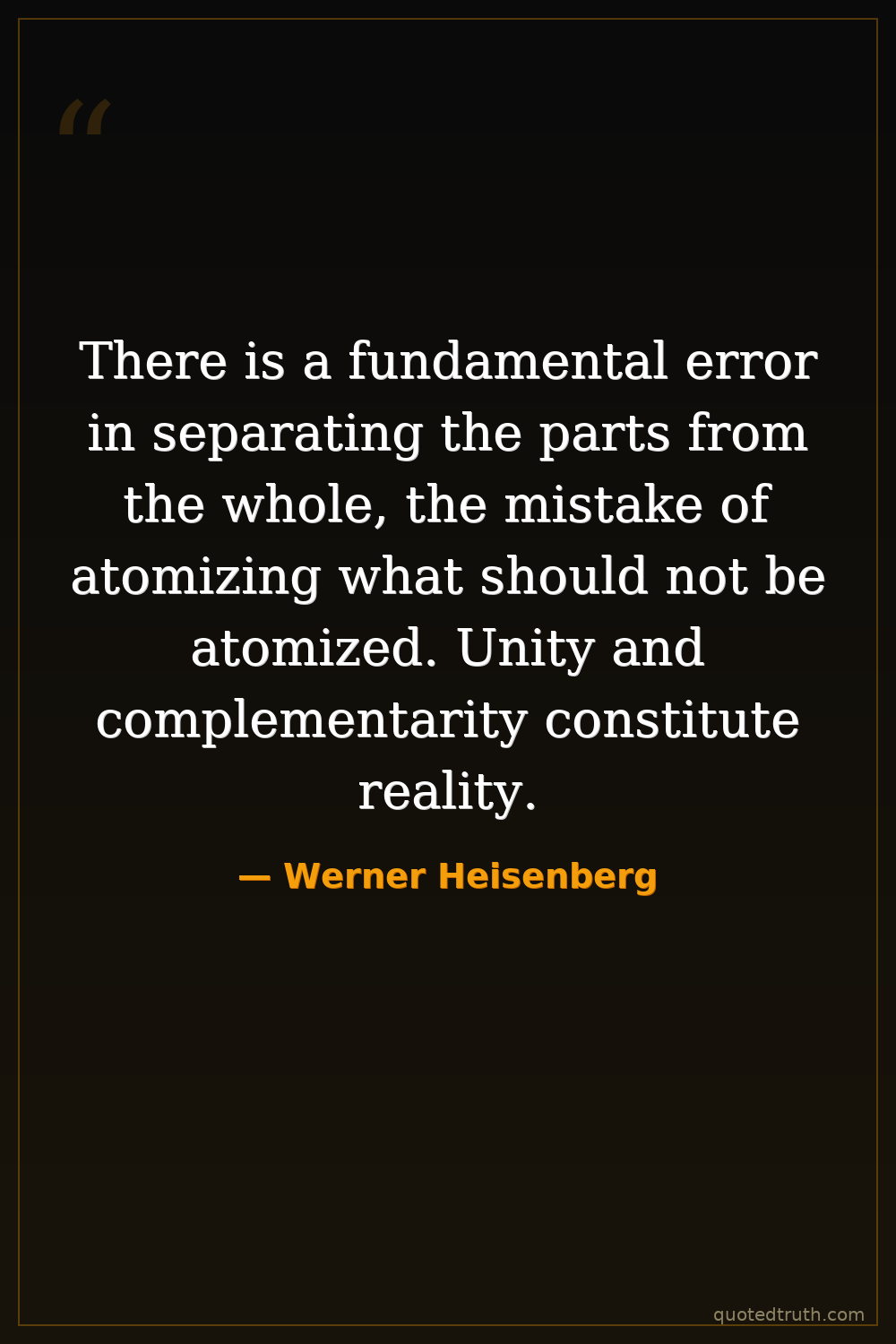
Breaking something into isolated pieces to study it often misses the point, because the pieces only make sense together. Reality isn't a pile of independent parts; it's a web where connections and seemingly opposite aspects both matter. Treating a system as just a sum of atoms ignores how those atoms behave only in relation to one another. Truth lives in the whole and in how contrasting views fit together.
Relevance to Werner Heisenberg
Heisenberg founded quantum mechanics and formulated the uncertainty principle, which showed that a particle's position and momentum cannot be cleanly separated. He worked closely with Niels Bohr, whose complementarity principle held that wave and particle descriptions are both needed. His matrix mechanics treated systems holistically rather than as classical billiard balls, so rejecting crude atomization and embracing unity-through-complementarity is a direct expression of his scientific worldview.
The era
Heisenberg worked in the 1920s-1970s, as classical physics collapsed and quantum theory upended determinism. Reductionist, mechanistic science was being forced to accept observer effects, entanglement, and wave-particle duality. Amid two world wars, the atomic bomb, and Cold War anxiety about fragmentation, thinkers across physics, philosophy, and systems theory began emphasizing interconnection. His remark fits a modern moment when splitting reality into isolated parts was visibly failing both in the lab and in geopolitics.
AI-generated insights based on extensive research and information for context. Factual errors? Email [email protected].