Max Planck — "There is no matter as such. All matter originates and exists only by virtue of a…"
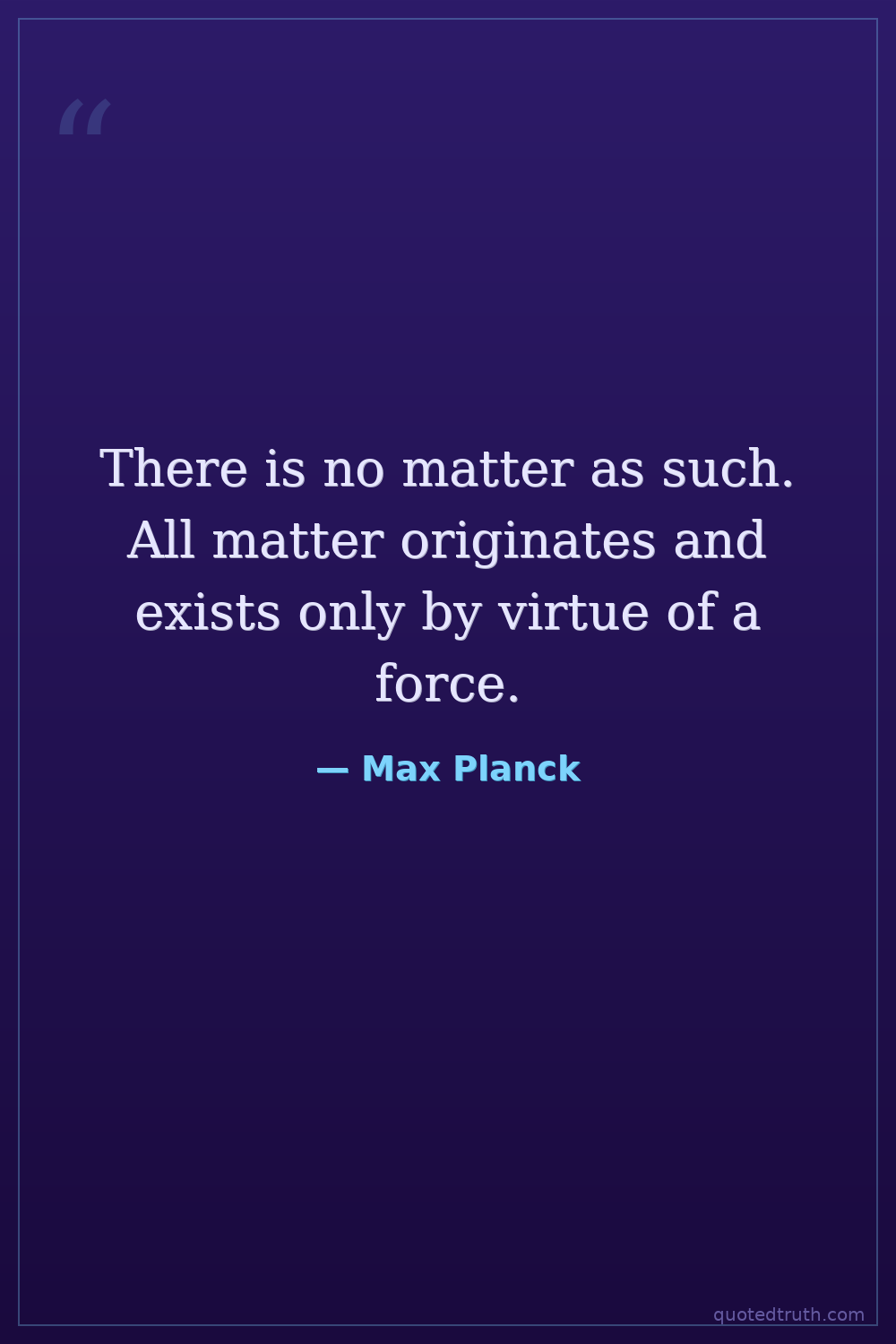
There is no matter as such. All matter originates and exists only by virtue of a force.
There is no matter as such. All matter originates and exists only by virtue of a force.
Click any product to generate a realistic preview. Up to 3 at a time.
* Initial load can take up to 90 seconds — revising the preview in another color is nearly instant.
"The creative scientist is one who can see things in a new way."
"The quantum theory has done a great deal for physics, but it has not made it any easier to understand."
"Physics is a branch of knowledge which aims at the discovery of the laws governing the phenomena of nature."
"I started from the assumption that the energy of an oscillator is quantized. I did this in an act of desperation."
"The world is not a machine, but a living organism."
Found in 1 providers: deepseek
1 source checked
Planck argues that solid, tangible matter is not a fundamental building block of reality. Instead, what we perceive as physical substance is actually sustained by underlying forces or fields. Everything we touch, see, and measure exists only because invisible forces hold particles together and give them structure. Without these forces, matter would not exist at all. Reality, at its deepest level, is energetic rather than material.
Planck spent decades probing the nature of energy and radiation, eventually discovering that energy comes in discrete quanta, a breakthrough that earned him the 1918 Nobel Prize. This statement reflects the radical shift his own work forced on physics: the solid Newtonian world dissolved into probabilities and fields. A devout Lutheran, Planck also saw a conscious, intelligent force behind physical law, making this quote both a scientific conclusion and a personal philosophical stance.
Planck spoke during the early twentieth century, when classical physics was collapsing under new discoveries. Einstein's relativity, Rutherford's atomic nucleus, and the emerging quantum mechanics were dismantling centuries of assumptions about solid matter and absolute space. European laboratories, especially in Germany, led this revolution. Two world wars, the rise of Nazism, and the loss of Planck's own son to the Gestapo framed a turbulent backdrop against which scientists reimagined the very fabric of physical reality.
AI-generated insights based on extensive research and information for context. Factual errors? Email [email protected].
Your cart is empty