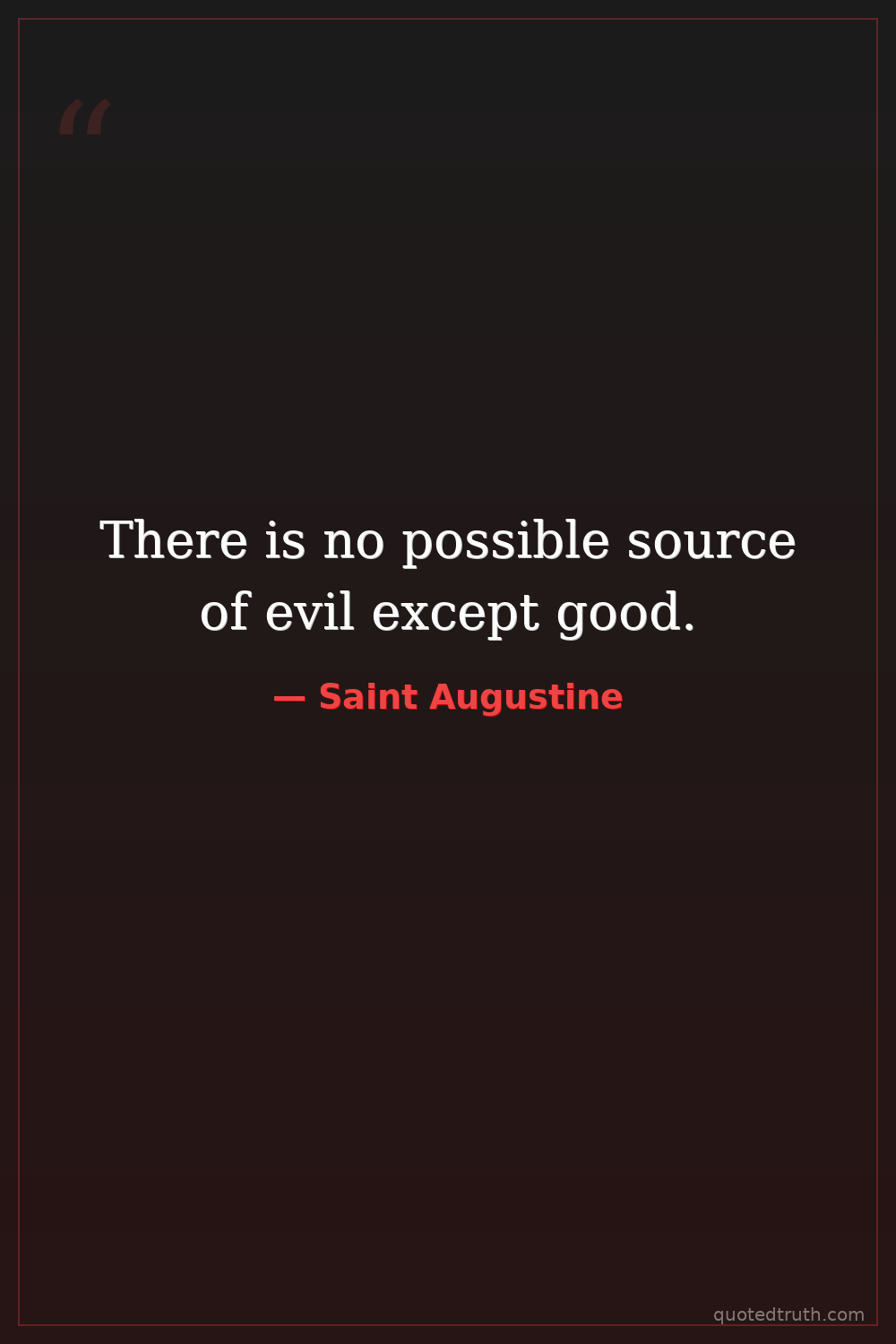
Saint Augustine — "There is no possible source of evil except good."
There is no possible source of evil except good.
There is no possible source of evil except good.
Click any product to generate a realistic preview. Up to 3 at a time.
* Initial load can take up to 90 seconds — revising the preview in another color is nearly instant.
"Sin is looking for the right thing in the wrong place."
"Having children is the only worthy fruit of sexual intercourse."
"Give me chastity and continence, but not yet."
"It is according to the natural order that women serve their husbands."
"Woman is subject to man."
Found in 1 providers: deepseek
1 source checked
Evil has no independent existence or origin of its own. It can only arise as a corruption or absence within something that was originally good. Nothing evil can come from nothing — it must twist or deprive what was once whole and good. This is not a paradox but a metaphysical claim: evil is a privation, a lack, not a substance or force unto itself.
Augustine, a bishop and theologian who converted from Manichaeism — which taught that evil was a co-equal cosmic force opposing good — rejected that dualism entirely. His Confessions and City of God argue that God created all things good, and sin is a turning away from that good. His own life of moral struggle before conversion made the corruption of good feel personally urgent, not merely abstract.
In 4th–5th century Roman North Africa, Manichaeism, Neoplatonism, and Donatism competed with orthodox Christianity for souls. The Roman Empire was fracturing, paganism was blamed for Rome's fall, and Christians wrestled with theodicy — why does evil exist if God is good? Augustine's answer, rooted in Neoplatonic privation theory, gave the Church a durable philosophical defense against dualist heresies.
AI-generated insights based on extensive research and information for context. Factual errors? Email [email protected].
Your cart is empty