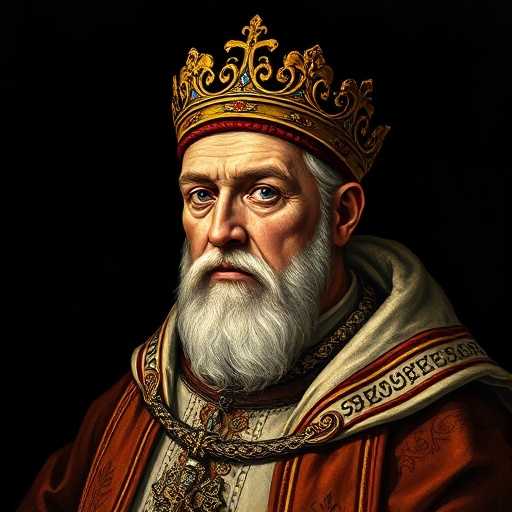
Pope Urban II — "They torture Christians with unheard-of cruelties."
They torture Christians with unheard-of cruelties.
They torture Christians with unheard-of cruelties.
Click any product to generate a realistic preview. Up to 3 at a time.
* Initial load can take up to 90 seconds — revising the preview in another color is nearly instant.
"All who die in the true faith will receive the crown of life."
"Jerusalem is the navel of the world; the land is fruitful above all others, like another paradise of delights."
"They have destroyed the churches of God or have converted them to the rites of their own religion."
"Oh, what a disgrace if such a despised and base race, which worships demons, should conquer a people which has the faith of omnipotent God and has been made glorious with the name of Christ!"
"But if you are hindered by love of children, parents, or of wife, remember what the Lord says in the Gospel, 'He that loveth father or mother more than me is not worthy of me', 'Every one that hath fo…"
Pope (1088-1099) whose Council of Clermont speech (November 1095) launched the First Crusade — the founding event of nine centuries of Christian-Muslim military conflict. Closely associated with Pope Gregory VII (his predecessor on papal-imperial reform). For an intellectual contrast, see Saladin, Kurdish-Muslim Sultan of Egypt and Syria (1138-1193) — Saladin recaptured Jerusalem in 1187, undoing the First Crusade Urban II launched 92 years earlier. Saladin's chivalrous treatment of Christian prisoners became the canonical Muslim counter-image to Crusader brutality. The cleanest before/after pairing of the Crusades' moral arc.
Found in 1 providers: grok
1 source checked
Christians in the Holy Land are being subjected to extreme, unprecedented brutality and suffering at the hands of those who control Jerusalem. The statement frames the situation as an urgent moral crisis demanding immediate response, portraying the victims as innocent people enduring unimaginable pain that transcends ordinary warfare or conflict into something requiring righteous intervention from the wider Christian world.
Urban II spoke these words at the Council of Clermont in 1095, deliberately using visceral language to mobilize European nobility. As pope, he wielded spiritual authority but needed secular armies. His rhetorical strategy of emphasizing Christian suffering transformed a geopolitical struggle over Jerusalem into a sacred duty, reflecting his sophisticated understanding of how to unite fractious feudal lords under ecclesiastical leadership.
The Seljuk Turks had conquered Jerusalem in 1071 and defeated Byzantine forces at Manzikert, threatening Constantinople. Pilgrim routes to holy sites became dangerous. Feudal Europe was riven by internal violence, and Urban saw redirecting martial energy toward a holy war as both spiritually legitimizing and politically stabilizing, channeling endemic knightly warfare outward while strengthening papal authority over Christendom.
AI-generated insights based on extensive research and information for context. Factual errors? Email [email protected].
Your cart is empty