What it means
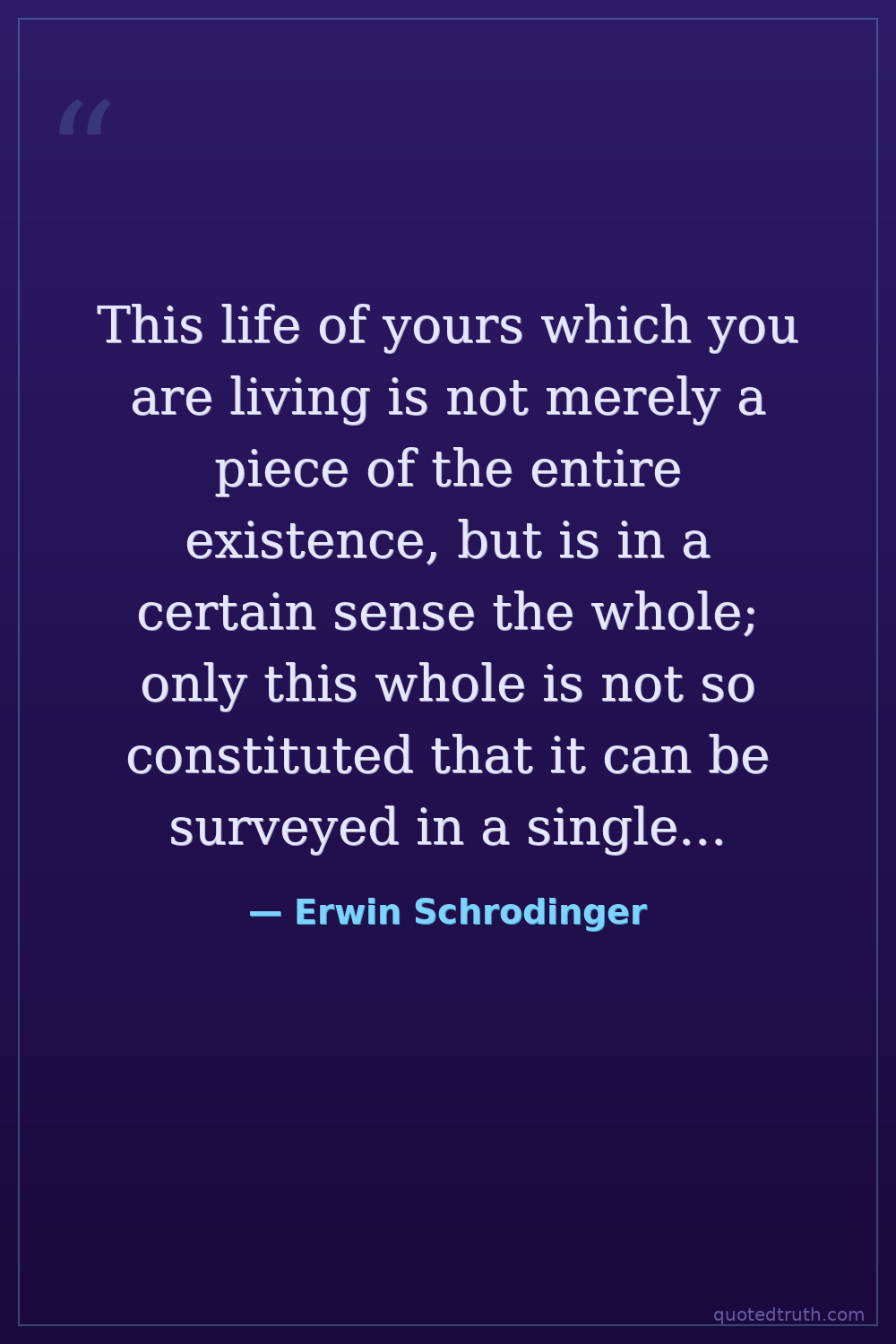
Each individual life is not just a small fragment of a larger whole — it contains the entire scope of existence within it. Yet this totality cannot be grasped at once; it unfolds gradually, resisting any single comprehensive view. Consciousness is not divided among billions of people but is somehow one thing experienced from countless angles, none fully visible to itself.
Relevance to Erwin Schrodinger
Schrödinger spent decades probing quantum mechanics, where particles exist in superposed states defying single-perspective observation — directly mirroring this idea. His 1944 book 'What is Life?' explored consciousness philosophically. He drew heavily from Vedantic philosophy, which holds that individual consciousness is identical to universal consciousness (Atman = Brahman), making this quote a direct expression of his deepest intellectual convictions.
The era
Schrödinger wrote amid quantum mechanics overturning classical determinism in the 1920s–1940s. The Copenhagen interpretation challenged the idea of objective singular reality. Simultaneously, Eastern philosophy gained Western academic interest. Post-WWII existentialism questioned individual meaning within vast systems. This tension between part and whole — in physics, philosophy, and humanity's place in a shattered post-war world — gave this observation urgent cultural resonance.
AI-generated insights based on extensive research and information for context. Factual errors? Email [email protected].