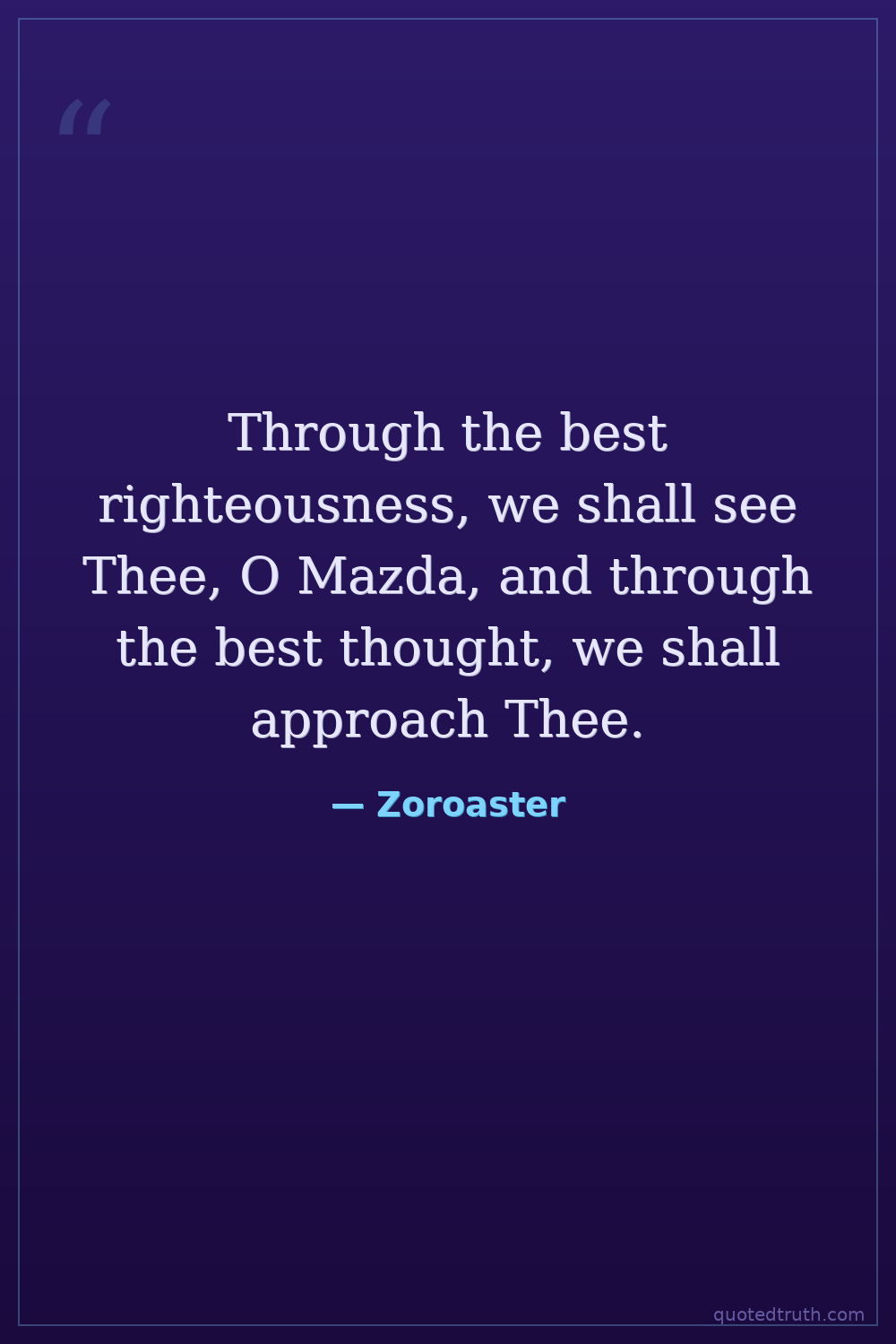
Zoroaster — "Through the best righteousness, we shall see Thee, O Mazda, and through the best…"
Through the best righteousness, we shall see Thee, O Mazda, and through the best thought, we shall approach Thee.
Through the best righteousness, we shall see Thee, O Mazda, and through the best thought, we shall approach Thee.
Click any product to generate a realistic preview. Up to 3 at a time.
* Initial load can take up to 90 seconds — revising the preview in another color is nearly instant.
"All flows out from the Deity, and all must be absorbed in Him again."
"Whoso makes the poor joyful, him Ahura Mazda will make joyful."
"May your heart be full of love and your pockets full of... well, whatever you like."
"Let us strive to be like Ahura Mazda, with good thoughts, good words, and good deeds."
"He who is good to the pious, he is good to himself, but he who is evil to the pious, he is evil to himself."
Iranian prophet who founded Zoroastrianism, the first major religion of cosmic dualism between good (Ahura Mazda) and evil (Angra Mainyu). Closely associated with The Buddha (near-contemporary Eastern moral-cosmological revolutionary). For an intellectual contrast, see Friedrich Nietzsche, German philosopher of 'beyond good and evil' — Nietzsche appropriated Zarathustra's name for Thus Spoke Zarathustra (1883) precisely to invert the original's moral cosmology — the historical Zoroaster founded the good-versus-evil framework Nietzsche's character announces the end of.
Found in 1 providers: gemini
1 source checked
Living with the highest moral integrity and cultivating the purest thinking are the two paths that bring a person closer to the divine. Right action and right mind work together as a spiritual practice, not as separate virtues. You do not reach God through ritual alone or intellect alone, but by aligning both your conduct and your inner reasoning with truth, which reveals the divine presence directly.
Zoroaster built his entire religion around the triad of good thoughts, good words, and good deeds, and this quote fuses two of those pillars. As a reformist priest who rejected the ritual-heavy polytheism of his era, he insisted that ethical behavior and clear reasoning, not sacrifices, were the real route to Ahura Mazda, the supreme wise lord he preached.
Zoroaster lived in ancient Persia, likely between 1500 and 1000 BCE, among pastoral Indo-Iranian tribes who worshipped many gods through animal sacrifice and intoxicating rituals. He broke with that culture to preach one uncreated god and a cosmic struggle between truth and falsehood. His monotheism and emphasis on personal moral choice later shaped Judaism, Christianity, and Islam.
AI-generated insights based on extensive research and information for context. Factual errors? Email [email protected].
Your cart is empty