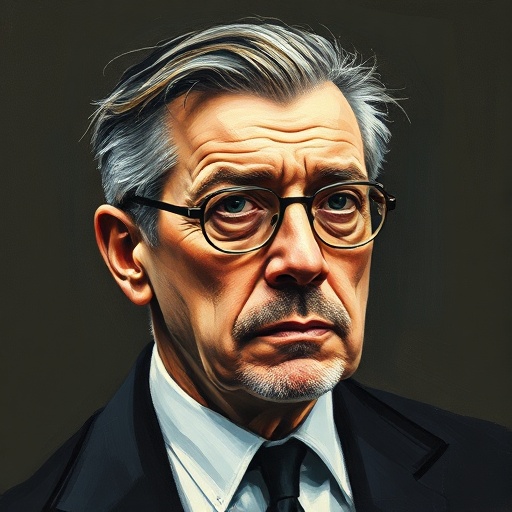
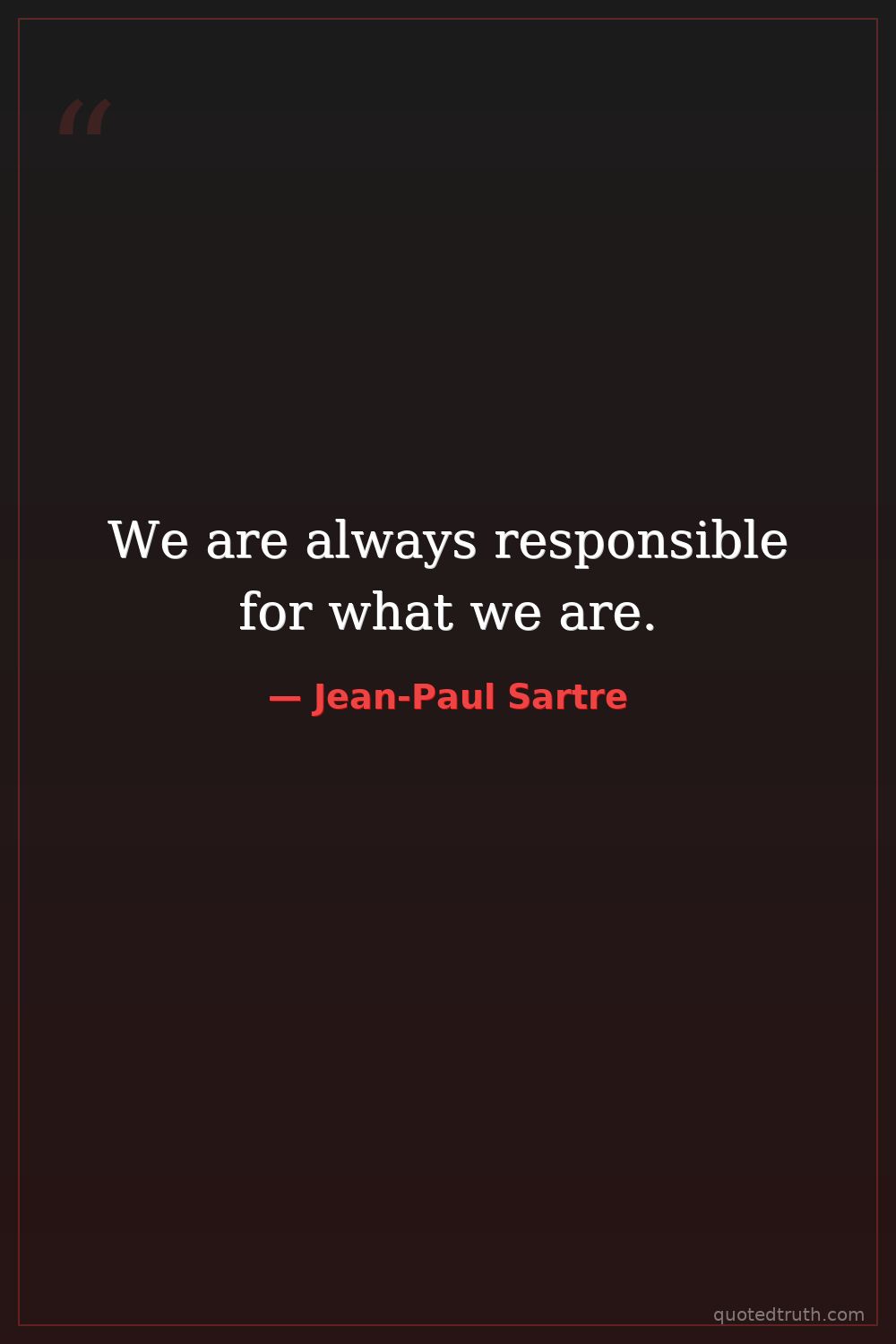
Jean-Paul Sartre — "We are always responsible for what we are."
We are always responsible for what we are.
We are always responsible for what we are.
Click any product to generate a realistic preview. Up to 3 at a time.
* Initial load can take up to 90 seconds — revising the preview in another color is nearly instant.
"I regret nothing. I have done what I have done."
"Violence is good for those who have nothing to lose."
"We are left alone, without excuse."
"One always dies too soon - or too late. And yet existence is a gift."
"Commitment is an act, not a word."
French existentialist philosopher (Being and Nothingness, 1943) and Nobel literature laureate (refused, 1964) who shaped postwar French intellectual culture. Closely associated with Simone de Beauvoir (lifetime partner and existentialist co-founder) and Maurice Merleau-Ponty (phenomenologist contemporary and Les Temps Modernes co-editor). For an intellectual contrast, see Albert Camus, Algerian-French novelist and philosopher — Once Sartre's closest collaborator, Camus broke with him publicly in 1952 over Soviet communism; Camus's moral-resistance liberalism and Sartre's revolutionary commitment became the two postwar French Left poles. The Sartre-Camus break is the canonical postwar French intellectual rupture — they argued whether revolutionary violence is ever justified, and never reconciled.
The standard scholarly entry points to Jean-Paul Sartre's work: Annie Cohen-Solal (French biographer, NYU) — Sartre: A Life (1985); Ronald Aronson (Wayne State University, philosophy) — Camus and Sartre: The Story of a Friendship (2004); Bernard-Henri Lévy (French public philosopher) — Sartre: The Philosopher of the Twentieth Century (2003). These are the works graduate seminars cite when teaching Jean-Paul Sartre.
Your cart is empty