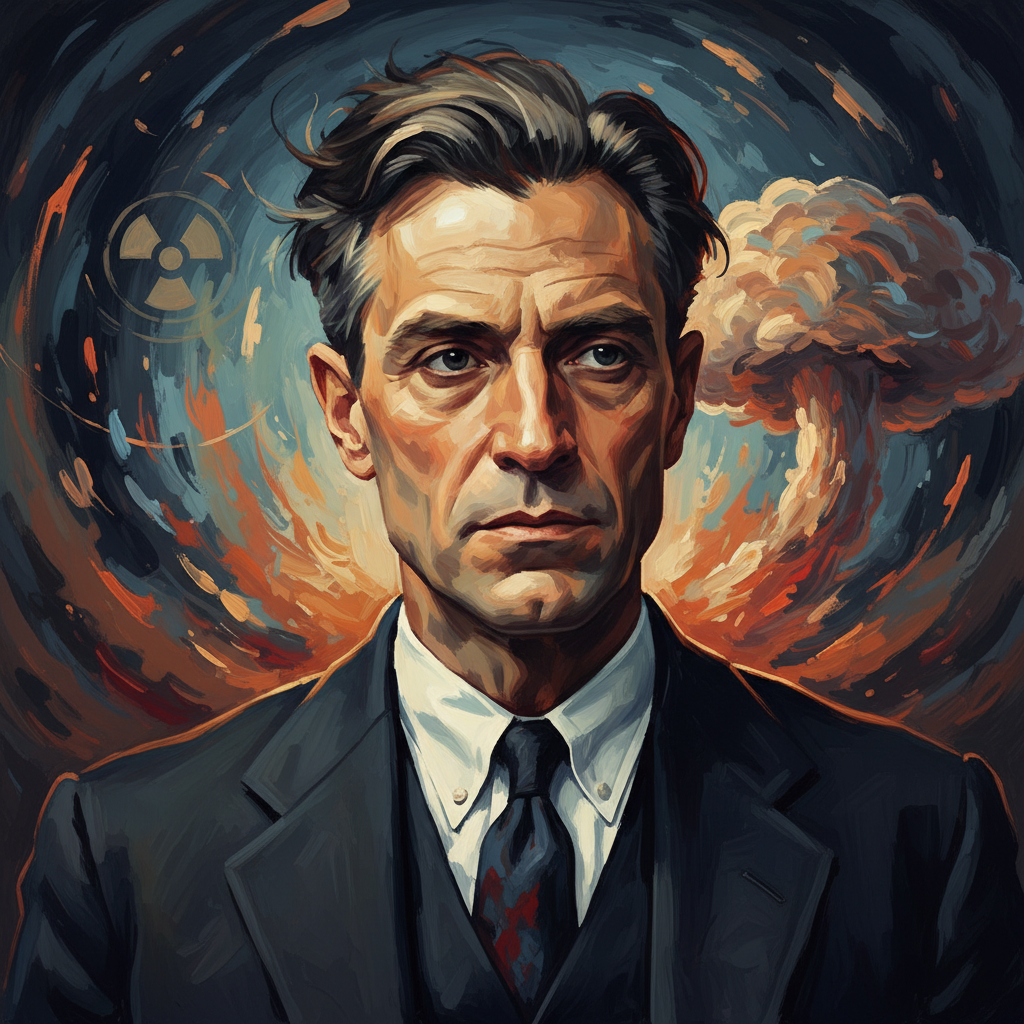
Robert Oppenheimer — "We are living in a world which is profoundly new, and profoundly dangerous."
We are living in a world which is profoundly new, and profoundly dangerous.
We are living in a world which is profoundly new, and profoundly dangerous.
Click any product to generate a realistic preview. Up to 3 at a time.
* Initial load can take up to 90 seconds — revising the preview in another color is nearly instant.
"The only constant in life is change."
"We have opened a Pandora's Box."
"There must be no more wars."
"I feel that in a world where atomic bombs are possible, the only safety is in a world where atomic bombs are no longer needed."
"The best way to send information is to wrap it up in a person."
American theoretical physicist who directed the Manhattan Project's Los Alamos Laboratory and oversaw the atomic bombs; lost his security clearance in 1954. Closely associated with Niels Bohr (Manhattan Project consultant and atomic-policy advisor) and Hans Bethe (Los Alamos theoretical-division chief). For an intellectual contrast, see Edward Teller, Hungarian-American physicist and 'father of the H-bomb' — Teller pushed the H-bomb against Oppenheimer's objections and testified against him at his 1954 security hearing — the precise moment that ended Oppenheimer's career. The canonical 'physicist-of-conscience vs physicist-of-state' pairing in nuclear-age ethics; Christopher Nolan's Oppenheimer (2023) dramatized this rivalry for a mass audience.
Found in 1 providers: grok
1 source checked
Humanity has entered a fundamentally transformed era — one where scientific knowledge and technology have grown so powerful they threaten civilization's survival. The world is 'new' because forces like nuclear fission have unlocked capabilities unimaginable a generation before; it is 'dangerous' because those same forces can annihilate cities in seconds. The responsibility to manage what we've created now falls on everyone — scientists, governments, and ordinary people alike.
Oppenheimer directed the Manhattan Project, overseeing the design and testing of the first atomic bombs. At the 1945 Trinity test, he recalled the Bhagavad Gita: 'Now I am become Death.' Haunted by Hiroshima and Nagasaki, he spent his postwar years lobbying for international nuclear control and opposing the hydrogen bomb — positions that cost him his security clearance in 1954. His entire later life embodied this warning.
The bombings of Hiroshima and Nagasaki in August 1945 killed over 200,000 people and launched the Cold War nuclear arms race. By the early 1950s, both the US and Soviet Union possessed hydrogen bombs thousands of times more powerful than those first weapons. Fallout shelters, civil defense drills, and proliferation fears defined daily life. The Cuban Missile Crisis in 1962 confirmed that annihilation had become a genuine geopolitical option.
AI-generated insights based on extensive research and information for context. Factual errors? Email [email protected].
Your cart is empty