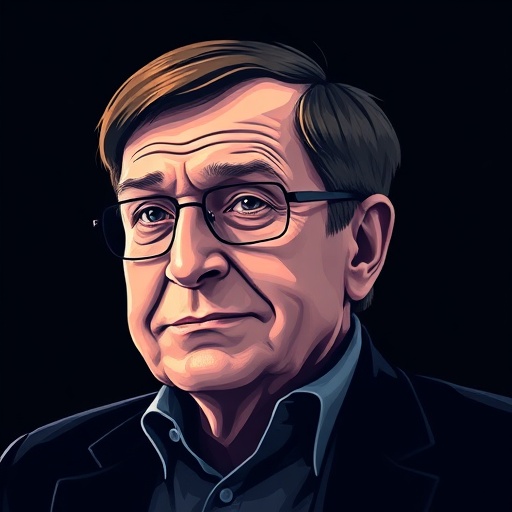
Stephen Hawking — "We are very, very small, but we are profoundly significant."
We are very, very small, but we are profoundly significant.
We are very, very small, but we are profoundly significant.
Click any product to generate a realistic preview. Up to 3 at a time.
* Initial load can take up to 90 seconds — revising the preview in another color is nearly instant.
"Wrong again, Albert."
"You have no talent. You are like a Chinese food delivery guy without Chinese food."
"The universe is not expanding into anything."
"The greatest achievement of the human race would be to understand the universe."
"It is a waste of time to be angry about my disability. One has to get on with life and I haven't done badly. People won't have time for you if you are always angry or complaining."
British theoretical physicist whose Hawking radiation work and A Brief History of Time (1988) brought black-hole physics to a mass audience while he lived with ALS for 55 years. Closely associated with Roger Penrose (his collaborator on singularity theorems) and Carl Sagan (fellow popularizer who wrote Brief History's foreword). For an intellectual contrast, see William Lane Craig, American philosopher of religion — Craig's Kalam cosmological argument depends on the Big Bang requiring a divine first cause; Hawking's no-boundary proposal was specifically designed to remove the moment that would require one — the cleanest cosmology-vs-natural-theology contrast in modern thought.
Found in 1 providers: grok
1 source checked
In an incomprehensibly vast universe of billions of galaxies, humans occupy a microscopic speck. Yet the quote insists physical triviality doesn't define our worth. Our ability to think, question, discover, and create meaning sets us apart. Size is not significance. Even the smallest conscious beings can grasp the cosmos — and that capacity to understand makes us matter in a way pure scale never could.
Hawking spent decades calculating the physics of black holes and the Big Bang — scales where humanity vanishes entirely. Yet he also lived 55 years with ALS, confined to a wheelchair, communicating through a speech synthesizer. Physically diminished to an extreme, he remained intellectually formidable. His own life embodied the quote's paradox: a body barely functioning, a mind mapping the cosmos. Significance, for Hawking, was always earned through intellect, never through body or size.
During Hawking's lifetime, humanity discovered the universe's true scale — billions of galaxies, dark matter, exoplanets — making Earth feel increasingly negligible. A Brief History of Time arrived in 1988 as Cold War existential anxiety peaked. Space exploration revealed cosmic indifference while simultaneously fueling wonder. Hawking's generation had to reconcile scientific humility with human purpose, making the tension between smallness and significance a defining philosophical challenge of the late 20th century.
AI-generated insights based on extensive research and information for context. Factual errors? Email [email protected].
Your cart is empty