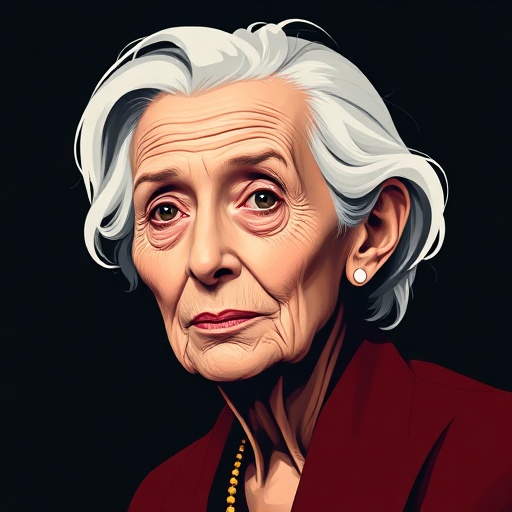
Jane Goodall — "We have so much to learn from the animals, if we would only listen."
We have so much to learn from the animals, if we would only listen.
We have so much to learn from the animals, if we would only listen.
Click any product to generate a realistic preview. Up to 3 at a time.
* Initial load can take up to 90 seconds — revising the preview in another color is nearly instant.
"The power of one individual to make a difference is immense, and we should never underestimate it."
"We are, indeed, often cruel and evil. Nobody can deny this. We gang up on one another, we torture each other, we use our intellect to manipulate, we kill."
"I believe that we can make a difference, if we just try."
"We have a moral obligation to protect the environment for future generations."
"We are all interconnected. What we do to the Earth, we do to ourselves."
British primatologist who in 1960 began the longest-running wild primate study at Gombe Stream, transforming our understanding of chimpanzees. Closely associated with Dian Fossey (mountain-gorilla researcher) and Birutė Galdikas (orangutan researcher; together with Goodall and Fossey one of Louis Leakey's 'Trimates'). For an intellectual contrast, see Walter Palmer, American dentist who killed Cecil the Lion in Zimbabwe in 2015 — Palmer represents the trophy-hunting tradition Goodall's life's work has been organized against — the colonial-era hunter-naturalist worldview that treated primates and big game as specimens or trophies, which Goodall's Roots & Shoots and Jane Goodall Institute exist specifically to displace.
Found in 1 providers: grok
1 source checked
Animals possess knowledge and behaviors developed over millions of years of evolution that humans have barely begun to understand. By observing them without prejudice or exploitation, we can gain insights into social structures, communication, emotion, problem-solving, and even our own evolutionary origins. True learning requires humility — setting aside human arrogance to genuinely witness what other species demonstrate daily about survival and connection.
Goodall spent decades living among Gombe chimpanzees, learning their individual personalities, family bonds, and tool use — discoveries that fundamentally reshaped scientific understanding of primates and human uniqueness. Her methodology was radical: patient observation rather than controlled experiment. She named the chimps, recognized their emotions, and let them teach her. This quote is essentially her career's thesis statement.
Goodall began her Gombe research in 1960, during a scientific era that rigidly separated humans from animals and dismissed animal emotion as anthropomorphism. The postwar decades saw industrial-scale habitat destruction and the rise of factory farming. Against this backdrop, her insistence that animals deserved careful listening — not just exploitation — was both scientifically controversial and culturally countercultural, anticipating the modern animal rights and conservation movements.
AI-generated insights based on extensive research and information for context. Factual errors? Email [email protected].
Your cart is empty