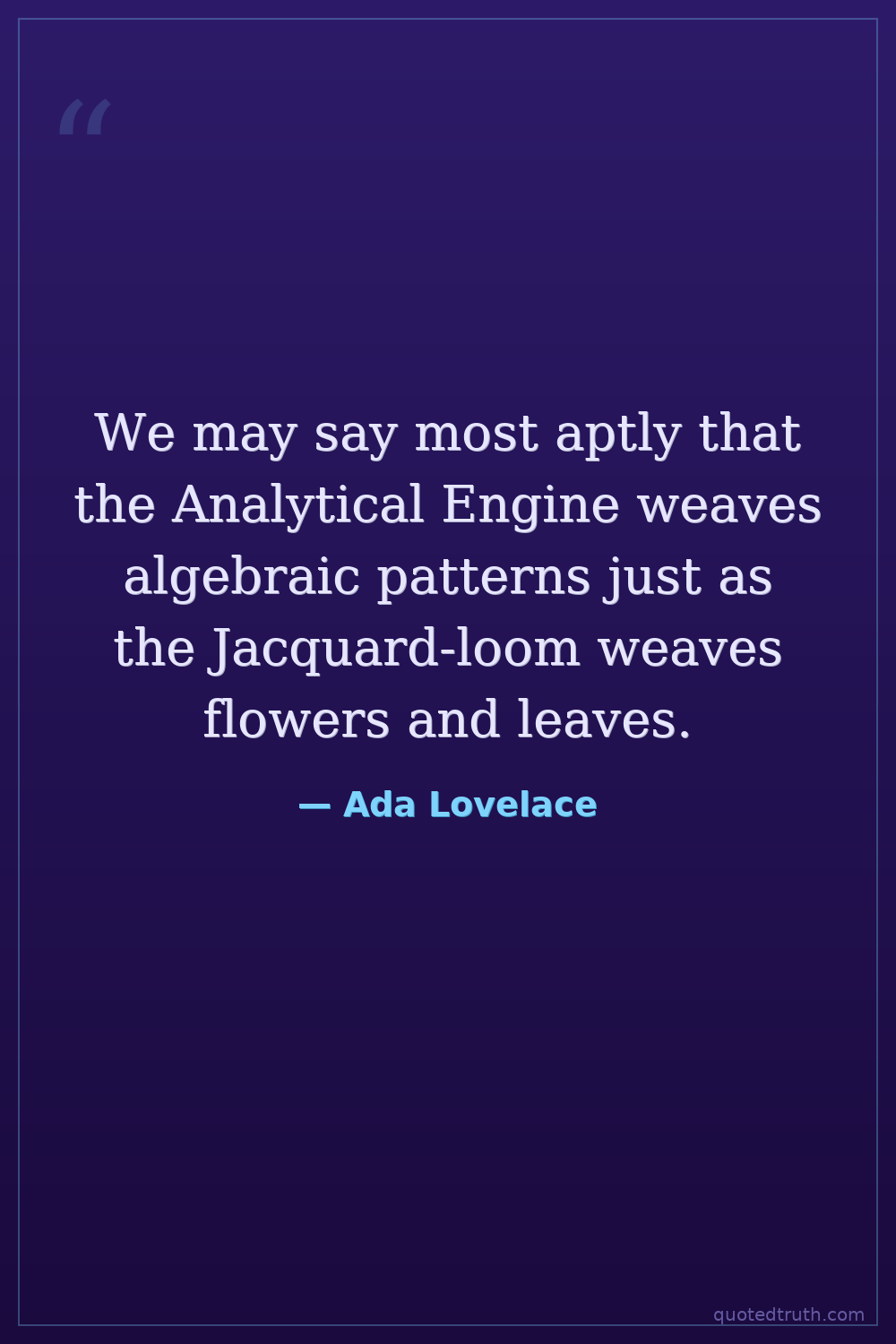
Ada Lovelace — "We may say most aptly that the Analytical Engine weaves algebraic patterns just …"
We may say most aptly that the Analytical Engine weaves algebraic patterns just as the Jacquard-loom weaves flowers and leaves.
We may say most aptly that the Analytical Engine weaves algebraic patterns just as the Jacquard-loom weaves flowers and leaves.
Click any product to generate a realistic preview. Up to 3 at a time.
* Initial load can take up to 90 seconds — revising the preview in another color is nearly instant.
"The Analytical Engine has no pretensions whatever to originate anything. It can do whatever we know how to order it to perform."
"I am often called upon to be a sort of scientific interpreter."
"I am not afraid to venture into unknown territory."
"It is an error to suppose that the Analytical Engine has for its object to perform calculations only."
"I am much more than a mere mathematician; I am a metaphysician."
Notes to 'Sketch of the Analytical Engine Invented by Charles Babbage Esq.'
Date: 1843
Nature & WorldFound in 1 providers: grok
1 source checked
A mechanical computing machine manipulates mathematical expressions the same way a programmable loom manipulates thread — both follow encoded instructions to produce structured, repeatable patterns. This analogy frames computation not as mere arithmetic but as a generative, rule-driven process. Any system that follows instructions to build complex output from simple units is, at its core, running a program, whether the output is silk brocade or an algebraic result.
Lovelace wrote the first published algorithm for Babbage's Analytical Engine in 1843, cementing her as computing's first programmer. She grasped that punch-card mechanisms borrowed directly from the Jacquard loom gave the Engine its programmable character. Her dual grounding in music and mathematics cultivated a talent for seeing abstract patterns. The weaving metaphor reflects her instinct to connect mechanical industry with symbolic thought, articulating what computers could ultimately become beyond pure calculation.
In 1843 the Industrial Revolution was remaking Britain. The Jacquard loom, patented in 1804, was already famous for encoding complex fabric designs on punched cards — effectively the world's first stored programs. Babbage's Analytical Engine remained unbuilt and poorly understood by the public. Lovelace's analogy made the abstract machine legible to an industrial-era audience by mapping it onto a technology everyone already trusted, anchoring computation inside a century defined by what machines could create.
AI-generated insights based on extensive research and information for context. Factual errors? Email [email protected].
Your cart is empty