What it means
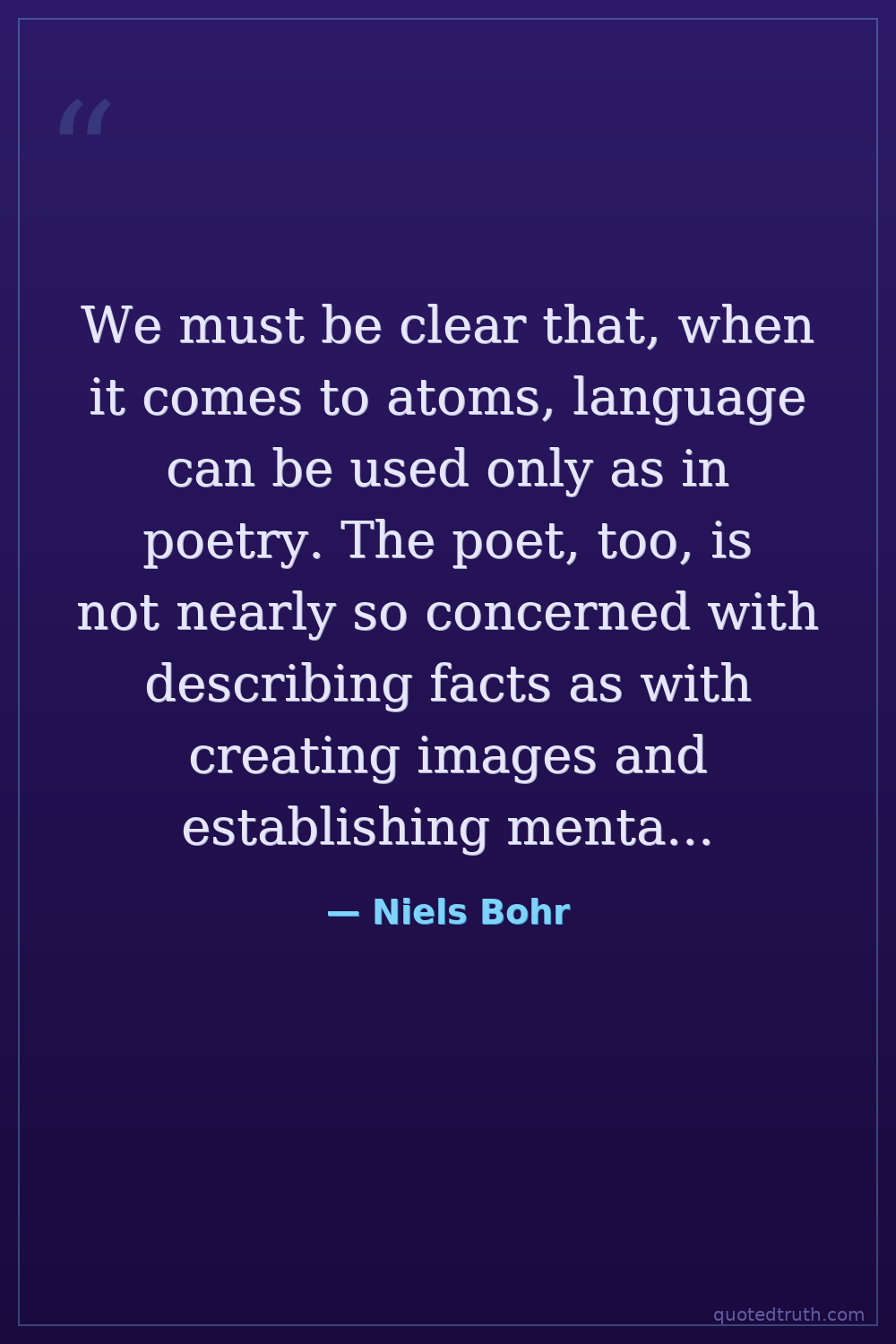
Bohr argues that atomic reality cannot be captured by ordinary, literal language. Just as poets use metaphor and imagery to evoke truths that plain description misses, physicists describing subatomic phenomena must rely on suggestive images and analogies rather than direct factual statements. The quantum world resists straightforward depiction, so scientists must accept that their words are approximations, tools for building intuition and connections rather than precise mirrors of an observable reality.
Relevance to Niels Bohr
Bohr pioneered the atomic model and the Copenhagen interpretation of quantum mechanics, wrestling daily with phenomena that defied classical description, like wave-particle duality and complementarity. He famously insisted that quantum concepts could only be discussed through classical language stretched to its limits. A philosophical physicist deeply influenced by Kierkegaard and William James, Bohr treated physics as partly an exercise in careful metaphor, making this poetic framing central to his scientific worldview.
The era
Bohr worked during the early twentieth-century quantum revolution, when experiments revealed atomic behavior that shattered Newtonian intuition. Between the 1913 Bohr model and the 1927 Copenhagen interpretation, physicists faced electrons that behaved as both particles and waves and outcomes that were inherently probabilistic. Classical vocabulary failed, sparking fierce debates with Einstein. Simultaneously, modernist poets like Eliot and Rilke were reinventing language to capture fractured realities, making Bohr's poetry analogy resonate with the broader intellectual moment.
AI-generated insights based on extensive research and information for context. Factual errors? Email [email protected].