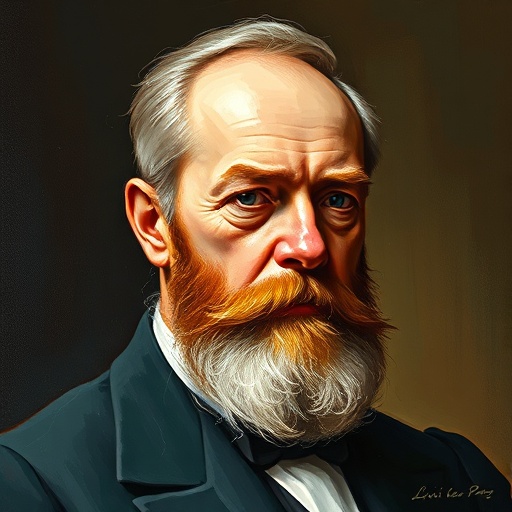
Louis Pasteur — "We must not forget that science, like all human activities, has its limits."
We must not forget that science, like all human activities, has its limits.
We must not forget that science, like all human activities, has its limits.
Click any product to generate a realistic preview. Up to 3 at a time.
* Initial load can take up to 90 seconds — revising the preview in another color is nearly instant.
"The greatest victory is that over oneself."
"In the fields of observation chance favors only the prepared mind."
"Do not let yourself be tainted with a barren skepticism."
"My dearest wife, I have arrived at the conclusion that the disease of silkworms is caused by a microbe."
"The day will come when the microbe is both friend and foe."
Attributed, a humble acknowledgment of the boundaries of scientific inquiry.
Date: Late 19th Century (approx.)
EducationalFound in 1 providers: grok
1 source checked
Science is powerful but not all-knowing. Like any human endeavor, it has boundaries—questions it cannot answer, problems it cannot solve, and ethical lines it should not cross. Recognizing these limits prevents arrogance and keeps researchers honest about what their work can and cannot deliver. It also leaves room for other ways of understanding the world, such as philosophy, ethics, or personal experience, alongside empirical inquiry.
Pasteur revolutionized medicine through germ theory and pasteurization, yet remained a devout Catholic who saw no conflict between faith and research. Having witnessed both triumphs—saving Joseph Meister from rabies in 1885—and failures in his lab, he understood science as a disciplined method, not a universal oracle. His humility here reflects a working scientist who knew how often hypotheses collapsed before experiments confirmed truth, and who respected domains beyond the microscope.
Pasteur worked during the late 19th century, when rapid advances in chemistry, biology, and medicine fueled a rising scientism that treated empirical research as humanity's ultimate authority. Positivists like Auguste Comte argued science would replace religion and metaphysics. Against this backdrop, Pasteur's caution pushed back on overreach, insisting that laboratory methods, however powerful, could not address every human question. Industrialization and Darwinian debates made the tension between faith, ethics, and science especially sharp.
AI-generated insights based on extensive research and information for context. Factual errors? Email [email protected].
Your cart is empty