What it means
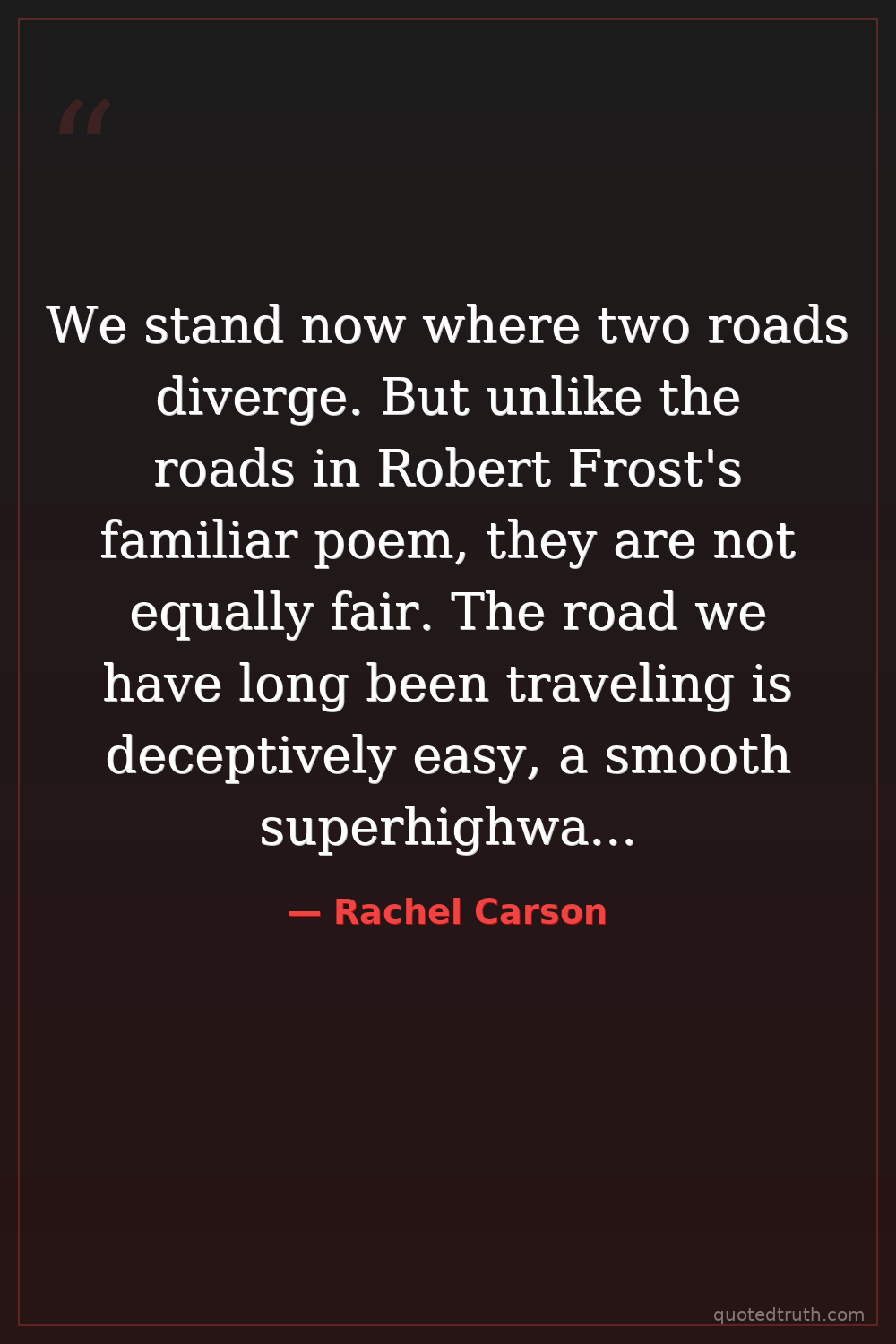
Humanity faces a genuine fork: one path is seductively easy, the industrial and chemical status quo that feels like progress but ends in collapse. Unlike Frost's poem, where both roads are inviting, Carson insists these choices are not morally equivalent. The comfortable road — industrial pesticide use, unchecked ecological exploitation — is a slow catastrophe dressed as convenience. The warning is civilizational: comfort and speed are not safety.
Relevance to Rachel Carson
Carson was a marine biologist trained at the Bureau of Fisheries who spent decades studying coastal ecosystems before writing Silent Spring, the book this quote opens. She documented DDT's obliteration of bird populations and food chains with scientific rigor. Crucially, she wrote it while privately battling breast cancer, knowing chemical industry giants would attack her personally. Her entire career — careful observation of what humans destroy — made this metaphor of a fatal road feel earned, not rhetorical.
The era
Silent Spring appeared in 1962 at peak American techno-optimism. DDT had been heralded since World War II as a miracle of chemistry; agribusiness and Monsanto marketed pesticides with almost no regulatory scrutiny. Cold War ideology linked scientific mastery of nature to national strength. Carson's book cracked that consensus, igniting a movement that produced the EPA in 1970 and the U.S. DDT ban in 1972 — consequences her 'two roads' metaphor essentially predicted and demanded.
AI-generated insights based on extensive research and information for context. Factual errors? Email [email protected].