What it means
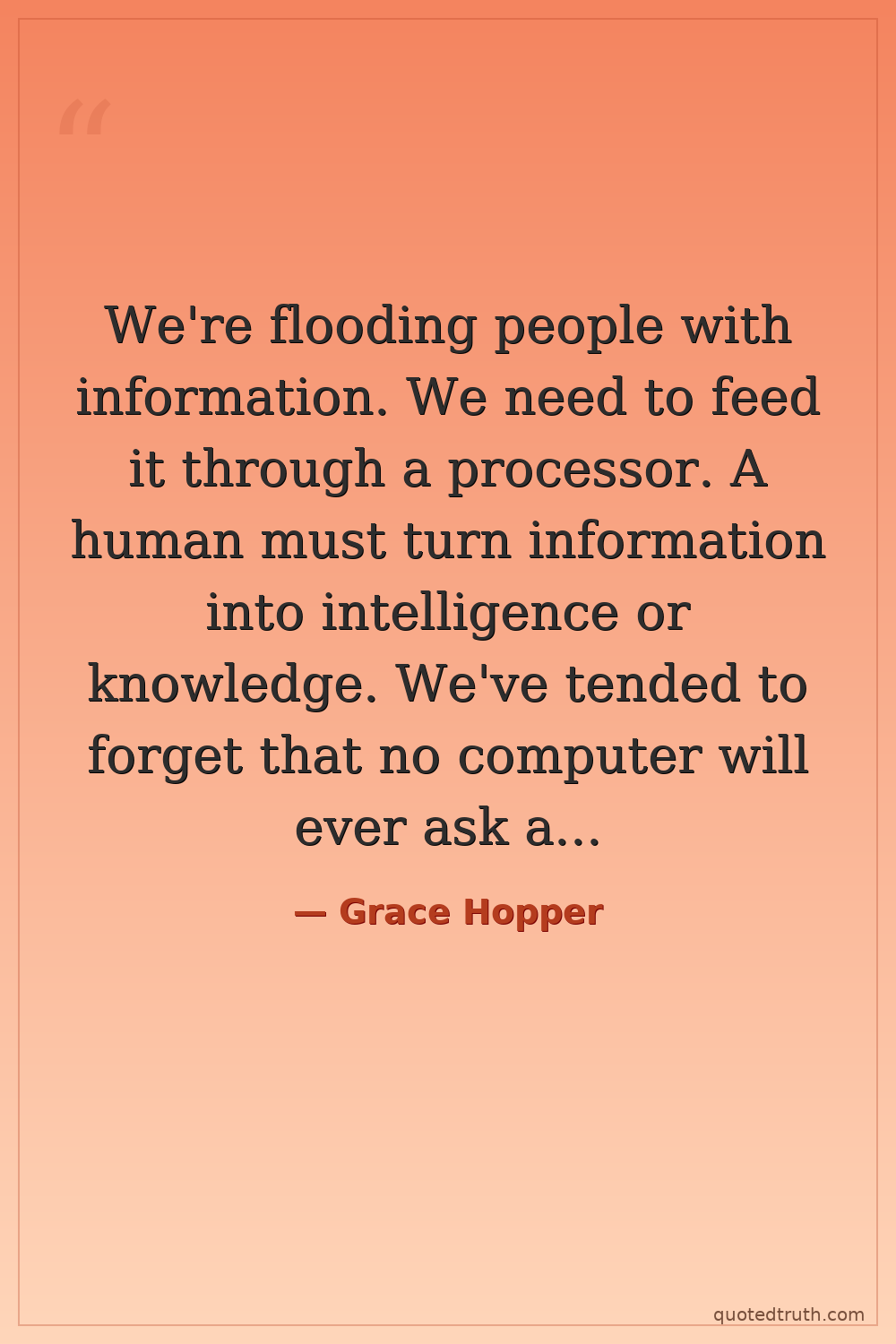
The quote distinguishes raw data from genuine understanding. Information alone is inert—it must be processed by a human mind to become intelligence or knowledge. The closing line carries the sharpest edge: computers only ever answer questions humans have already thought to ask. No algorithm generates original inquiry. Human curiosity—the act of asking entirely new questions—remains irreplaceable, even as machines grow more powerful at processing the ones we hand them.
Relevance to Grace Hopper
Hopper invented the first compiler and co-developed COBOL, understanding computing's limits from the inside out. A Navy Rear Admiral who spent decades translating machine logic for skeptical commanders, she knew every program begins with a human question. This conviction—that machines serve human intellect rather than replace it—drove her career-long mission to make computers accessible tools, not autonomous oracles. She had programmed the earliest systems by hand and earned the standing to say so.
The era
Hopper's career spanned the 1940s through 1980s, when computers grew from room-sized curiosities to business infrastructure. The 1970s–80s brought the first serious information-overload debates as mainframes and early networks produced more data than organizations could interpret. Simultaneously, AI researchers were making bold claims about machine cognition. Hopper, who had wired the earliest systems herself, was a credible voice insisting that raw data without human judgment was not progress—it was noise with a power cord.
AI-generated insights based on extensive research and information for context. Factual errors? Email [email protected].