Charles Darwin — "What a book a Devil's Chaplain might write on the clumsy, wasteful, blundering, …"
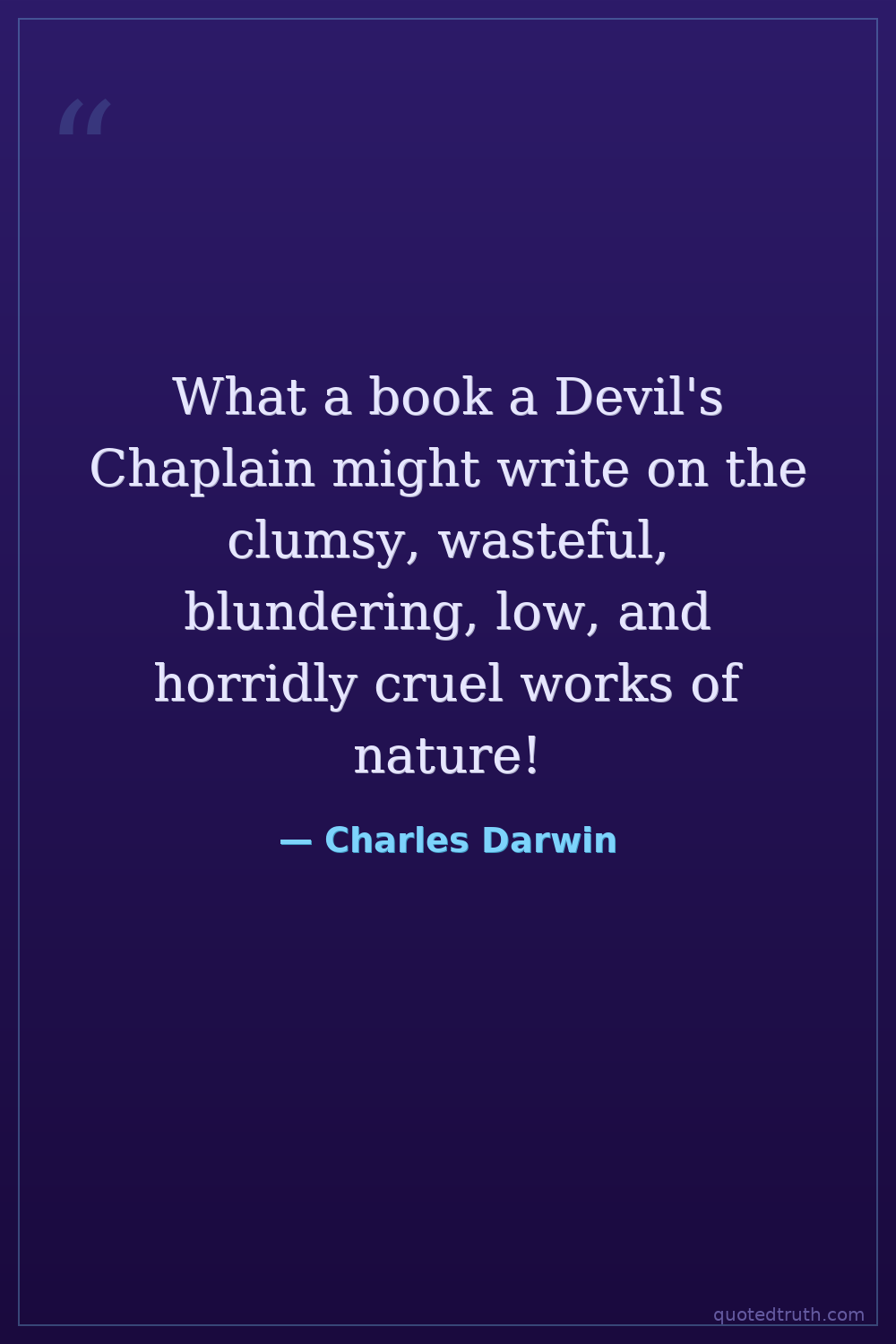
What a book a Devil's Chaplain might write on the clumsy, wasteful, blundering, low, and horridly cruel works of nature!
What a book a Devil's Chaplain might write on the clumsy, wasteful, blundering, low, and horridly cruel works of nature!
Click any product to generate a realistic preview. Up to 3 at a time.
* Initial load can take up to 90 seconds — revising the preview in another color is nearly instant.
"He who understands baboon would do more towards metaphysics than Locke."
"Man selects only for his own good: Nature only for that of the being which she tends."
"I am turned into a sort of machine for observing facts and grinding out generalizations."
"I have tried lately to read Shakespeare, and found it so intolerably dull that it nauseated me."
"Man tends to increase at a greater rate than his means of subsistence."
British naturalist whose On the Origin of Species (1859) established evolution by natural selection — the unifying theory of modern biology. Closely associated with Thomas Henry Huxley (his 'bulldog' public defender) and Alfred Russel Wallace (independent co-discoverer of natural selection). For an intellectual contrast, see William Paley, Anglican theologian and Natural Theology author (1743-1805) — Origin of Species is structurally a 400-page reply to Paley — Darwin admired Paley's watchmaker-argument as an undergraduate at Cambridge and then spent 20 years building the empirical machinery to displace him. The cleanest 'design argument vs natural selection' founding rebuttal in science.
The standard scholarly entry points to Charles Darwin's work: Janet Browne (Harvard, history of science) — Charles Darwin: Voyaging (1995) and The Power of Place (2002); Adrian Desmond (UCL, biographer) — Darwin: The Life of a Tormented Evolutionist (1991, with James Moore). These are the works graduate seminars cite when teaching Charles Darwin.
Found in 2 providers: gemini,grok
2 sources checked
Nature is not the serene, purposeful creation religious tradition imagined — it's messy, inefficient, and brutal. Parasites that blind children, predators that consume prey alive, and mass extinctions reveal no divine craftsmanship. Natural selection optimizes only for survival and reproduction, not beauty or mercy. Evolution's engine runs on waste, failure, and suffering on an unimaginable scale, and any honest account of it would read as an indictment, not a hymn.
Darwin trained as a theologian at Cambridge before becoming a naturalist, and his faith eroded as he confronted evolution's brutal logic. The death of his beloved daughter Annie in 1851 devastated him spiritually. He wrote to Asa Gray that the ichneumon wasp — which paralyzes caterpillars alive as larval food — made him doubt any benevolent God. His own theory forced him to see nature's suffering not as purposeful design but as mechanistic and wholly indifferent.
Darwin wrote this in 1856, when natural theology still dominated educated thought. William Paley's argument that nature's complexity proved a divine Designer was required reading at Cambridge. Victorian Britain expected science to confirm God's handiwork, and nature was widely portrayed as harmonious and purposeful. Darwin's theory demolished that view, replacing the benevolent Creator with blind, wasteful natural selection — anticipating the crisis of faith that swept Victorian England after On the Origin of Species appeared in 1859.
AI-generated insights based on extensive research and information for context. Factual errors? Email [email protected].
Your cart is empty