Stephen Hawking — "What makes human beings unique? Some say it's language or tools. Others say it's…"
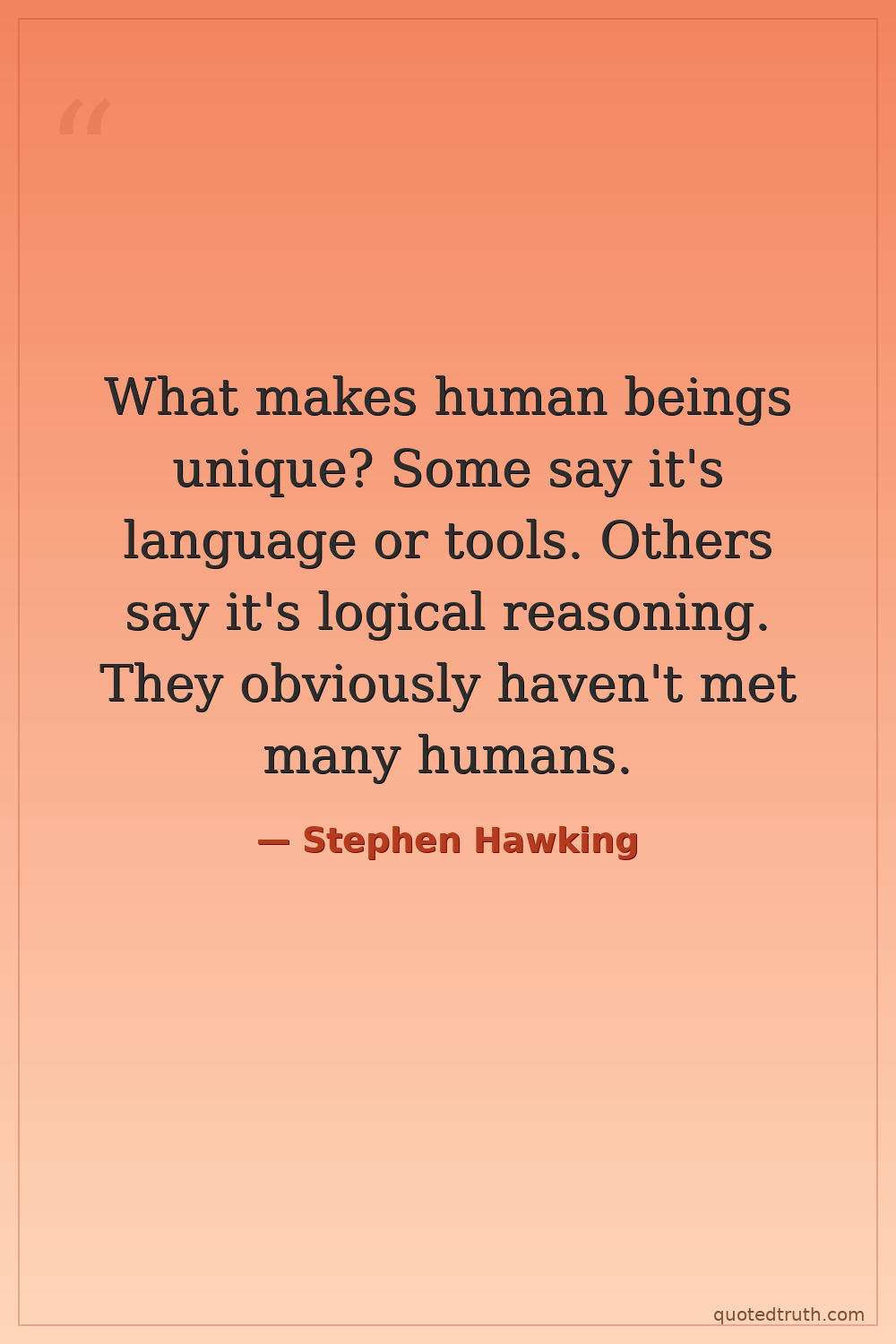
What makes human beings unique? Some say it's language or tools. Others say it's logical reasoning. They obviously haven't met many humans.
What makes human beings unique? Some say it's language or tools. Others say it's logical reasoning. They obviously haven't met many humans.
Click any product to generate a realistic preview. Up to 3 at a time.
* Initial load can take up to 90 seconds — revising the preview in another color is nearly instant.
"We are very, very small, but we are also very, very smart."
"I believe the simplest explanation is, there is no God. No one created the universe and no one directs our fate. This leads me to a profound realization that there probably is no heaven and no afterli…"
"It is a waste of time to be angry about my disability. One has to get on with life and I haven't done badly. People won't have time for you if you are always angry or complaining."
"The universe is not just out there, it's in here."
"We are close to the tipping point, where global warming becomes irreversible. Trump's action could push the Earth over the brink, to become like Venus, with a temperature of 250 degrees [Celsius], and…"
British theoretical physicist whose Hawking radiation work and A Brief History of Time (1988) brought black-hole physics to a mass audience while he lived with ALS for 55 years. Closely associated with Roger Penrose (his collaborator on singularity theorems) and Carl Sagan (fellow popularizer who wrote Brief History's foreword). For an intellectual contrast, see William Lane Craig, American philosopher of religion — Craig's Kalam cosmological argument depends on the Big Bang requiring a divine first cause; Hawking's no-boundary proposal was specifically designed to remove the moment that would require one — the cleanest cosmology-vs-natural-theology contrast in modern thought.
During an announcement of his Starshot Project for interstellar travel
Date: 2016
Life & AgingFound in 1 providers: gemini
1 source checked
This quote humorously dismantles traditional answers to a classic philosophical question about human uniqueness. Language, tools, and logical reasoning are the standard candidates—but Hawking's punchline skewers all of them. The real joke is that logical reasoning, supposedly humanity's crowning achievement, is demonstrably absent in most people's daily behavior. It's sardonic wit aimed at human pretension and irrationality, suggesting we're far less exceptional than we like to believe.
Hawking spent his career probing the universe's deepest mysteries—black holes, the Big Bang, the nature of time—requiring rigorous logical reasoning few humans actually apply. Yet he was equally famous for sharp, self-deprecating wit. Living with ALS from age 21, he observed human behavior across decades, watching irrationality dominate politics, religion, and even science. This quip reflects both his scientist's frustration with anti-intellectualism and his refusal to place humanity on an unearned pedestal.
Hawking's career spanned the Cold War through the rise of social media, a period defined by simultaneous scientific breakthroughs and spectacular failures of public reasoning—climate denial, anti-vaccination movements, nuclear brinkmanship, and resurgent populist anti-intellectualism. Humans had landed on the Moon and mapped the genome yet rejected basic logic on a mass scale. The gap between humanity's cognitive potential and its actual behavior had never been more visibly absurd.
AI-generated insights based on extensive research and information for context. Factual errors? Email [email protected].
Your cart is empty