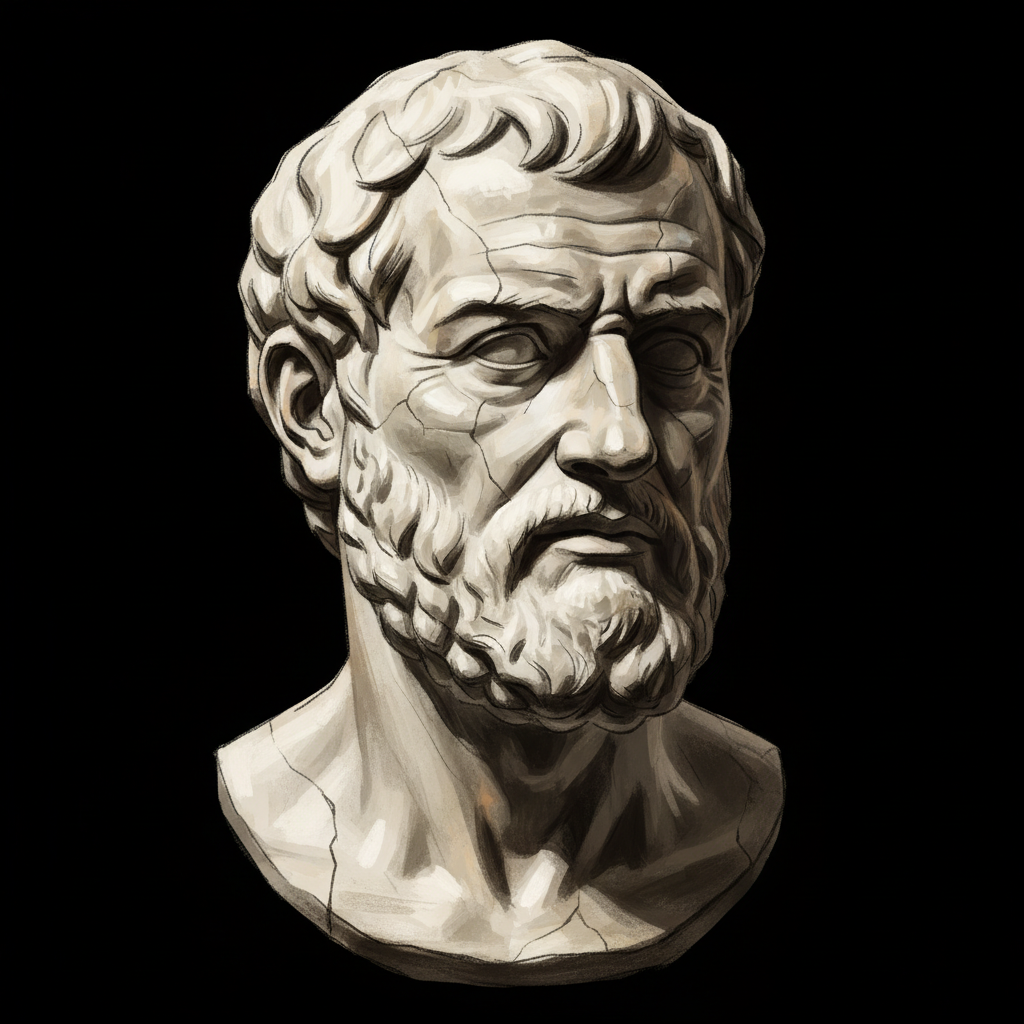
Epictetus — "What need is there to weep over parts of life? The whole of it calls for tears."
What need is there to weep over parts of life? The whole of it calls for tears.
What need is there to weep over parts of life? The whole of it calls for tears.
Click any product to generate a realistic preview. Up to 3 at a time.
* Initial load can take up to 90 seconds — revising the preview in another color is nearly instant.
"It is impossible for a man to begin to learn what he thinks he already knows."
"It is better to starve to death in a calm and tranquil state than to live in abundance with vexation."
"If you wish to be good, know that you are bad."
"When you are going to meet with any person, and particularly one of those who are considered to be great, represent to yourself what Socrates or Zeno would have done in such a case."
"If you want to improve, be content to be thought foolish and stupid with regard to external things."
Greek Stoic philosopher and former slave whose Discourses (recorded by his student Arrian) shaped Marcus Aurelius and the modern Stoic revival. Closely associated with Seneca (earlier Roman Stoic) and Marcus Aurelius (his student-by-text on the imperial throne). For an intellectual contrast, see Epicurus, Greek philosopher of pleasure-as-tranquility — the Stoic-Epicurean rivalry was the central philosophical debate of the Hellenistic and Roman world for 400 years — Epicurean materialist hedonism is the precise alternative the Stoic discipline-of-acceptance was built against.
The standard scholarly entry points to Epictetus's work: A.A. Long (UC Berkeley, Classics) — Epictetus: A Stoic and Socratic Guide to Life (2002); Pierre Hadot (Collège de France) — Philosophy as a Way of Life (1995); Anthony R. Birley (Manchester, Roman historian) — Marcus Aurelius (1987) — the standard biography of Epictetus's most famous student. These are the works graduate seminars cite when teaching Epictetus.
Your cart is empty