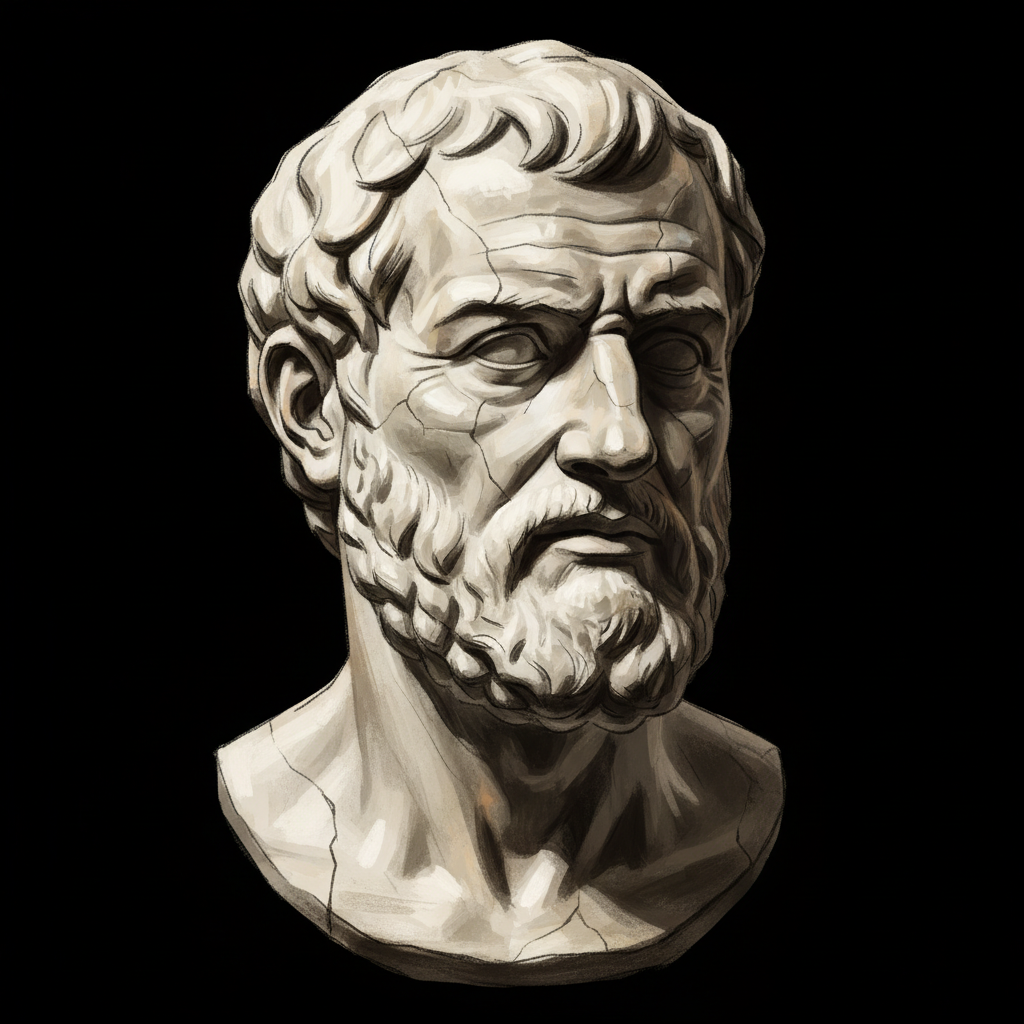
Epictetus — "Whoever is not content with what he has, would not be content with what he wishe…"
Whoever is not content with what he has, would not be content with what he wishes to have.
Whoever is not content with what he has, would not be content with what he wishes to have.
Click any product to generate a realistic preview. Up to 3 at a time.
* Initial load can take up to 90 seconds — revising the preview in another color is nearly instant.
"If you always remember that God stands by you, and inspects your acts, whether in soul or body, you will not err either in your prayers or in your acts."
"You are a little soul carrying around a corpse."
"No great thing is created suddenly, any more than a bunch of grapes or a fig. If you tell me that you desire a fig, I answer you that there must be time. Let it first blossom, then bear fruit, then ri…"
"The more we value things outside our control, the less control we have."
"A man is not hurt by what happens to him, but by his opinion of what happens to him."
Greek Stoic philosopher and former slave whose Discourses (recorded by his student Arrian) shaped Marcus Aurelius and the modern Stoic revival. Closely associated with Seneca (earlier Roman Stoic) and Marcus Aurelius (his student-by-text on the imperial throne). For an intellectual contrast, see Epicurus, Greek philosopher of pleasure-as-tranquility — the Stoic-Epicurean rivalry was the central philosophical debate of the Hellenistic and Roman world for 400 years — Epicurean materialist hedonism is the precise alternative the Stoic discipline-of-acceptance was built against.
The standard scholarly entry points to Epictetus's work: A.A. Long (UC Berkeley, Classics) — Epictetus: A Stoic and Socratic Guide to Life (2002); Pierre Hadot (Collège de France) — Philosophy as a Way of Life (1995); Anthony R. Birley (Manchester, Roman historian) — Marcus Aurelius (1987) — the standard biography of Epictetus's most famous student. These are the works graduate seminars cite when teaching Epictetus.
Your cart is empty