What it means
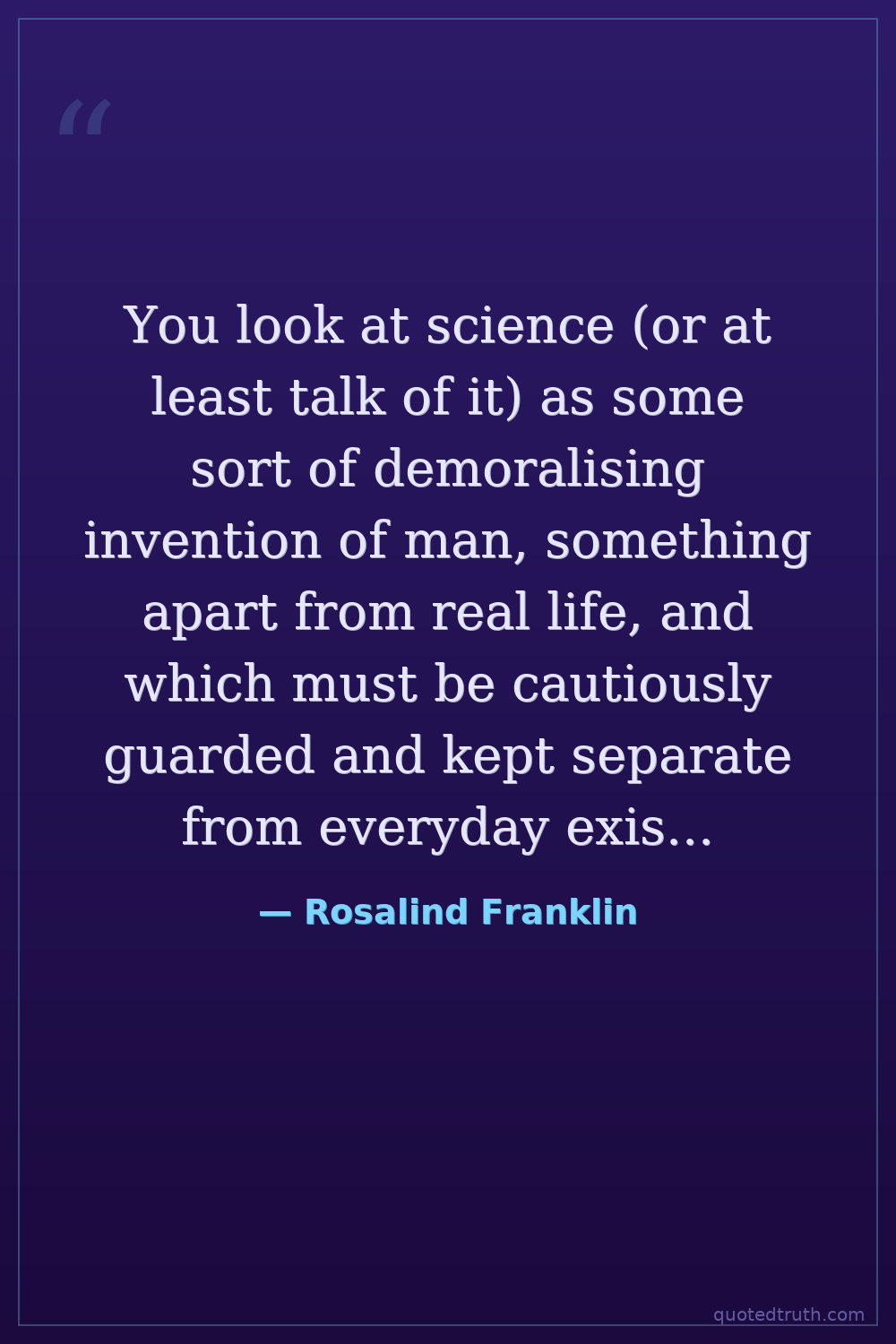
Franklin pushes back against treating science as some intimidating, corrupting force that belongs locked away from ordinary living. She argues the opposite: scientific thinking and daily existence are inseparable. Science isn't a sterile specialty practiced in isolation by suspicious experts; it's a way of understanding the world that belongs woven into how people cook, work, raise children, and make decisions. Walling it off impoverishes both science and the lives of those who avoid it.
Relevance to Rosalind Franklin
Franklin lived this conviction. As the X-ray crystallographer whose Photo 51 cracked DNA's double helix, she pursued rigorous lab work while rejecting the era's notion that science was an elite male priesthood. Raised in a prominent Anglo-Jewish family that valued public service, she wrote this in a letter to her father defending her choice of chemistry. Her career at King's College and Birkbeck reflects someone who refused to treat research as separate from civic duty or human meaning.
The era
Franklin wrote during the 1940s-50s, when science had just delivered the atomic bomb, penicillin, and radar, leaving the public awed and uneasy. Postwar Britain debated whether scientific power was dehumanizing, and traditional voices treated labs as morally suspect. Women were largely shut out of serious research, and figures like her colleague Maurice Wilkins worked in institutions that barred women from common rooms. Defending science as ordinary, accessible, and human was genuinely radical.
AI-generated insights based on extensive research and information for context. Factual errors? Email [email protected].