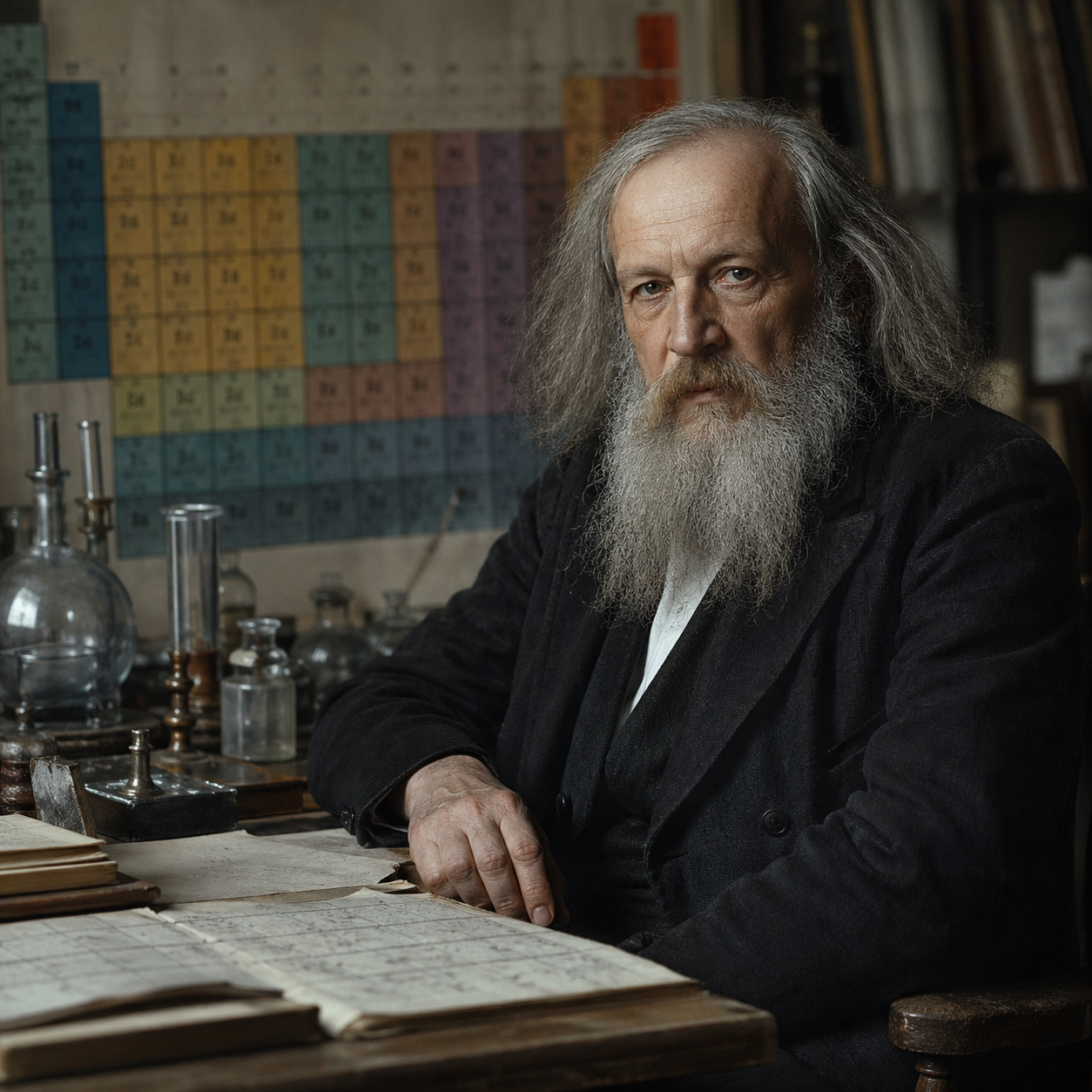
Dmitri Mendeleev — "No one nor anything can silence me."
No one nor anything can silence me.
No one nor anything can silence me.
Click any product to generate a realistic preview. Up to 3 at a time.
* Initial load can take up to 90 seconds — revising the preview in another color is nearly instant.
"In science we must all submit not to what seems to us attractive from one point of view or another, but to what represents an agreement between theory and experiment."
"Science which deals with the infinite is itself without bounds."
"To conceive, understand, and grasp the whole symmetry of the scientific edifice, including its unfinished portions, is equivalent to tasting that enjoyment only conveyed by the highest forms of beauty…"
"It is the function of the scientist to do 3 things: to observe, to generalize, and to predict."
"I have been called a charlatan, a madman, and a dreamer, but I have always pursued the truth."
A general statement reflecting his resolute and independent character, widely attributed to him.
Date: Undetermined, but reflects his personality throughout his career.
GeneralFound in 1 providers: gemini
1 source checked
The speaker declares absolute resolve: no person, institution, or force can suppress their voice or halt their work. It is a statement of defiance against censorship, intimidation, and external pressure, insisting that truth and personal conviction will continue to be expressed regardless of who opposes them or what consequences follow. It frames silence as a choice that only the speaker can make.
Mendeleev repeatedly clashed with authority: the Tsarist government blocked his election to the Russian Academy of Sciences in 1880, and he resigned his St. Petersburg University chair in 1890 after officials refused to forward a student petition. Despite political friction over his liberal views, divorce, and reform advocacy, he kept publishing on chemistry, economics, and industry, embodying this refusal to be muzzled by bureaucracy or clergy.
Late 19th-century Imperial Russia operated under Tsarist censorship, Orthodox Church influence over morality, and tight state control of universities. Intellectuals faced surveillance, exile, and career blacklisting for dissent, while the 1860s reforms had raised expectations that the autocracy kept rolling back. Scientists who spoke on policy, education, or social questions risked official retaliation, making a public vow of unsilenceability a pointed political stance, not mere rhetoric.
AI-generated insights based on extensive research and information for context. Factual errors? Email [email protected].
Your cart is empty