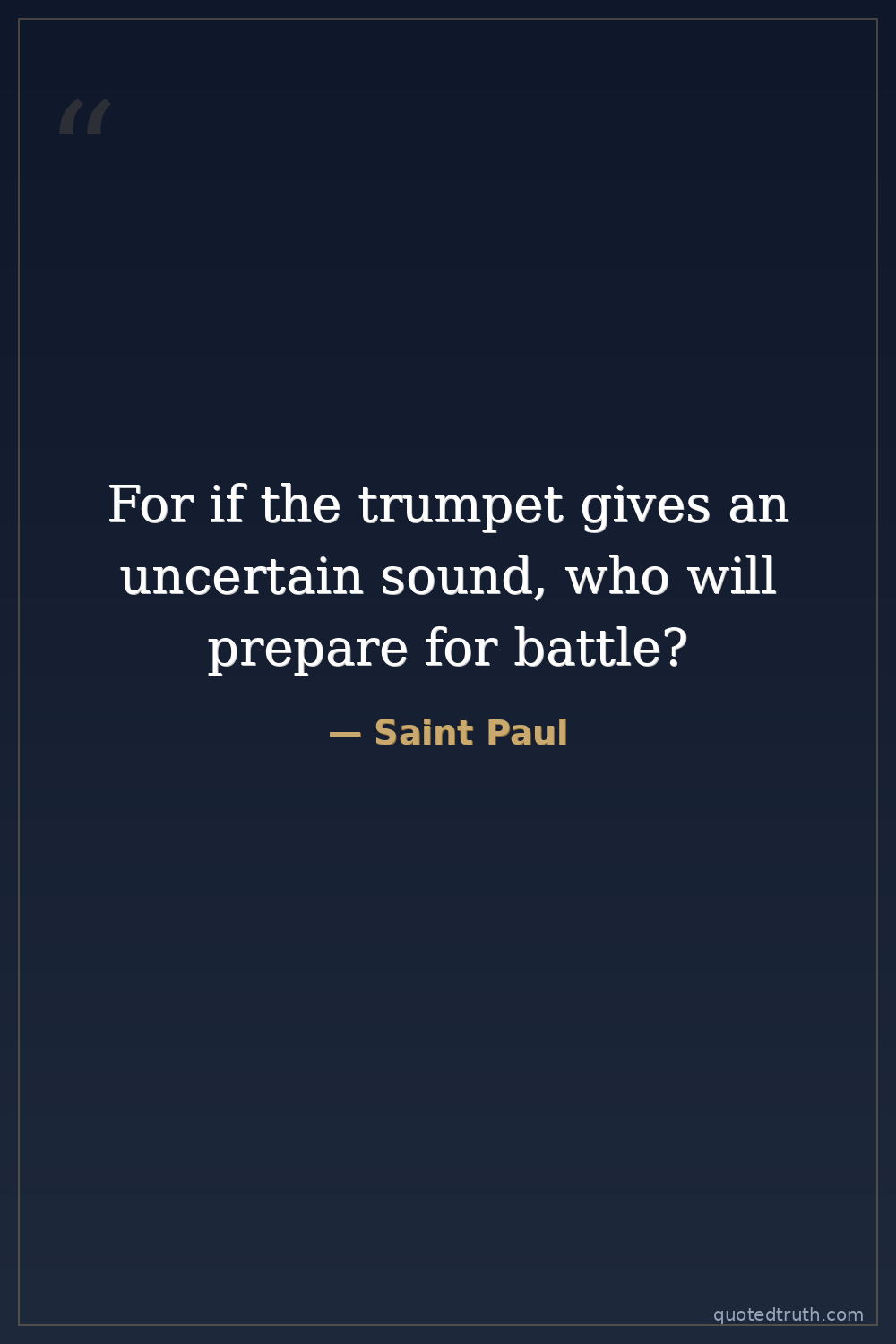
Saint Paul — "For if the trumpet gives an uncertain sound, who will prepare for battle?"
For if the trumpet gives an uncertain sound, who will prepare for battle?
For if the trumpet gives an uncertain sound, who will prepare for battle?
Click any product to generate a realistic preview. Up to 3 at a time.
* Initial load can take up to 90 seconds — revising the preview in another color is nearly instant.
"Not all of those who descend from Israel are Israel."
"For the message of the cross is foolishness to those who are perishing, but to us who are being saved it is the power of God."
"For though I be free from all men, yet have I made myself servant unto all, that I might gain the more."
"Do not be deceived: ‘Bad company ruins good morals.’"
"For the wages of sin is death; but the gift of God is eternal life through Jesus Christ our Lord."
Found in 1 providers: grok
1 source checked
Clear communication is essential when you want people to act. A muddled or ambiguous signal leaves listeners confused and unprepared, so they fail to respond appropriately. If you want followers, teammates, or an audience to move in a specific direction, your message must be unmistakable. Vague instructions produce vague results; decisive, intelligible guidance produces decisive action. Leaders and teachers bear responsibility for making their meaning plain.
Paul wrote this to the Corinthians while arguing that spiritual gifts like speaking in tongues needed interpretation to benefit the church. As a trained Pharisee turned missionary, he valued intelligible teaching over ecstatic display. His entire career—planting churches across the Roman world through letters and sermons—depended on communicating complex theology clearly to Greeks, Jews, and Romans. Clarity was his craft, not a metaphor.
In the first-century Roman world, trumpets (the salpinx) were battlefield command instruments; specific calls meant advance, retreat, or regroup. Paul's audience in Corinth knew this viscerally from Roman legions stationed across the empire. His era also saw the early church wrestling with chaotic worship practices, including unintelligible glossolalia, amid a Greco-Roman culture that prized rhetorical precision in the agora and public assembly.
AI-generated insights based on extensive research and information for context. Factual errors? Email [email protected].
Your cart is empty