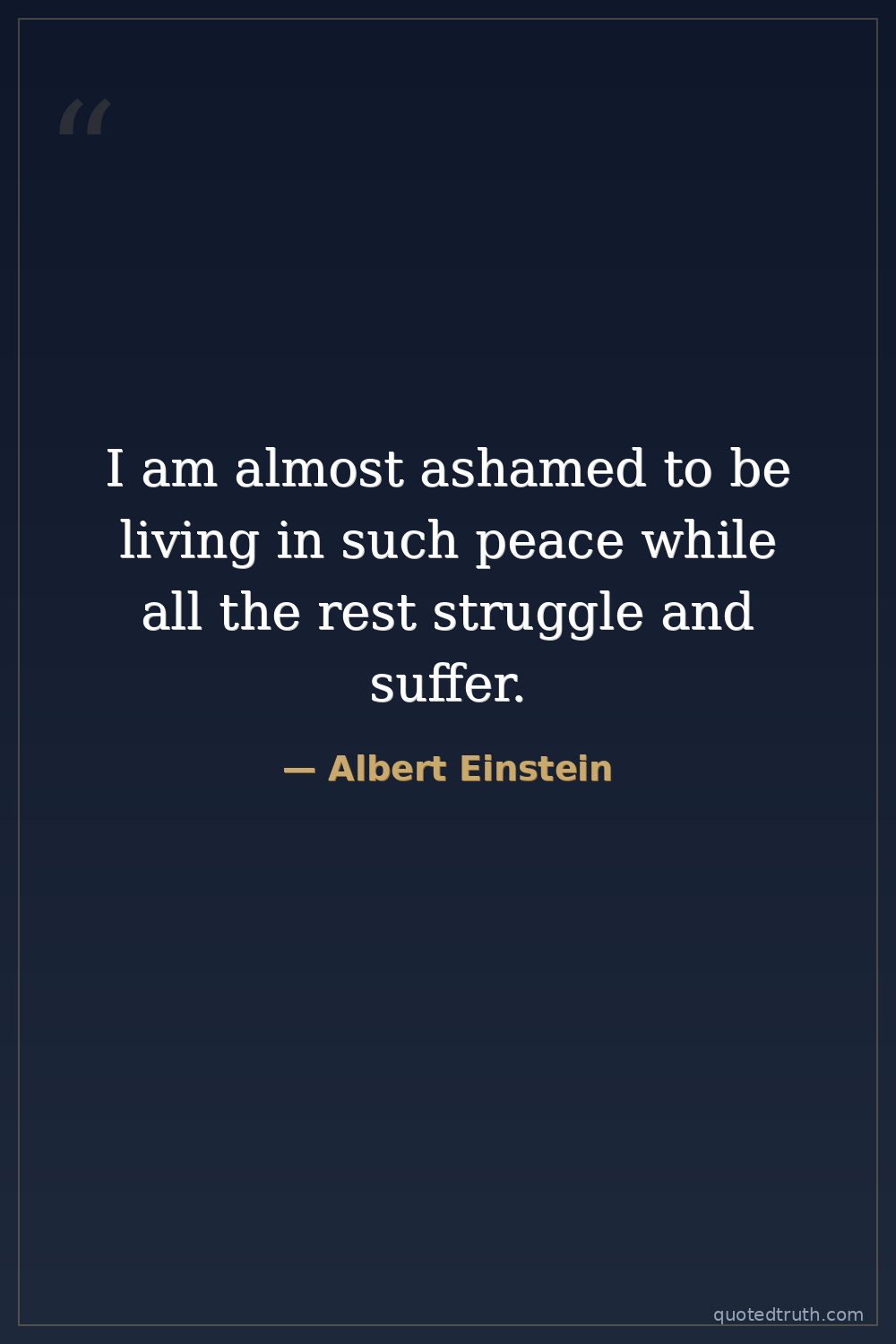
Albert Einstein — "I am almost ashamed to be living in such peace while all the rest struggle and s…"
I am almost ashamed to be living in such peace while all the rest struggle and suffer.
I am almost ashamed to be living in such peace while all the rest struggle and suffer.
Click any product to generate a realistic preview. Up to 3 at a time.
* Initial load can take up to 90 seconds — revising the preview in another color is nearly instant.
"God does not play dice with the universe."
"Marriage is the unsuccessful attempt to make something lasting out of an incident."
"Reading, after a certain age, diverts the mind too much from its creative pursuits. Any man who reads too much and uses his own brain too little falls into lazy habits of thinking."
"I am by heritage a Jew, by citizenship a Swiss, and by temperament a human being, and only a human being, without any special attachment to any state or national entity whatsoever."
"The difference between stupidity and genius is that genius has its limits."
From a letter, reflecting on his privilege as a refugee in Princeton during a time of global strife.
Date: Post-1933
Life & DeathFound in 1 providers: gemini
1 source checked
The speaker feels guilt over their own comfort and calm while others around them endure hardship, conflict, and pain. It is an expression of moral discomfort with privilege — an acknowledgment that personal peace feels unearned or even wrong when suffering is widespread. It reflects empathy stretched to the point of shame, a conscience that cannot fully rest while injustice persists elsewhere.
Einstein, a Jewish pacifist who fled Nazi Germany in 1933, lived with acute awareness of persecution he escaped while others did not. His prominence gave him safety and a platform unavailable to millions. He channeled this guilt into vocal anti-war activism, support for civil rights, and refugee advocacy — actions driven by the same moral unease this quote expresses. His conscience was inseparable from his public life.
Einstein lived through two World Wars, the Holocaust, and the early Cold War — eras defined by mass death, displacement, and ideological violence. The rise of fascism in Europe, the atomic bombings he indirectly enabled through E=mc², and the suffering of Jewish communities worldwide made comfortable intellectual life feel morally fraught. His guilt was historically grounded, not abstract — millions genuinely were struggling and dying while he theorized in relative safety.
AI-generated insights based on extensive research and information for context. Factual errors? Email [email protected].
Your cart is empty