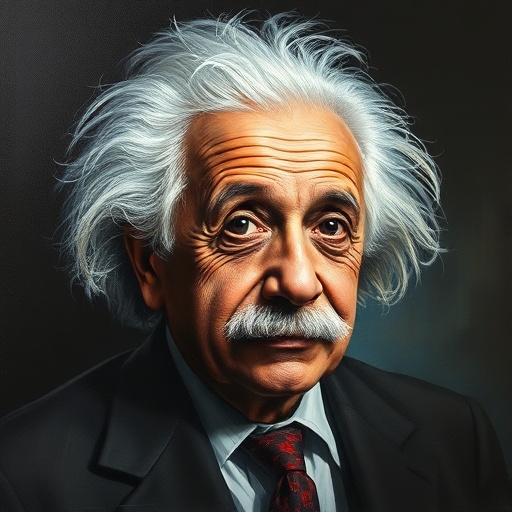
Albert Einstein — "I want to go when I want. It is tasteless to prolong life artificially. I have d…"
I want to go when I want. It is tasteless to prolong life artificially. I have done my share, it is time to go. I will do it elegantly.
I want to go when I want. It is tasteless to prolong life artificially. I have done my share, it is time to go. I will do it elegantly.
Click any product to generate a realistic preview. Up to 3 at a time.
* Initial load can take up to 90 seconds — revising the preview in another color is nearly instant.
"The world is a dangerous place to live; not because of the people who are evil, but because of the people who don't do anything about it."
"It is not that I'm so smart, but I stay with problems longer."
"I do not believe in the God of theology who rewards good and punishes evil."
"The Negroes are certainly more primitive than us, but not in a negative sense."
"I see only with deep regret that God punishes so many of His children for their numerous stupidities."
His refusal of life-saving surgery after experiencing an abdominal aortic aneurysm.
Date: 1955
WisdomFound in 1 providers: gemini
1 source checked
This quote asserts the right to die on one's own terms, rejecting medical intervention that merely delays the inevitable. Einstein declares he has contributed enough and chooses to exit with dignity rather than submit to procedures that prolong suffering without purpose. It is a statement about autonomy, self-awareness, and the difference between living meaningfully and simply remaining alive through technological persistence.
Einstein spoke these words in April 1955 when surgeons offered surgery for his ruptured abdominal aortic aneurysm. He refused. Known for ruthless intellectual honesty and contempt for pretension, he applied that same clarity to his own death. Having revolutionized physics with relativity and the photoelectric effect, he genuinely believed his productive life was complete. His lifelong distaste for vanity and performance extended to how he chose to die.
By 1955, postwar medicine was rapidly expanding surgical capability, and extending life through intervention was becoming normalized. The ethics of dying with dignity had no established framework yet. Einstein also lived under the shadow of the atomic bomb — technology he helped enable — giving him a complex relationship with science's power over life and death. His refusal of surgery was implicitly a rebuke of the era's growing faith in technological solutions to natural ends.
AI-generated insights based on extensive research and information for context. Factual errors? Email [email protected].
Your cart is empty