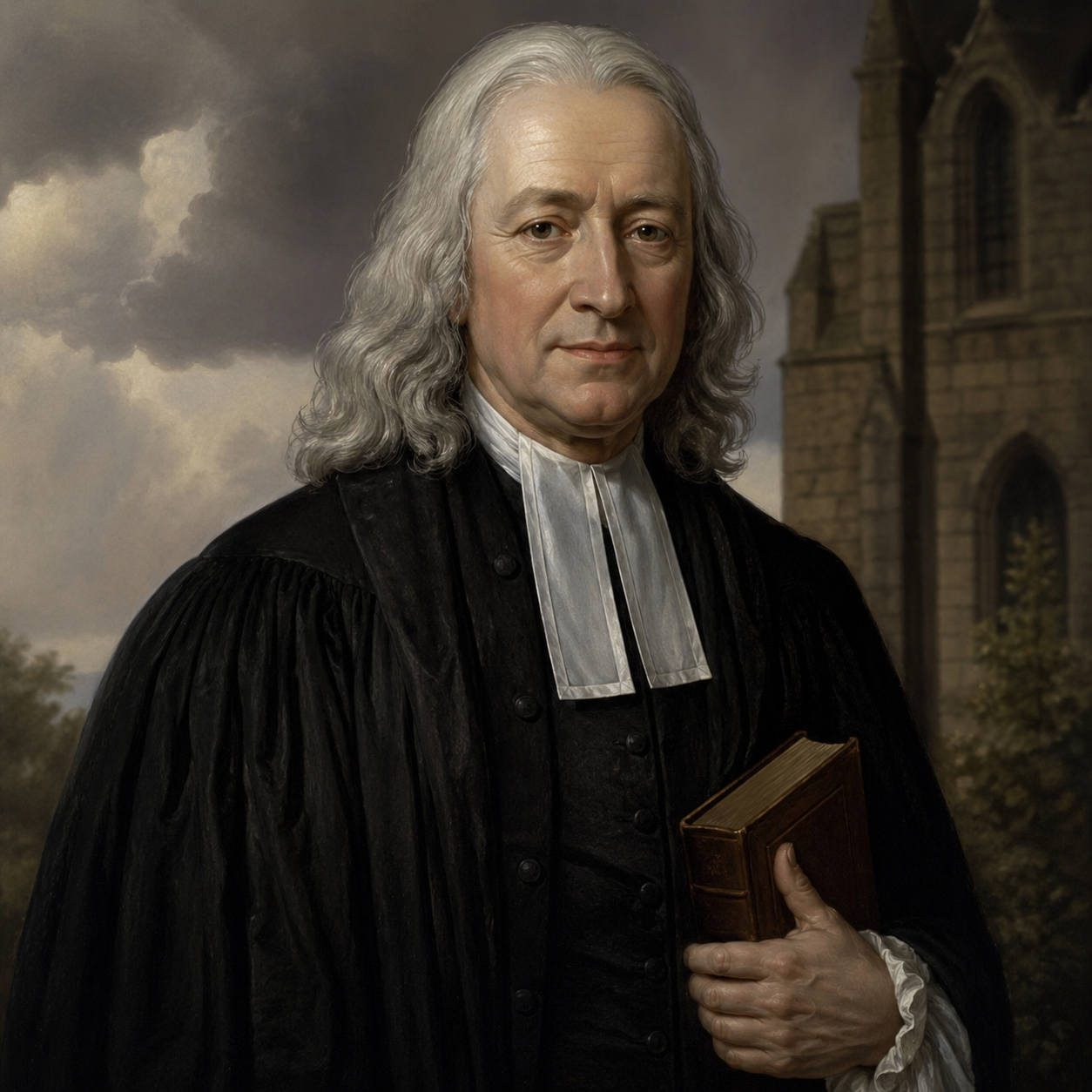
John Wesley — "I do not believe that there is any woman in the world who has an equal share of …"
I do not believe that there is any woman in the world who has an equal share of both understanding and grace with my sister Martha.
I do not believe that there is any woman in the world who has an equal share of both understanding and grace with my sister Martha.
Click any product to generate a realistic preview. Up to 3 at a time.
* Initial load can take up to 90 seconds — revising the preview in another color is nearly instant.
"I have often thought, that if I were to choose a companion to travel with, it should be one that would talk little."
"I am not afraid of any man, but I am afraid of God."
"I offered Christ to the Negroes in Antigua. I offered him to the slaves. I offered him to the very dregs of the people."
"Holy tempers are the very essence of religion."
"Holiness of heart and life is the one great end of all our preaching."
English Anglican cleric and founder of Methodism, whose open-air preaching and class-meeting structure created the largest 18th-century evangelical revival. Closely associated with Charles Wesley (his hymn-writing brother) and George Whitefield (early co-revivalist, later doctrinal opponent). For an intellectual contrast, see George Whitefield, Calvinist evangelical revivalist — Whitefield's predestinarian Calvinism vs Wesley's free-grace Arminian theology split the early Methodist movement permanently in the 1739-41 break. The founding evangelical Calvinist-Arminian schism — the two parallel evangelical traditions American Christianity descends from.
Found in 1 providers: grok
1 source checked
Wesley is declaring his sister Martha intellectually and spiritually exceptional, claiming no other woman combines her level of rational understanding with genuine Christian grace. He is making an absolute comparative judgment, elevating her above all women he has encountered or known. The statement reflects deep personal admiration rooted in both cognitive respect and religious esteem, treating intellect and piety as the two supreme measures of a person's worth.
Wesley came from a remarkable family—his mother Susanna Wesley educated all her children rigorously, including the daughters, which was unusual for the era. Martha Wesley was among his highly educated sisters. As Methodism's founder, Wesley valued both intellectual engagement and sanctified character as inseparable virtues. His high regard for Martha reflects his broader belief in women's spiritual and intellectual capacity, and his lifelong close bond with his siblings shaped his theology and personal correspondence.
In 18th-century Britain, women's intellectual capacity was routinely dismissed or confined to domestic roles. Formal education for women was rare and often discouraged. Wesley's statement is striking because it takes female intellect and spiritual grace entirely seriously as measurable, comparable qualities. Methodist culture, which Wesley shaped, notably empowered women as class leaders and even preachers—making this personal tribute consistent with a movement that challenged prevailing gender hierarchies within Protestant Christianity.
AI-generated insights based on extensive research and information for context. Factual errors? Email [email protected].
Your cart is empty