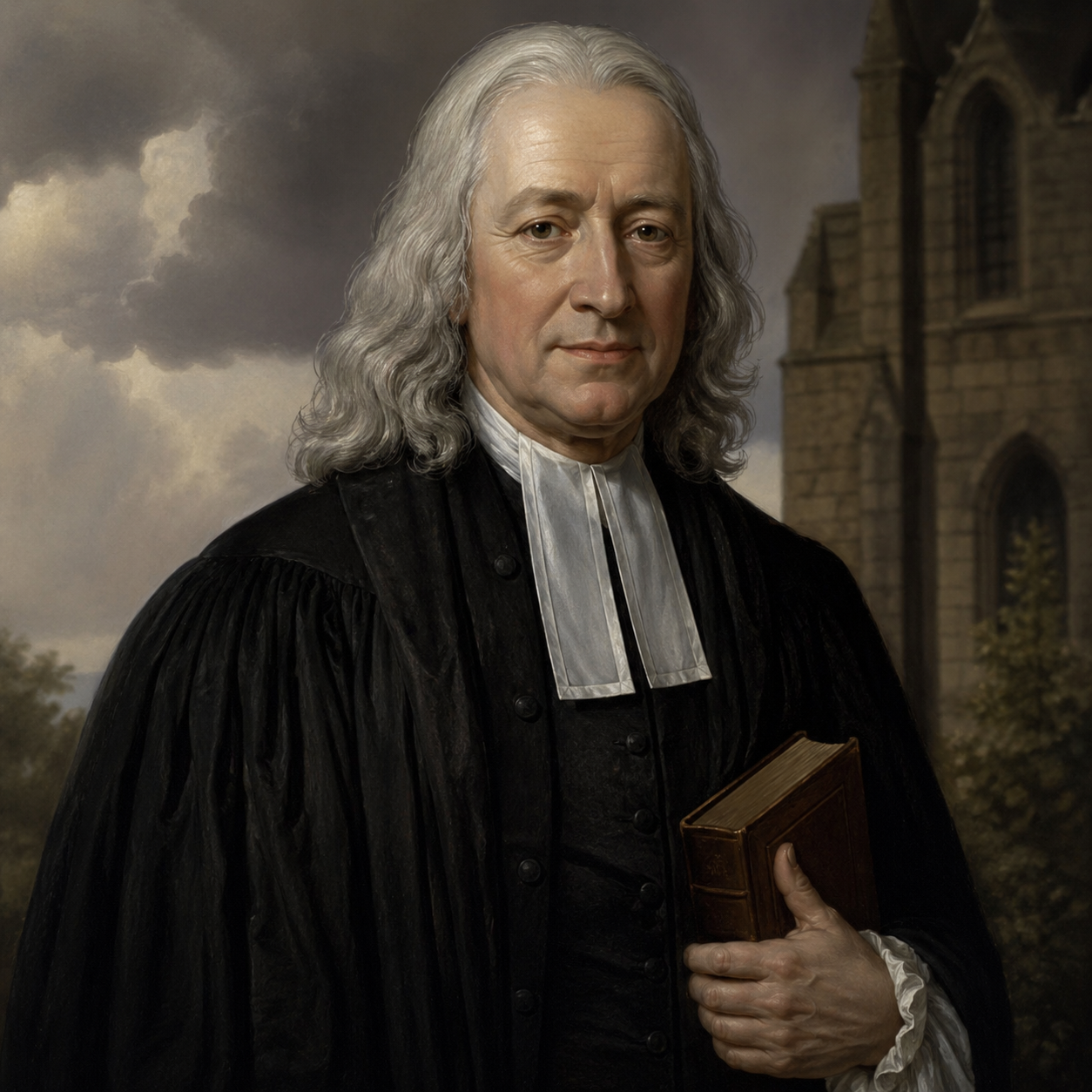
John Wesley — "It is not enough to be zealous; we must be zealous for God."
It is not enough to be zealous; we must be zealous for God.
It is not enough to be zealous; we must be zealous for God.
Click any product to generate a realistic preview. Up to 3 at a time.
* Initial load can take up to 90 seconds — revising the preview in another color is nearly instant.
"As to my own comfort, I know not that I ever felt any, from the time I was born."
"What is the Lord’s Supper? It is a feast upon a sacrifice."
"I have no doubt that God will save all who are sincere, whether they believe in Christ or not."
"I am as much a High-Churchman as ever I was. And I hope to live and die so."
"I found myself much out of order, and apprehended that my end was near. I had no fear of death, but I was concerned for the cause of God, which I apprehended would suffer by my removal."
English Anglican cleric and founder of Methodism, whose open-air preaching and class-meeting structure created the largest 18th-century evangelical revival. Closely associated with Charles Wesley (his hymn-writing brother) and George Whitefield (early co-revivalist, later doctrinal opponent). For an intellectual contrast, see George Whitefield, Calvinist evangelical revivalist — Whitefield's predestinarian Calvinism vs Wesley's free-grace Arminian theology split the early Methodist movement permanently in the 1739-41 break. The founding evangelical Calvinist-Arminian schism — the two parallel evangelical traditions American Christianity descends from.
Found in 1 providers: grok
1 source checked
Passion alone is not enough — what matters is where that passion is aimed. Wesley warns that someone can be intensely devoted to a cause, a church institution, or even religious rules without genuinely centering God. True zeal must be God-directed: motivated by love for God, aligned with God's purposes, not merely human enthusiasm wearing a religious label. Misdirected fervor, however intense, misses the point entirely.
Wesley himself embodied ferocious energy: he preached over 40,000 sermons and rode 250,000 miles on horseback. But his 1738 Aldersgate conversion — where he felt his heart 'strangely warmed' — convinced him that effort without genuine God-centeredness was empty religion. His Oxford Holy Club had been mocked as overly rigorous; he understood firsthand how zeal could become mere performance. Methodist theology centered on inward transformation, not outward religious activity alone.
Eighteenth-century Britain saw the Enlightenment eroding traditional faith while the Church of England had grown institutionally comfortable, often serving the wealthy and ignoring the poor. Religious 'enthusiasm' was a term of mockery. Meanwhile, political factions routinely invoked religion to justify wars and persecution. Wesley's revival movement arose precisely because zeal had become either suppressed or weaponized — he insisted authentic Christian fervor must answer to God's purposes, not cultural fashion or political agenda.
AI-generated insights based on extensive research and information for context. Factual errors? Email [email protected].
Your cart is empty