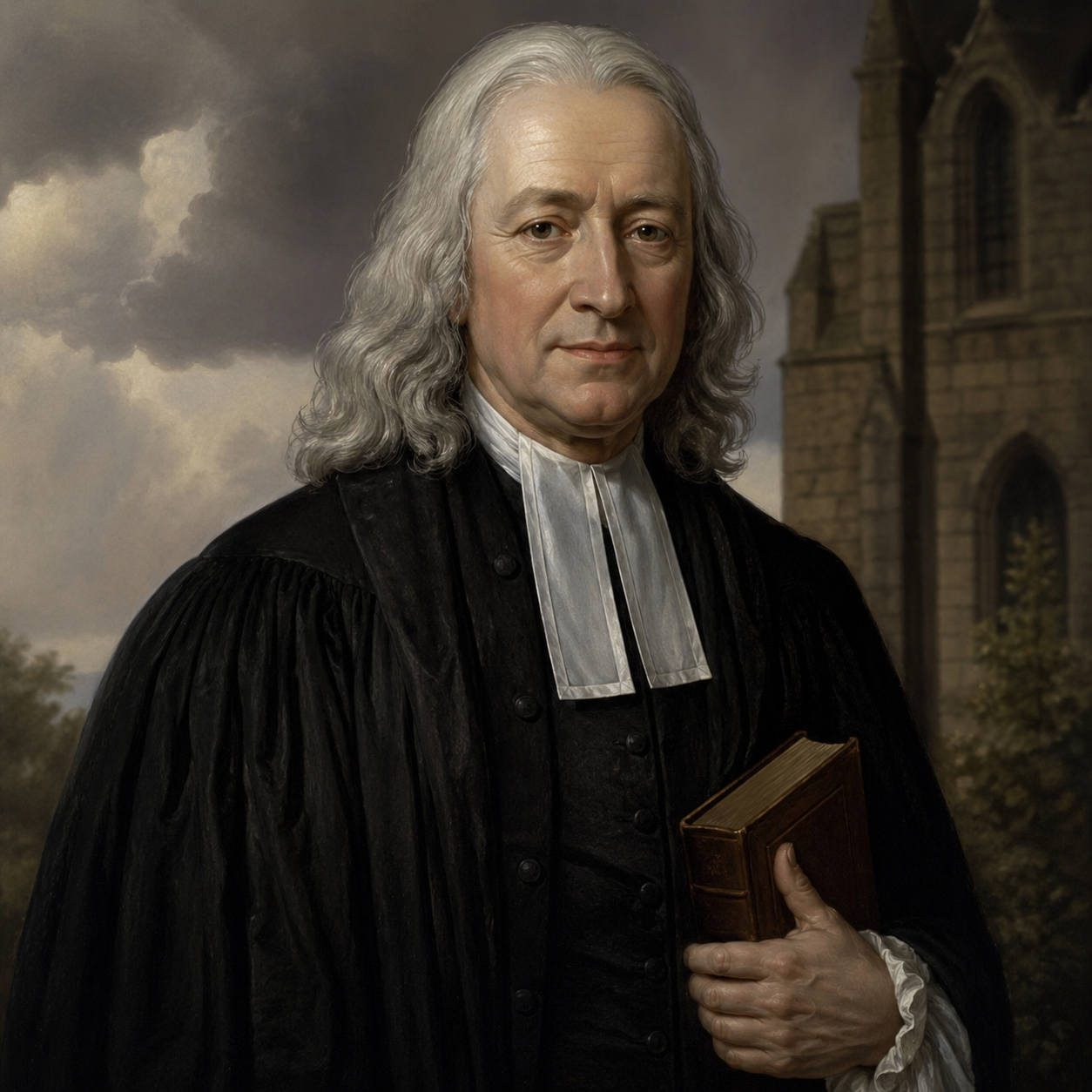
John Wesley — "It is not the being of sin, but the love of sin, that condemns us."
It is not the being of sin, but the love of sin, that condemns us.
It is not the being of sin, but the love of sin, that condemns us.
Click any product to generate a realistic preview. Up to 3 at a time.
* Initial load can take up to 90 seconds — revising the preview in another color is nearly instant.
"I have often thought that the greatest proof of the goodness of God to man, is that he has given him a wife."
"I have no doubt that God will be merciful to me, a poor miserable sinner."
"Are we not a little too apt to forget that the Methodists are not the only Christians in the world?"
"I believe that all true Christians are brothers and sisters, whatever their denomination."
"I have not found one single man, among all those I have conversed with, who is able to give a rational account of the difference between an honest man and a rogue."
English Anglican cleric and founder of Methodism, whose open-air preaching and class-meeting structure created the largest 18th-century evangelical revival. Closely associated with Charles Wesley (his hymn-writing brother) and George Whitefield (early co-revivalist, later doctrinal opponent). For an intellectual contrast, see George Whitefield, Calvinist evangelical revivalist — Whitefield's predestinarian Calvinism vs Wesley's free-grace Arminian theology split the early Methodist movement permanently in the 1739-41 break. The founding evangelical Calvinist-Arminian schism — the two parallel evangelical traditions American Christianity descends from.
Found in 1 providers: grok
1 source checked
Having sinful impulses or tendencies isn't what condemns a person — everyone struggles with flawed desires. What condemns is actively loving, cherishing, and choosing to nurture sin. Someone who battles temptation and stumbles is fundamentally different from someone who treasures their vices. Condemnation follows the heart's orientation toward sin, not the mere fact of human weakness or the unavoidable presence of sinful urges in a fallen person.
Wesley's theological project centered on sanctification — the belief Christians could progressively eliminate sin's hold, ultimately achieving 'entire sanctification' or perfect love. He founded Oxford's Holy Club, practicing rigorous spiritual discipline daily. His Arminian theology rejected Calvinist predestination, insisting humans have genuine agency over their hearts' attachments. This quote captures that framework precisely: condemnation isn't predetermined fate but flows from a person's freely chosen, ongoing orientation toward and love of sin.
Wesley lived through 18th-century Britain when Calvinist predestination dominated much Protestant thought — many believed salvation and damnation were divinely fixed before birth. The established Church of England had grown ritualistic and spiritually cold amid early industrialization's social upheaval. Wesley's quote directly challenged fatalism: no one is condemned by mere human weakness but by freely chosen attachment to sin. This was radical when moral accountability versus divine election was theology's fiercest battleground.
AI-generated insights based on extensive research and information for context. Factual errors? Email [email protected].
Your cart is empty