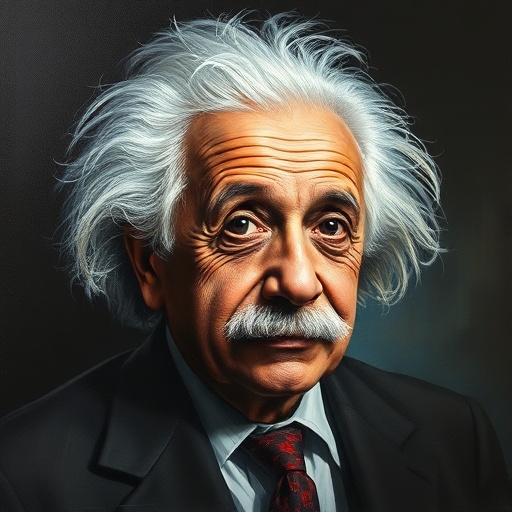
Albert Einstein — "The greatest scientists are artists as well."
The greatest scientists are artists as well.
The greatest scientists are artists as well.
Click any product to generate a realistic preview. Up to 3 at a time.
* Initial load can take up to 90 seconds — revising the preview in another color is nearly instant.
"The only way to do great work is to love what you do."
"The Germans as a whole are guilty of these mass murders and must be punished as a people..."
"The most beautiful emotion we can experience is the mystical. It is the sower of all true art and science."
"I am almost ashamed to be living in such peace while all the rest struggle and suffer."
"I am against any form of violence, for I know that violence only leads to more violence."
Found in 1 providers: grok
1 source checked
True scientific greatness demands more than technical mastery or data crunching — it requires imagination, aesthetic sensibility, and creative vision. The best scientists don't merely calculate; they conceptualize, spotting patterns others miss and crafting elegant theories the way artists craft compelling works. Breakthroughs rarely emerge from pure incremental logic alone but from intuitive leaps that closely resemble artistic inspiration rather than mechanical reasoning.
Einstein embodied this fusion throughout his life — he played violin constantly and credited music with unlocking his thinking during stalled physics problems. His landmark theories weren't derived purely from experiment but from vivid thought experiments, such as imagining riding alongside a light beam. He explicitly valued aesthetic elegance as a guide to truth, believing an ugly equation was probably wrong regardless of its mathematical validity.
Einstein worked during the early 20th century, when science and art were simultaneously dismantling their own foundations. Quantum mechanics shattered Newtonian certainty just as Cubism and abstraction shattered classical representation. Both fields reached beyond observable reality using intuition and imaginative leaps. This parallel revolution made the boundary between disciplines feel genuinely permeable, giving Einstein's observation cultural weight beyond metaphor — it described a shared spirit reshaping human understanding across every creative domain.
AI-generated insights based on extensive research and information for context. Factual errors? Email [email protected].
Your cart is empty