Enrico Fermi — "I consider myself a lucky man who did not have to choose between going to war an…"
I consider myself a lucky man who did not have to choose between going to war and doing something else. I just did what I was doing.
I consider myself a lucky man who did not have to choose between going to war and doing something else. I just did what I was doing.
Click any product to generate a realistic preview. Up to 3 at a time.
* Initial load can take up to 90 seconds — revising the preview in another color is nearly instant.
"I believe that the future of humanity depends on our ability to control the forces that we have unleashed."
"I have always believed that physics should be simple and beautiful."
"The only way to do great work is to love what you do."
"The problem with statistics is that you can prove anything with them."
"I have been very lucky in my life. I have always been able to do what I wanted to do, and I have always been able to do it with people I liked."
Found in 1 providers: grok
1 source checked
Fermi reflects that he was fortunate his scientific work and wartime demands aligned perfectly. Many men faced an agonizing choice between enlisting to fight and staying home for other pursuits. Fermi never faced that dilemma — his physics research, building nuclear reactors and contributing to weapons development, was itself the war effort. He simply continued doing what he already loved, spared the moral weight of choosing between duty and vocation.
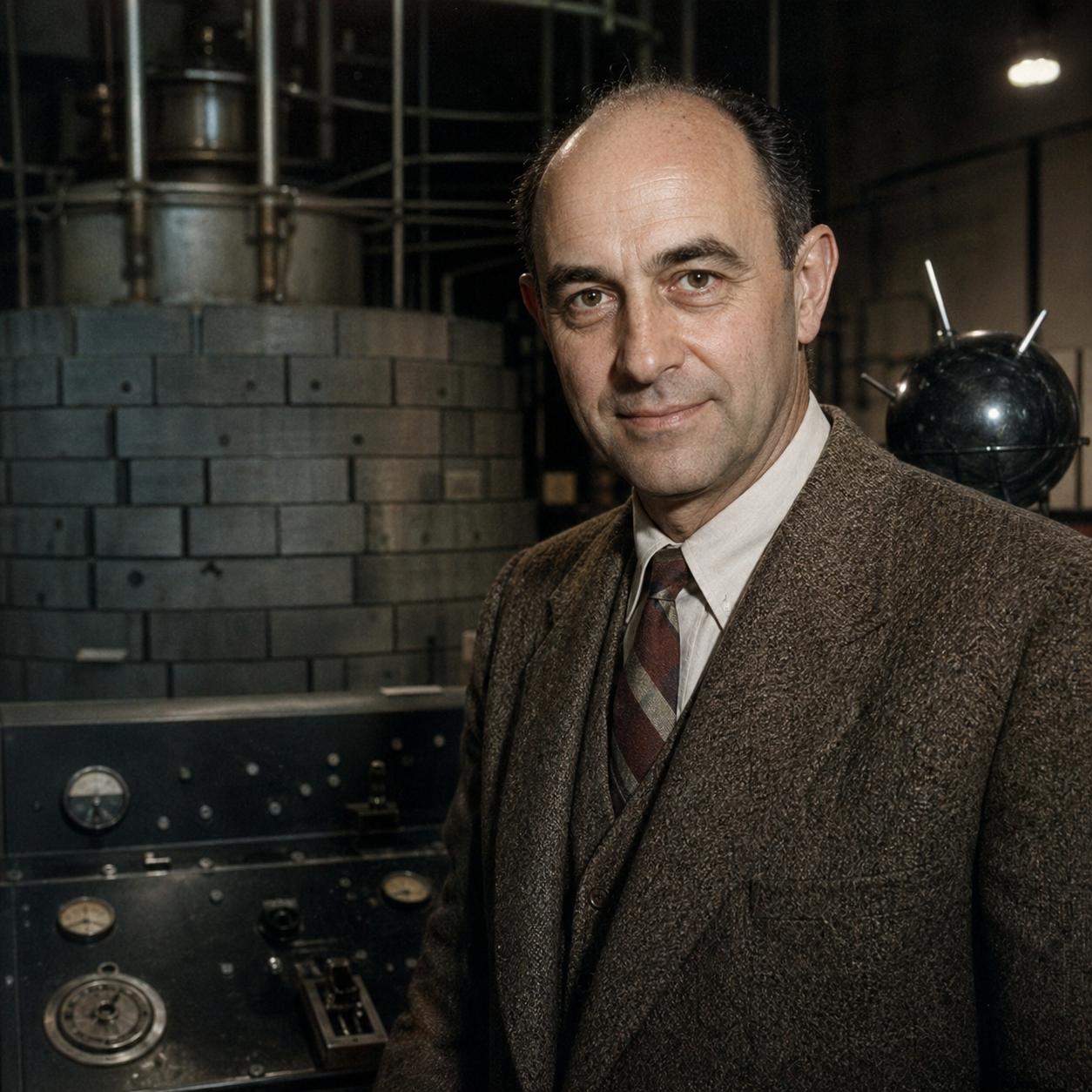
Fermi fled fascist Italy in 1938, using his Nobel Prize ceremony as cover for emigration. In America, he led the team achieving the first sustained nuclear chain reaction beneath Chicago's Stagg Field in December 1942, then worked at Los Alamos on the bomb itself. His unique expertise made him irreplaceable to the Allied war effort — a rare alignment of personal calling and national need that few scientists of his era experienced so cleanly.
During World War II, millions wrestled with the tension between military service and civilian contributions. The Manhattan Project drew physicists worldwide into a secret weapons program, blurring the line between science and warfare. European intellectuals who fled fascism — Einstein, Szilard, Teller, Fermi — found their expertise suddenly strategic. The atomic bomb marked the first time pure physics became decisive military technology, permanently transforming scientists from observers into active participants in global conflict.
AI-generated insights based on extensive research and information for context. Factual errors? Email [email protected].
Your cart is empty