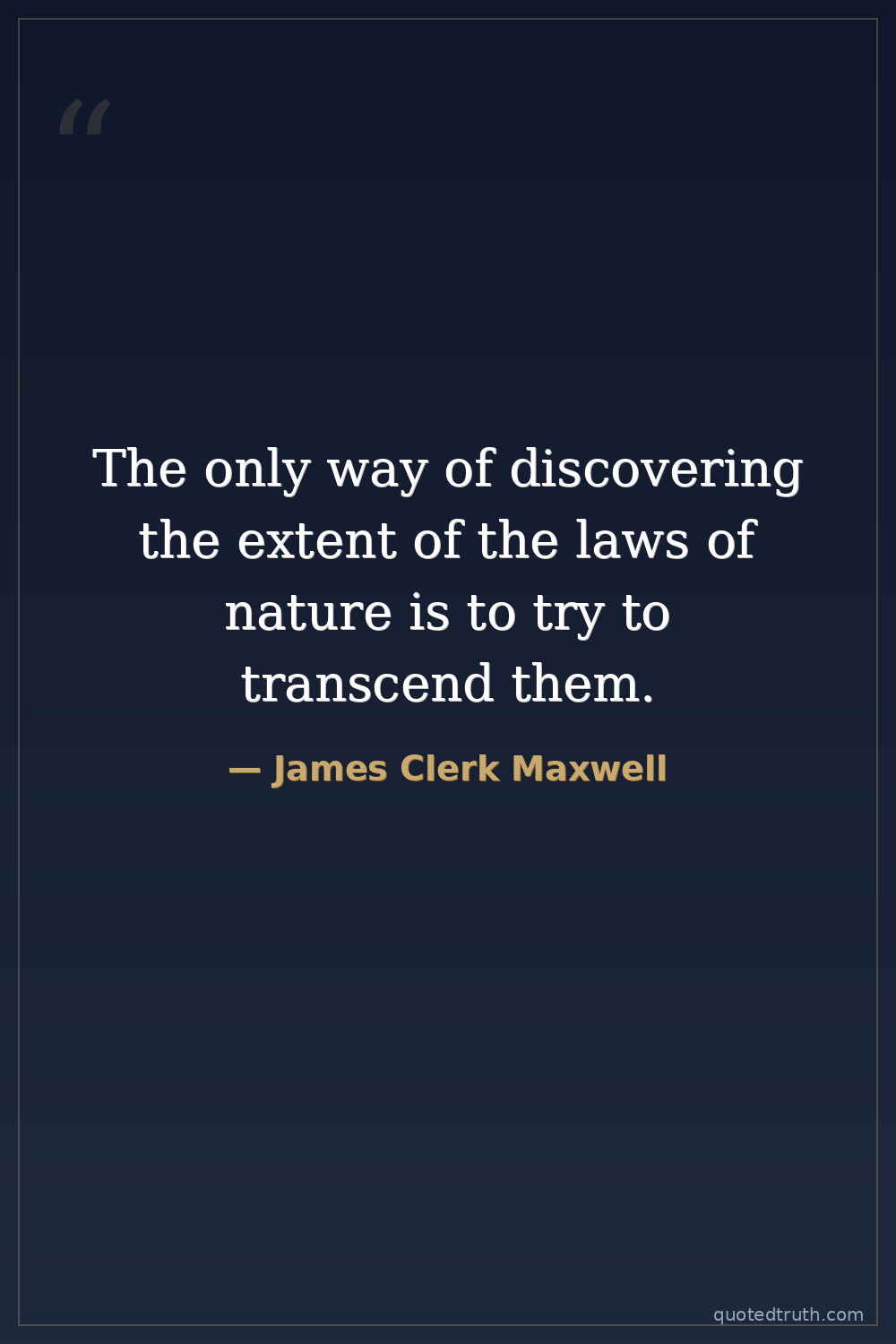
James Clerk Maxwell — "The only way of discovering the extent of the laws of nature is to try to transc…"
The only way of discovering the extent of the laws of nature is to try to transcend them.
The only way of discovering the extent of the laws of nature is to try to transcend them.
Click any product to generate a realistic preview. Up to 3 at a time.
* Initial load can take up to 90 seconds — revising the preview in another color is nearly instant.
"I have also a paper afloat, with an electromagnetic theory of light, which, till I am convinced to the contrary, I hold to be great guns."
"I have been trying to think what is the difference between an experiment and an experience."
"The chief philosophical difficulty in the present state of electrical science is to form a distinct conception of the mode in which electrical action is propagated through space."
"I have no doubt that there are many persons who would be very glad to get rid of the ether."
"In the very beginning of science, the parsons, who managed things then, Being handy with hammer and chisel, made gods in the likeness o' men; Till Commerce arose and at length some men of exceptional …"
Found in 1 providers: grok
1 source checked
Real understanding of nature's rules comes from pushing past them, not just accepting them. By testing where a law breaks down, or imagining what would happen if it didn't hold, you find its true boundaries. Passive observation reveals only surface patterns; active challenge reveals the deeper structure. Knowledge advances when you probe the edges where current rules stop working, because that is where the next truth hides.
Maxwell lived this principle. He unified electricity, magnetism, and light into four equations by refusing to treat them as separate fixed laws, instead pushing each to its limit until a deeper symmetry appeared. His thought experiments, like Maxwell's demon, deliberately imagined violating thermodynamics to probe what the second law truly forbids. A devout Christian and rigorous mathematician, he saw transcending apparent laws as the honest path to grasping the order beneath them.
Maxwell worked in mid-Victorian Britain (1850s-1870s), when classical physics felt nearly complete yet strained at the seams. The Industrial Revolution demanded precise electromagnetic and thermodynamic theory for telegraphs, engines, and power. Faraday's field ideas, Darwin's evolution, and new statistical methods were dissolving older certainties. Scientists increasingly realized that Newtonian mechanics alone could not explain light, heat, or gases, so pushing against accepted laws was becoming the defining method of discovery in a rapidly modernizing world.
AI-generated insights based on extensive research and information for context. Factual errors? Email [email protected].
Your cart is empty