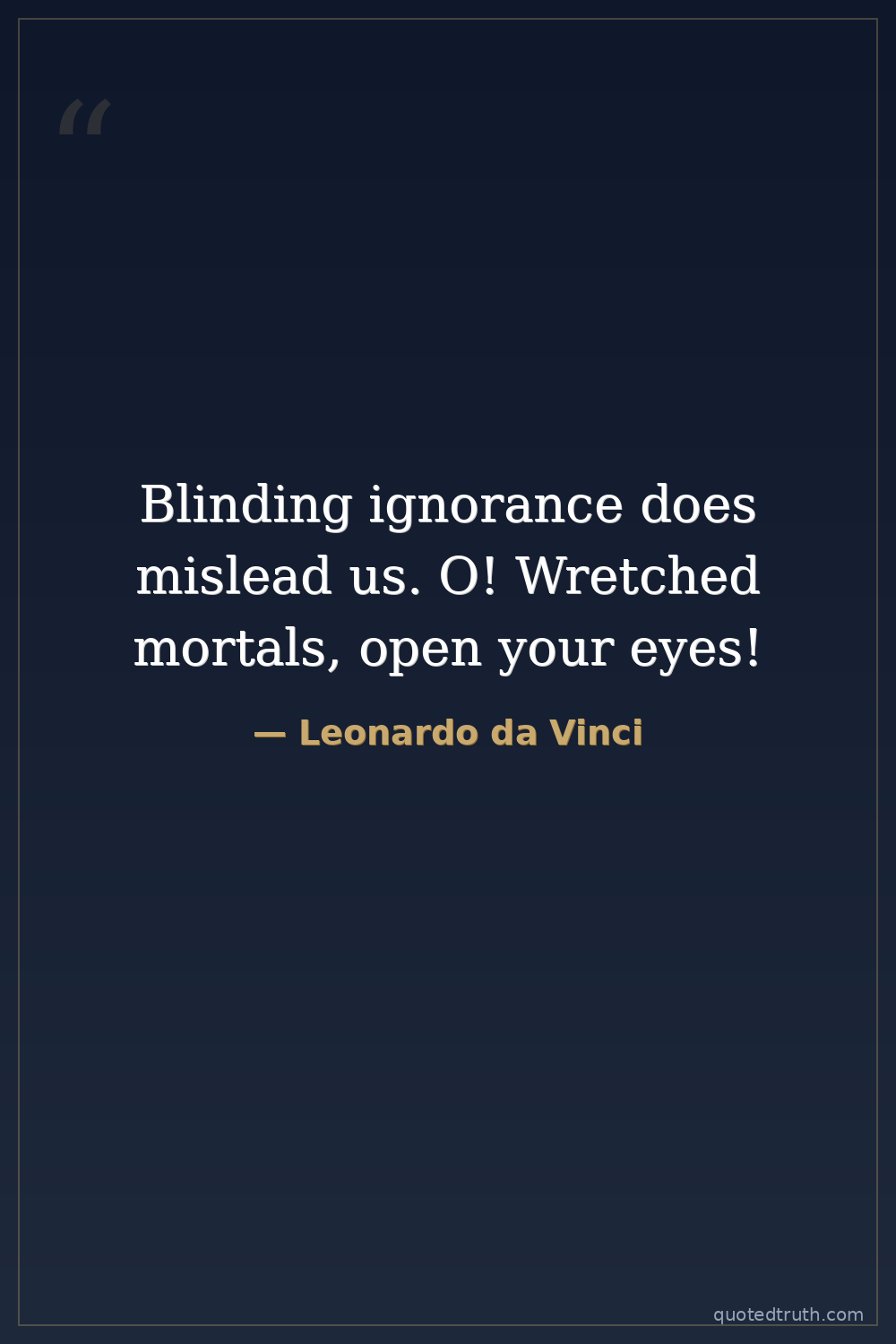
Leonardo da Vinci — "Blinding ignorance does mislead us. O! Wretched mortals, open your eyes!"
Blinding ignorance does mislead us. O! Wretched mortals, open your eyes!
Blinding ignorance does mislead us. O! Wretched mortals, open your eyes!
Click any product to generate a realistic preview. Up to 3 at a time.
* Initial load can take up to 90 seconds — revising the preview in another color is nearly instant.
"The painter has the universe in his mind and hands."
"Nothing strengthens authority so much as silence."
"No human investigation can be called true science if it doesn't pass through mathematical demonstrations."
"The wise man will want to be rich only in order to be able to help himself and his friends."
"The value of a thing is in its use."
Found in 2 providers: grok,gemini
2 sources checked
Ignorance is not passive — it actively steers people toward wrong beliefs and bad decisions. Da Vinci is urging us to stop accepting inherited assumptions without question and to use direct observation and critical thinking instead. He expresses genuine frustration that people let unexamined ideas govern their lives when the truth is plainly visible to anyone willing to look carefully and think for themselves.
Da Vinci built his entire intellectual life on firsthand observation — dissecting corpses to understand anatomy, filling roughly 7,000 notebook pages studying water, flight, and mechanics. Born illegitimate and excluded from formal Latin scholarship, he distrusted received authority and coined 'saper vedere' (knowing how to see) as his core philosophy. He viewed willful blindness as humanity's central failure, making this quote a direct statement of his lifelong intellectual creed.
During da Vinci's lifetime (1452–1519), Scholasticism demanded deference to Aristotle and Church doctrine over direct inquiry. The printing press was just beginning to circulate competing ideas, Columbus had rewritten geography, and humanists were chipping at medieval orthodoxy — yet most people still accepted religious and classical authority unquestioningly. The tension between faith-based received wisdom and empirical observation defined the Renaissance, and da Vinci stood precisely at that fault line.
AI-generated insights based on extensive research and information for context. Factual errors? Email [email protected].
Your cart is empty